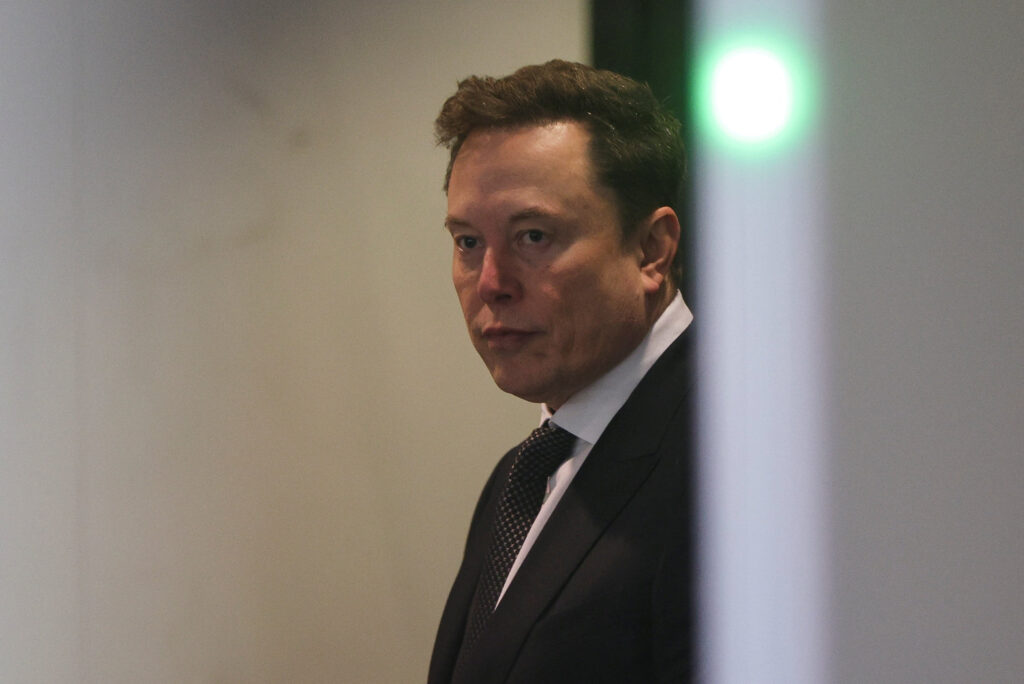
OAKLAND, Calif. — Tesla chief executive Elon Musk sparred in federal court for hours Wednesday with a lawyer representing ChatGPT-maker OpenAI, in a verbal tussle over whether the billionaire played the role of hero or villain in the founding of the artificial intelligence company he is now suing along with its top executives.
In Musk’s telling when he took the stand Tuesday, he was the driving force behind OpenAI’s 2015 founding and early success, providing initial funding and using his business clout to secure key technology and employees. But as OpenAI’s lead attorney in court Bill Savitt cross-examined Musk on Wednesday, he argued that Musk reneged on providing most of the money he had committed, poached a top researcher for Tesla and abandoned OpenAI after his co-founders refused an unreasonable demand to give him full control of the company.
The clashing views of Musk’s actions at OpenAI are central to the case, which Musk brought against his fellow OpenAI co-founders Sam Altman, the company’s CEO, and Greg Brockman, its president, alleging they illegally turned the nonprofit organization into a for-profit firm for their own enrichment. Musk is demanding that Brockman and Altman be fired and that the company be restored as a nonprofit, which would upend OpenAI’s plans to go public later this year.
OpenAI has said Musk is trying to harm a competitor to his own AI venture, xAI. Musk initially filed his lawsuit in 2024, and two years of legal wrangling have already surfaced hundreds of legal documents filled with texts and emails between Musk, Altman and other tech titans.
Altman and Brockman have been present in court, but Musk has dominated the three days of court action, even during jury selection on Monday. Prospective jurors were asked whether they could put aside any opinions they held on Musk’s politics if they were selected.
During opening arguments on Tuesday, Musk’s lawyer talked up the billionaire’s accomplishments in building his electric-car and space companies, and called him as the first witness to testify. OpenAI’s lawyer began cross-examining Musk late on Tuesday, and he has sat for nearly seven hours of testimony over two days. Musk is expected to speak more on Thursday.
Throughout Wednesday, Savitt walked Musk through dozens of emails, text messages and legal documents included in court filings, trying to undermine the entrepreneur’s contention that he opposed OpenAI becoming a for-profit company. Savitt took a prosecutorial tone, asking questions designed to elicit “yes” or “no” answers. Musk responded to many of them with longer explanations that at times showed his frustration.
“Your questions are not simple, they are designed to trick me,” Musk told Savitt at one point. After a tense back-and-forth later on, Musk asked, “Can I answer this question without you interrupting?”
“I don’t know,” Savitt shot back.
OpenAI’s co-founders created the company in 2015 with promises to develop AI that benefits all of humanity. Musk has alleged that Altman and Brockman abandoned those founding principles, positioning himself as concerned about the potential dangers of AI. In court on Wednesday, Savitt tried to undermine that narrative by bringing up Musk’s close relationship with President Donald Trump, who has vocally spoken out against AI regulation and moved to prevent states from restricting the technology.
Musk said he had brought up AI safety with Trump, but his own lawyer objected before the entrepreneur could continue. Judge Yvonne Gonzalez Rogers of the U.S. District Court for the Northern District of California agreed to discuss the matter with the opposing legal teams without the jury present.
Musk’s lawyer objected again after Savitt pressed on by asking Musk about his AI company xAI, whose Grok chatbot has been found to generate violent and sexualized images.
Savitt then asked Musk about OpenAI’s “safety cards” — a reference to documents commonly termed “model cards” or “system cards” in the tech industry that are released by AI companies to describe potential risks from their technology. Musk was confused, and then said he did not know what a safety card was. Musk’s own company xAI releases such cards for Grok.
After the jury left the room, Savitt argued that he should be allowed to question the safety record of Musk’s own AI company because Musk is framing himself as an AI safety champion. The judge agreed, shutting down complaints from Musk’s lawyer by saying, “You do not get to have grandiose proclamations on safety without some measure of cross examination.”
Savitt for OpenAI introduced new documents in court on Wednesday that revealed previously unknown details about the company’s early years.
In 2017, Musk invited OpenAI’s executive team to discuss the company’s future at a party he was holding at what he described as a “haunted mansion” that he owned, according to one document. “We can probably meet at the haunted mansion I just bought near SF,” Musk wrote, apparently referring to San Francisco. “It’s kinda crazy and weird and will have party carnage, but it might make for a good backdrop.”
When Savitt asked whether Musk used the meeting at the party to talk about turning OpenAI into a for-profit company, Musk said he didn’t remember. But the billionaire confirmed that in the weeks after the haunted mansion party, he discussed the transition with other OpenAI leaders. Musk said in previous testimony that conversations he joined about forming a for-profit arm inside OpenAI had simply been “brainstorming.”
OpenAI’s lawyer also contended that in 2017 Musk actively hired away the AI company’s No. 2 researcher, Andrej Karpathy, to work for Tesla. “The OpenAI guys are going to want to kill me but it had to be done,” Musk wrote in an email from the time that was shown in court.
Musk pushed back from the witness stand, saying multiple times that Karpathy was planning to leave OpenAI before Tesla hired him. Karpathy did not return a request for comment.
The post Musk fights in court to portray himself as hero, not villain, in founding of OpenAI appeared first on Washington Post.