For the past two years, Amazon, Google, Microsoft and Meta have repeatedly set records for how much they are spending on artificial intelligence.
On Wednesday, the four giants did it again.
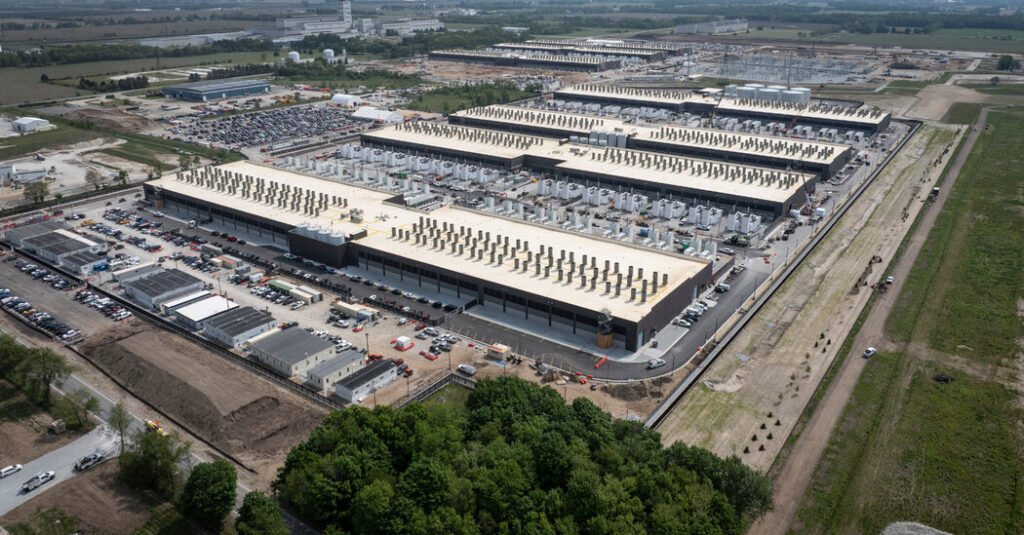
In the first three months of the year, the four companies reported in their financial results, they plowed a total of $130.65 billion into capital expenditures, largely spending on data centers that power A.I. That figure — which was another record — was more than three times what the Manhattan Project cost to develop nuclear bombs and 71 percent higher than what the tech giants spent in the same quarter a year earlier.
Investors may need to brace for more spending. Meta, for one, raised its spending forecast for the year to between $125 billion and $145 billion, up from its previous prediction of $115 billion to $135 billion.
The spending showcased how the biggest tech companies are in the middle of a wildly expensive era of A.I., which many of them see as a once-in-a-lifetime chance to become far larger. And as the frenzy escalates, it’s increasingly only the planet’s wealthiest companies that have the money to lead this race.
That’s because Amazon, Google, Microsoft and Meta continue to dominate in core businesses that spew cash, such as serving ads on YouTube or Instagram, delivering items in a few hours or tallying cells in Excel. The companies generated a combined $431 billion in sales in the quarter and made $151 billion in profit.
“They can handle it” because of their cash flow, John Blackledge, an analyst with the investment bank TD Cowen, said about the A.I. spending.
For much of last year, Wall Street was jittery about whether the tech spending would bring in enough returns, but some investors have backed away from those fears. That’s partly because of the recent success of Anthropic’s Claude Code, an A.I. tool that lets users quickly generate code without knowing programming and a product that has become a juggernaut. This month, Anthropic said its March sales were the equivalent of $30 billion a year, up from $9 billion at the end of 2025.
“The expectations are getting higher and higher,” said Arjun Bhatia, who covers tech companies for the investment bank William Blair.
The biggest tech companies have also formed deeper partnerships with the leading A.I. labs Anthropic and OpenAI, investing billions in them. In turn, Anthropic and OpenAI have committed to spending hundreds of billions on computing power that the tech giants provide.
Last week, Google and Amazon announced plans to invest up to a combined $65 billion in Anthropic, and they will provide the start-up with at least 10 gigawatts of computing power — or enough to power more than four million homes.
Google and, increasingly, Amazon have also seen traction developing their own A.I. chips to power the boom. Google has begun selling its chips to Anthropic, and Meta announced a multibillion-dollar deal last week to use some of Amazon’s chips.
No company is spending more than Amazon, which has been racing to build data centers to satisfy demand for computing power. It has focused particularly on building Project Rainier, which are massive A.I. data centers for Anthropic.
Amazon spent $43 billion on capital expenditures in the quarter, primarily for data centers. Its cloud computing business — which slowed a year ago, before picking up steam more recently — generated $181.5 billion in sales, up 17 percent from a year earlier.
Microsoft spent $31.9 billion in the first three months of the year, up 49 percent from a year earlier. Azure, its core cloud computing offering, and related A.I. services grew about 40 percent.
(The New York Times has sued OpenAI and Microsoft, its partner, claiming copyright infringement of news content related to A.I. systems. The two companies have denied the suit’s claims.)
Google said its spending was $36 billion in the quarter, more than double the $17 billion it spent in the same period last year.
The internet giant has benefited from A.I. in several ways. Its Gemini A.I. system has become the backbone of Google Search, offering quick and complete answers that drive people to make more search queries. As a result, Google can serve more ads that are also more relevant. For the first three months of the year, Google said, sales from search, its largest business, increased 19 percent to $60.4 billion.
A.I. has also helped Google’s cloud business. The company has signed $1 billion deals with new customers and persuaded existing customers to increase their spending. In the most recent quarter, its cloud sales rose 63 percent to $20 billion.
Meta is in some ways an outlier, because its capital spending is for its own use, rather than for cloud computing that it sells to others. As it morphs from a social media company to an A.I. company, Meta is spending amounts similar to Amazon’s and Microsoft’s totals. For the quarter, it spent $19.8 billion, more than half of the $39 billion that it spent for all of 2024.
Meta has developed A.I. to increase user engagement and improve advertising on its social platforms, which include Facebook and Instagram. Revenue increased 33 percent to $56.3 billion in the quarter, a sign that the spending was accelerating growth.
Some of the tech companies have justified their building binge by saying they cannot meet all the demand. But analysts said there were risks if the companies became too dependent on two young customers: OpenAI and Anthropic.
More than 40 percent of Microsoft’s $625 billion in outstanding cloud contracts, for example, come from OpenAI, the company said in January. This week, Microsoft and OpenAI announced new terms that loosened their ties.
Betting so much on OpenAI and Anthropic is a gamble. But even if the start-ups flop, the tech giants are likely to weather the losses because of their size, scale and other businesses, said Matt Stucky, who manages tech investments for Northwestern Mutual.
“The core business,” he said, “is good.”
Tripp Mickle and Eli Tan contributed reporting from San Francisco, and Natallie Rocha from New York.
Karen Weise writes about technology for The Times and is based in Seattle. Her coverage focuses on Amazon and Microsoft, two of the most powerful companies in America.
The post A.I. Spending Sets a Record, With No End in Sight appeared first on New York Times.