Just last week, when Virginia voters adopted a new congressional map intended to elect Democrats in 10 of the state’s 11 U.S. House districts, it seemed that Democrats had taken the advantage in the coast-to-coast redistricting fight President Trump instigated in Texas last summer.
Things have quickly shifted back in Republicans’ favor.
Major developments in Washington and Florida mean that Republicans now appear poised to net more seats in the 2026 congressional redistricting battle, even as the party faces a grim political environment.
The Supreme Court’s ruling on Wednesday to further weaken the Voting Rights Act — which will have far-reaching implications for American elections beyond the midterms — could prompt Louisiana to eliminate one or two Democratic seats. The decision came as Florida Republicans, led by Gov. Ron DeSantis, passed a new map meant to flip four Democratic House seats.
It remains unclear how many seats Republicans may end up gaining through redistricting. That figure will depend on whether a handful of Republican-led states rush to redraw their maps before the midterms, on potential legal challenges and on the eventual political environment in November, which could upend cartographers’ plans. But as of now, Republicans appear to have gained an edge in a handful of seats.
Here is what has happened in each state that has adopted or is in the process of redrawing congressional maps:
Texas: Texas Republicans started the unusual mid-decade redistricting fight last summer after Mr. Trump applied public pressure on lawmakers to draw a new map. After a brief interlude when Democratic state legislators fled the state to deny Republicans a quorum, Republican lawmakers passed, and Gov. Greg Abbott approved, new maps that were meant to shift five House seats away from Democrats. Whether Republicans can claim all five depends on the party’s fortunes in November.
Missouri: The state’s Republican-run legislature and Gov. Mike Kehoe drew new congressional districts in September that eliminated a Democratic district based in Kansas City.
North Carolina: Republican lawmakers redrew the Democratic-leaning First Congressional District in northeastern North Carolina and turned it into a seat that a Republican is likely to win.
Ohio: Ohio lawmakers in October redrew a congressional map that had delivered 10 of 15 House seats to Republicans so that the G.O.P. is likely to take 12 districts in the midterms.
California: In the first Democratic pushback to Republican redistricting efforts, California voters in November passed a referendum to enact a map designed to shift five Republican-held seats to Democrats in this year’s elections.
Utah: The state’s courts in November struck down Utah’s all-Republican congressional map and adopted a map likely to deliver one Democratic seat based in Salt Lake City, out of the state’s four overall.
Virginia: Virginia voters in April narrowly approved changes to the State Constitution that allowed legislators to enact a new map designed to give Democrats as many as 10 of the state’s 11 House seats, up from the six they now control. Republicans are challenging the map in state courts.
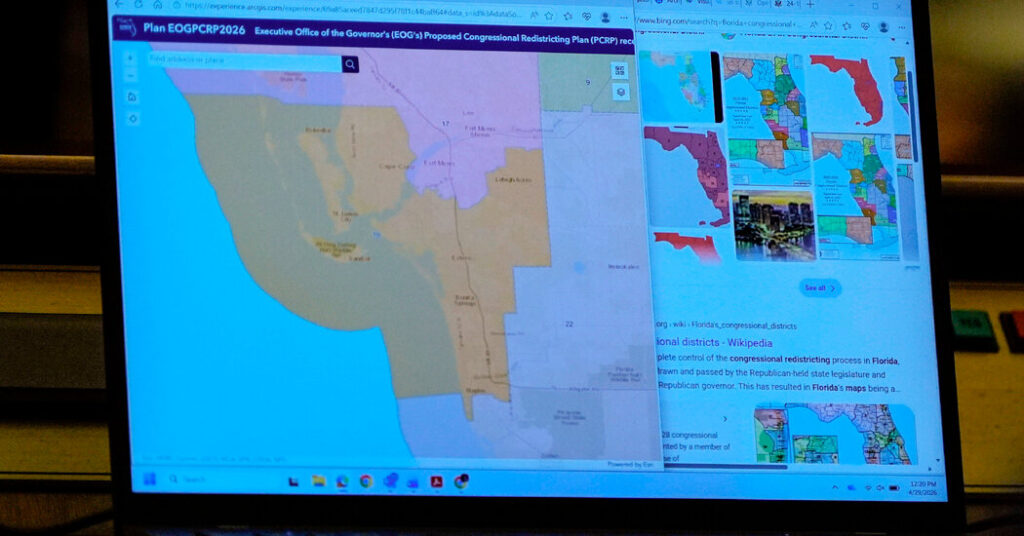
Florida: Gov. Ron DeSantis on Monday introduced new maps aimed at shifting up to four Democratic-held House seats to Republicans. On Wednesday, both chambers of the Florida Legislature passed his proposal.
Louisiana: The Supreme Court’s decision invalidated Louisiana’s congressional map that included two likely Democratic districts. For now, it is unclear if, when or how state lawmakers will amend their map before Louisiana’s primary elections, which are scheduled for May 16.
Still more Republican-run states could alter their maps, though time is running out before the midterm elections. Southern states like Georgia that have seats affected by the high court’s decision have already begun early voting. Mississippi and Texas already held their 2026 primaries.
Reid J. Epstein is a Times reporter covering campaigns and elections from Washington.
The post Republicans Seize Back an Edge in the Nation’s Redistricting Fight appeared first on New York Times.