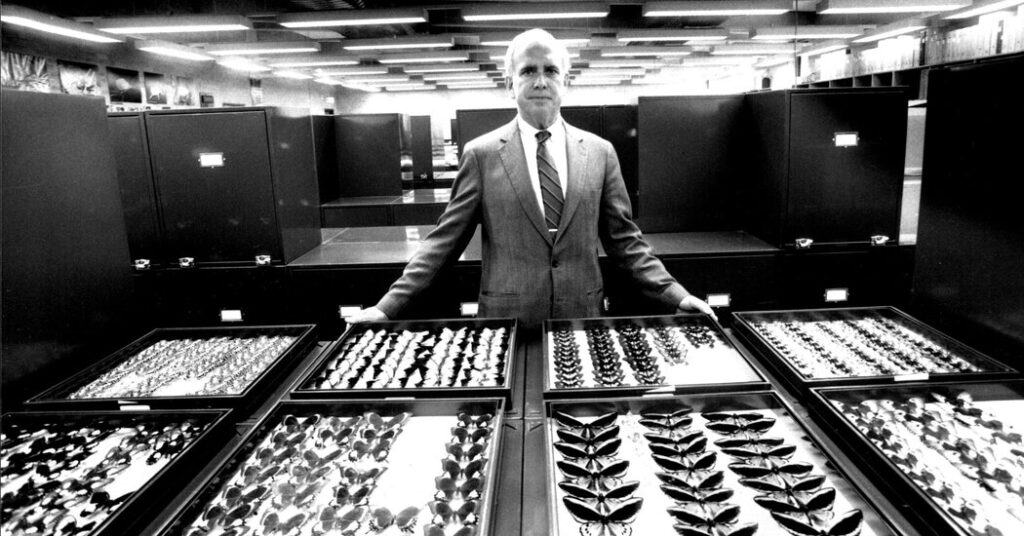
Peter H. Raven, a renowned botanist and author who remade the Missouri Botanical Garden into a premier research institution and became one of science’s most influential voices on threats posed by climate change, deforestation, overpopulation and unchecked development, died on Saturday in St. Louis. He was 89.
His death, in a hospital, was from congestive heart failure, his wife, Patricia Raven, said.
An ardent environmentalist, Dr. Raven advised presidents and popes on conservation, species extinction and climate change. He lectured around the world, regularly opined in television interviews and wrote articles about the ecological menace posed by pollution and industrial practices like the clear-cutting of rainforests.
“As we destroy the environment, we are destroying ourselves,” he told an audience at the United Nations Earth Summit in Rio de Janeiro in 1992, held to address global environmental issues. “We are part of the web of life, and what we do to the web, we do to ourselves.”
Dr. Raven’s expertise in the flora of California and tropical rainforests was showcased in seminal textbooks he wrote or co-wrote. He also mastered the skills of an effective nonprofit director and fund-raiser for the Missouri Botanical Garden, turning one of the country’s oldest public gardens into an elite center of research and education on plants and biodiversity.
Dr. Raven brought a moral and ethical focus to his various roles. He linked environmental degradation to Western consumers’ desire for tropical hardwoods. He argued that wealthy countries should forgive the debt of developing nations, which he said are otherwise forced to clear forests and sell vast amounts of timber on the international market to repay loans.
And he made the case that rainforests should be valued not just for their pristine beauty but also for the chemicals and compounds that are found in wild tropical plants and that can be the source of medical breakthroughs.
“Given that a full quarter of all prescriptions written in the United States contain substances derived from plants, and that industry uses plants to find new oils, alkaloids and chemicals, humanity is throwing away its patrimony without even knowing what it was,” he told the now defunct publication The World & I in 1991.
Dr. Raven first came to wide attention in 1964 as a faculty member of Stanford University’s department of biological sciences. In collaboration with Paul Ehrlich, a young entomologist and Stanford colleague, Dr. Raven published a paper in the journal Evolution that explained how plants develop symbiotic relationships with other plants and insects that enable them to thrive.
Some plants, they explained, develop poisonous defenses that keep butterflies from feeding on them. Butterflies counter by producing substances to detoxify the plant poisons. Drs. Raven and Ehrlich called the cooperative interactions “co-evolution,” a new principle of biology that advanced the Darwinian theory of natural selection.
“It was a harbinger of the understanding our generation has developed of the diversity and distribution of life on earth,” said Maharaj Pandit, former head of environmental studies at the University of Delhi and one of India’s most prominent ecologists.
Dr. Raven collaborated with the science writer Helena Curtis to produce “Biology of Plants” (1970), which remains a definitive textbook on botany. He became director of the Missouri Botanical Garden, in St. Louis, in 1971.
When he arrived, the institution, founded in 1859, had a world-class library and an important plant collection situated on 79 acres, most of it idle and overgrown. The Botanical Garden “was like an art museum with exhibits only in a few rooms,” he recalled to The New York Times in 1998.
Over the next 39 years, until his retirement in 2010, Dr. Raven raised more than $600 million, increased the staff to 500 professionals from 35, added new gardens and facilities, and turned it into a top visitor destination in St. Louis.
“Peter’s identity with the Missouri Botanical Garden was one of his major achievements,” said David Orr, a professor of environmental studies at Oberlin College in Ohio. “It was a place that wasn’t just about preserving biodiversity. It was about the importance of it politically.”
Dr. Raven’s directorship wasn’t without controversy. His support in the late 1990s for genetically modified field crops led to accusations that he had been captured by their developer, the Monsanto Company, which was long based near St. Louis and was one of the Botanical Garden’s most important benefactors.
“The boundaries of consideration need to be broader than Peter’s willing to make them,” Wes Jackson, an acclaimed geneticist and founder of the Land Institute in Kansas, told The Riverfront Times, a weekly St. Louis newspaper, in 1999. “In a certain sense, he’s a paid traveling salesman for Monsanto.”
In Dr. Raven’s view, genetic technology improved harvests and was not nearly as risky to health and the environment as its many critics contended.
Throughout his time leading the Missouri Botanical Garden, Dr. Raven continued his work as a research scientist. He wrote or cowrote more than 20 books and more than 700 papers and articles. He traveled to countries on six continents, addressing scientific forums and participating in expeditions to study and collect plants.
He became increasingly distressed about the deteriorating condition of tropical forests, in which he said thousands of plant species were dying because of climate change. In 2002, while serving as the president of the American Association for the Advancement of Science, he called skeptics of growing threats to the environment “false prophets and charlatans.”
Dr. Raven joined equally prominent scientists who were also his close friends — E.O. Wilson, the Harvard biologist; Thomas Lovejoy, the conservation ecologist; and Dr. Ehrlich, who wrote the best seller “The Population Bomb” — in naming the impending disaster the “sixth extinction.” (Dr. Ehrlich died last month.)
In 2000, President Bill Clinton awarded Dr. Raven the National Medal of Science, the nation’s highest scientific honor. He received more than 100 other honors, among them a MacArthur Foundation “genius” grant and the Hubbard Medal, the National Geographic Society’s most prestigious prize.
Peter Hamilton Raven, an only child, was born on June 13, 1936, in Shanghai, where he spent his first year before moving with his American-born parents to San Francisco. His father, Walter F. Raven, was in China helping with his family’s banking business. His mother, Isabelle (Breen) Raven, was a social worker.
In an autobiography, “Driven by Nature: A Personal Journey from Shanghai to Botany and Global Sustainability” (2021), Dr. Raven recounts how thoroughly he was absorbed in the study and collection of plants and insects as a schoolboy in San Francisco.
He was a 9-year-old ill with measles when his mother handed him a copy of “Six Feet” (1939), an illustrated book about insects by the writer Ruth Cooper Whitney. He began collecting butterflies and beetles in his backyard and mounting them for display at home. Four years later, he read Willis Linn Jepson’s “A Manual of the Flowering Plants of California,” which taught him how to identify almost every plant he came across.
At the California Academy of Sciences, just blocks from his home, he spent hours with prominent botanists studying and collecting plants. Tall and rangy as a teenager, he hiked the Sierras in California and the Cascade Range in Washington State, identifying and collecting plant specimens.
He graduated in 1957 from the University of California, Berkeley, with high honors in biology and earned a doctorate in botany from the University of California, Los Angeles, in 1960. He was soon hired as an assistant professor at Stanford.
His first wife, Sally Barrett, died in 1968. His subsequent two marriages, to Tamra Engelhorn and Kathryn Fish, ended in divorce. He married Patricia Duncan in 2001. In addition to her, he is survived by two daughters from his first marriage, Alice Raven and Elizabeth Raven McQuinn; two children from his second marriage, Francis and Kate Raven; and four grandchildren.
Dr. Raven credited a simple personal philosophy for his achievements. “Where the ground was fertile,” he said in an interview for this obituary in 2024, “I tried to come in and sow seeds.”
Ash Wu and Charlotte Dulany contributed reporting.
The post Peter Raven, Renowned Botanist and Conservationist, Dies at 89 appeared first on New York Times.