In the turquoise waters off La Ventana, a sleepy coastal town on Mexico’s Baja peninsula, Claudio Rios, 41, monitored the radio of a fishing boat. It was late March. His eyes scanned the horizon, one hand loose on the wheel as the Sea of Cortez swayed beneath him.
“It smells like orcas,” he said: pungent and oily.
He waited for a dorsal fin to slice through the waves. For captains to chatter over the radio. For boat engines to hum together. So far, nothing.
Tourists sat in boats nearby, eyes wide, hoping to spot one of several male orcas named for Aztec gods and emperors: Moctezuma, Cuitláhuac, Tlaloc. Some humans already had their wet suits on, fins at their feet — prepared to drop into the open water with the ocean’s apex predator.
Swimming with killer whales is one of the rarest wildlife encounters on earth, done in only two places: La Ventana, Mexico, and Skjervoy, Norway. In both, visitors don wet suits, snorkels and masks to observe the 20-foot-long animals moving through open water.
Growing crowds, fueled by social media and a generation that first encountered orcas in captivity or onscreen, are descending on two otherwise quiet coastal towns, bringing money and friction in equal measure. Researchers still cannot say what sustained human contact does to wild orcas. In neither country has that slowed the industry.
“Everyone will tell you there’s never been an orca attack on humans in the wild,” said Jorge Cervera Hauser, a Mexican underwater photographer who has led tours in Mexico and Norway. “But they’re highly intelligent animals. With constant pressure, an accident is bound to happen sooner or later.”
Shortly before noon, Mr. Rios’s radio crackled. The killer whales were south, close to Bahía de los Muertos. Mr. Rios grabbed the wheel, throttling the Suzuki engine to life. The boat tore through the water.
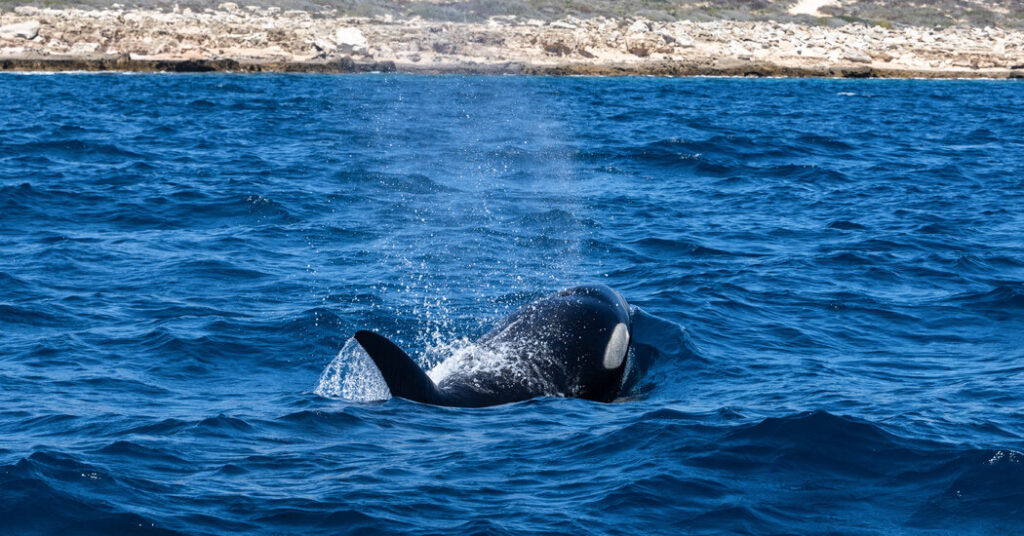
Ten or so dorsal fins broke the surface ahead, black against the sandy beige desert landscape of Baja California Sur. Mr. Rios was among the first to reach the animals, but not by much. Within minutes of the radio call, white wakes were cutting through the waves. He watched boats come, counting them.
“This thing is like poison,” he said, pointing to the radio.
A killer whale passed beneath the bow, shimmering in the sunlit shallows, its slick body breaking the blue. Boats jostled for position, some cutting through the orcas’ path. Someone on a neighboring boat dropped, fins first, into the water before the vessel had fully stopped, but the orcas sped past.
Then a drone, supposedly prohibited during the activity, buzzed overhead. The orcas were still visible, dark shapes moving away from the noise. Mr. Rios tensed. For years he had seen boats swarm killer whales — chasing them, harassing them, cutting them off. And now this.
He pulled alongside the neighboring boat and caught the other captain’s eye. “Hey,” he said, frustrated but calm, pointing upward. “We’ve got to do things right. We’ve got to do things better.”
January in Skjervoy
Although orcas are commonly associated with cold seas, in Mexico they find a gulf teeming with rich marine life. They hunt Mobula rays, whales, dolphins, sharks and bone fishes in the waters of the Sea of Cortez. Last year, in an attempt to regulate the tourism attracted by the opportunity to swim with these animals, Mexico — where “marine safaris” long operated in a legal gray zone — introduced a permitting system for tour operators.
Norway, where the practice has been running for several decades, has no comparable rules. Orcas follow vast herring migrations into the Arctic fjords each winter, arriving between November and January. The animals behave differently, hunt differently and present different challenges to the humans trying to regulate the industry.
On a morning in January, with the sun barely clearing the snow-capped mountains, Eve Jourdain, 38, led a boat through the choppy dark waters off Skjervoy, a working fishing town and small natural harbor. Tourists huddled on a rigid inflatable in subzero temperatures, faces buried under wool layers. Dr. Jourdain, a marine biologist and director of the Norwegian Orca Survey, was equally bundled; only her eyes and her nose were visible above her neon gear. She regularly captains whale-watching tours but never enters the water herself.
Dozens of other boats were already on the water, full of tourists determined to see the killer whales. Every morning during the season, buses from Tromso unloaded tourists from across the globe onto the harbor dock. By the time the sky turned (briefly) pale with light, the fjords were already crowded with inflatables carrying tourists who had paid hundreds of dollars to see or snorkel with killer whales.
“This is my dream since I’ve been a child,” said Yakir Asaraf, a nature photographer who had traveled to Skjervoy to swim with orcas.
Krisztina Balotay, a photographer and whale-watching guide who has worked in the industry for more than 10 years, recalled a time when she and her partner led tours to snorkel with the orcas. “We intentionally decided to stop because it became too much,” she said.
Even now, some situations upset them so much that she asks her partner, who works as a skipper, to move away from the orcas and the snorkelers. On busy days, small groups of orcas can be surrounded by more than 20 boats at once.
Whales also aggregate tightly around large herring fishing vessels; whale‑watching and snorkel boats seek out the same spots. Before a distance rule existed, snorkelers were too close to fishing vessels, triggering a regulation around active fishing boats, but not around the animals. Ms. Balotay has boarded herring fishing vessels many times to learn about the fishing operation and animal behavior.
The Arctic winter limits the hours of operation, but there is no cap on boats, creating intense, unregulated traffic around whales. A lack of regulations has made the activity unsafe for both humans and animals, Ms. Balotay said. Large whales are not “playmates” for humans, she said. “Just the sheer size difference can create dangerous situations.”
“Until someone dies here, they will not do anything,” she added.
‘It’s going to get worse’
Encounters with marine animals — whale-watching, cage diving with white sharks, swimming with manta rays — has become a multibillion-dollar industry around the world. But researchers are finding that some activities may be disruptive to the animals.
A 2021 study in Colombia found that the sound of a single whale-watching boat could mask up to 63 percent of a humpback’s song. In Washington, females of an endangered population of killer whales were more likely to abandon foraging when vessels were nearby, which could affect the animals’ ability to reproduce, researchers noted.
Boats or snorkelers might interrupt feeding or make hunting less efficient, pushing the animals to travel faster or change direction more often. In orca populations, tourists may also reduce opportunities for the animals to rest and socialize.
Some countries have responded with strict protections. New Zealand prohibits swimming within 300 feet of killer whales; in British Columbia, people who approach too closely can be fined thousands of dollars. Since 2013, Dr. Jourdain has tracked individual orcas in Norway — including their life histories and overall health.
In recent years, her focus has shifted to how whale watching and snorkeling may be stressing the animals. Her team is the first to measure cortisol levels in blubber samples from Norwegian killer whales, comparing results from active tourist seasons against years with no tourism, such as during the pandemic. Last November, Dr. Jourdain had a biopsy gun in her hand, to target a killer whale for a blubber sample, when snorkelers swam toward her.
“It’s absolutely ridiculous,” she said.
Elena Sasso, a master’s student at the Sapienza University of Rome who spent a season working as a snorkeling guide, analyzed drone footage to study how orcas responded to approaching boats and swimmers. Marten Bril, co-founder of Whale2Sea, spent seven years proposing guidelines for whale activities. He wanted to ensure responsible whale safari operations that considered safety for both humans and animals.
To him, two things were crucial: whale-watching licenses and regulating the number of boats. “It’s very simple,” he said. “Too much is not good.”
Dr. Jourdain is skeptical. “I think it’s going to get worse,” she said in January, adding that she doubted that her research would be of much help. “I don’t have faith that it will change anything.”
Marianne Sivertsen Naess, Norway’s minister of fisheries and ocean policy, said that she was aware of the need for clearer regulations and planned to strengthen whale-watching rules, such as establishing distance requirements for vessels and snorkelers, in time for the next season.
Sadie Hale, an anthropologist at the University of Bergen, noted in a 2025 study that the situation was commonly described as a “Wild West.” She has found that many visitors in Norway see the encounter as a form of apology for the ways humans have mistreated orcas, particularly in captivity.
“They are seeking an experience that doesn’t look like captivity,” she said. “But for some of them, it isn’t the peaceful, harassment-free encounter they hoped for.”
Ship of fools?
With the sun high in the Mexican sky, the day stretching into late afternoon, Mr. Rios took over the radio. He assigned turns, called down drones, and made sure each boat got its time with the animals before moving on. For several hours he coordinated the traffic — eight boats, more or less — until everyone had their pass at the pod.
“We’re all going to leave,” he said finally, his voice firm over the radio. “No double shifts.”
Voices mumbled their agreement.
No one wants to be in charge, he said afterward. This year, he had not wanted anything to do with orcas. “I didn’t want to be one of the ones who messed things up,” he said.
In both Norway and Mexico, the influx of orca-seeking tourists has transformed local economies. In La Ventana, some families are trading grueling, low-profit trades, like night fishing, for marine tourism. A tourist spot to swim with orcas starts at $100 in Mexico, and reaches $400 in Norway.
Some scientists argued that the activity should have stayed as whale watching and not swimming, said Georgina Saad, a marine biologist with Orcas Pacifico Mexicano, an initiative that is leading the regulatory efforts. “But the community wanted this activity,” she added, so the only path forward was to regulate it.
The plan put forward was detailed: no drones, no spotter planes, limits on boat numbers and swimmers in the water at once, distance and speed restrictions near the animals.
When the height of orca season returns in May and June, Mr. Rios estimates that around 100 boats will be on the water. Not all of them might have permits.
Jorge Urban, a whale researcher at the Autonomous University of Baja California Sur, has a broader concern: Killer whales are dolphins, and not legally protected like true whales. Regulations might “mask” the tourists who swim with protected marine mammals, he said, such as sperm whales, blue whales and humpbacks.
Even so, Dr. Urban said he would rather have some rules than none. The more pressing problem, he said, was how little anyone knew about Mexico’s killer whales to begin with. “What do they do?” he said. “What areas do they use? This is basic information.”
Mexico’s ministry of environment in Baja California Sur did not immediately respond to request for comment.
Mario Pardo, a marine biologist at the Center for Scientific Research and Higher Education in Ensenada who led courses on orca behavior for permit holders, said of the local captains, “Some think the orcas will always be there.”
The next morning, Mr. Rios went out again. So did dozens of other boats whose captains had gotten word or seen videos of the killer whales in La Ventana.
The bay was full of life. Dolphins leaped nearby. Blue whales surfaced, massive and gentle. A sea lion turned circles in the lapping waves. Tourists watched and waited, eyes fixed on the horizon, determined to see the black dorsal fin that would make the trip complete.
“We have all these animals,” Mr. Rios said, as a blue whale broke the surface beside the boat, “and yet, we are fools.”
Alexa Robles-Gil is a science reporter and a member of the 2025-26 Times Fellowship class, a program for journalists early in their careers.
The post Clear Waters, Murky Morals: When Humans Swim With Killer Whales appeared first on New York Times.