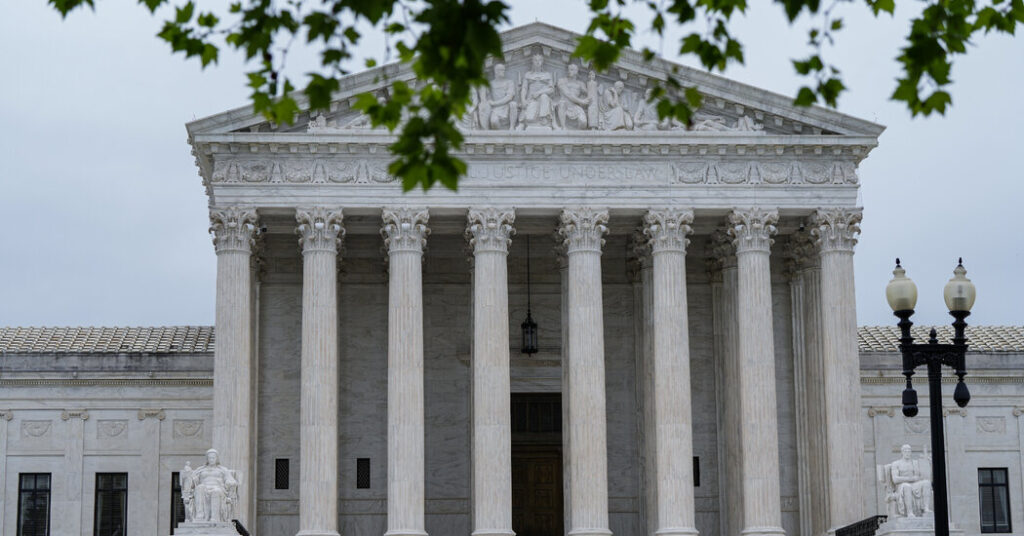
The Supreme Court’s ruling on the Voting Rights Act in the middle of primary season could create a potentially chaotic scramble among states that may consider drawing new maps.
At least one outcome is clear: The decision will improve Republicans’ fortunes ahead of the midterm elections. How big of an advantage that becomes remains to be seen.
The case directly affected one state, Louisiana, striking down its congressional map and most likely causing Democrats to lose at least one blue-leaning district there. It was not immediately clear how the ruling might play out in the other states that have yet to hold their primary elections this year.
In Florida, where Gov. Ron DeSantis and Republicans introduced a new map this week that added four G.O.P.-leaning seats, they cited in their reasoning the looming decision before the Supreme Court. The decision on Wednesday is likely to fuel those arguments.
Beyond those two states, the picture becomes significantly less clear.
The conservative majority asserted that Louisiana’s map, which included two majority-Black districts, had amounted to an unconstitutional racial gerrymander. The majority opinion described a limited ruling that preserved a central tenet of the Voting Rights Act. But the court’s liberal wing, in dissent, argued that the justices had effectively dismantled the landmark civil rights law.
South Carolina, Tennessee, and Missouri have not begun early voting, and theoretically could still draw new maps before the midterms. They all host primaries later in the year, but would also have to contend with filing deadlines for candidates to qualify for the ballot.
It is extremely unlikely that any state that has already started its early-voting process would begin to try to draw new maps before the midterms. That would amount to throwing out legally cast votes, and could create chaos and confusion among voters and candidates.
It is also unlikely, though still possible, that states where the filing deadline for candidates has passed will try to redraw their maps. Such a move would require states to pass new laws and move deadlines.
Filing deadlines have already passed in many states. Others have started the process of early voting. That leaves just a handful of states that could try to redraw their maps to gain a partisan advantage in November.
Not all states are likely to try. Some states’ congressional maps are already heavily gerrymandered, and it would be difficult or impossible to carve out a further partisan advantage.
Abbie VanSickle contributed reporting.
Nick Corasaniti is a Times reporter covering national politics, with a focus on voting and elections.
The post How the Supreme Court’s Voting Rights Ruling Could Be Felt in the Midterms appeared first on New York Times.