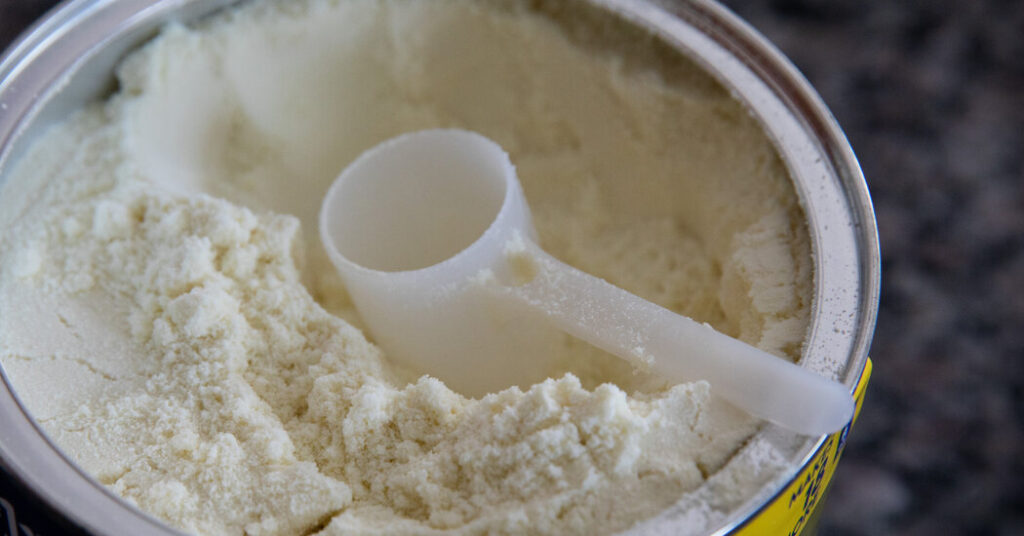
When the Food and Drug Administration announced “Operation Stork Speed” in March 2025, it vowed to improve the safety and quality of U.S. infant formulas — in part by increasing its testing of them for heavy metals, pesticides and other contaminants.
Now, the first round of test results are in, and while federal health officials are describing them as reassuring, some outside experts say they raise questions.
Between 2023 and 2025, the agency purchased more than 300 infant formula samples from stores and online retailers and tested them for heavy metals (lead, arsenic, cadmium and mercury), pesticides, phthalates (chemicals commonly found in plastics) and PFAS (or per- and polyfluoroalkyl substances, sometimes called “forever chemicals”).
The agency reported that the levels of all contaminants were low, and the formulas were safe. But after looking at the raw data, a few outside experts noted that some phthalate and PFAS levels were concerning.
“Any detection of PFAS or phthalates is problematic” and deserves scrutiny, especially in products that babies consume, said Dr. Sheela Sathyanarayana, a professor of pediatrics at the University of Washington.
It’s reassuring that the heavy metal and pesticide levels were low, experts said. And it’s good that the agency is evaluating these contaminants, Dr. Sathyanarayana said. But, she added, the findings highlight the need for continued monitoring and work to reduce levels of them in formula.
Why is the F.D.A. testing infant formulas?
Infants and young children who are exposed to high levels of heavy metals can have problems with brain development, potentially leading to long-term learning and behavioral issues, said Dr. Steven Abrams, a professor of pediatrics at the University of Texas at Austin Dell Medical School.
To address those health concerns, the F.D.A. began a large study of heavy metals in infant formula in 2023. The agency added tests for pesticides, phthalates and PFAS in 2025 as part of Operation Stork Speed, said Greg Noonan, the director of the F.D.A.’s office of chemistry and toxicology.
While those analyses were in progress, outside organizations have published their own test results.
In 2025, Consumer Reports published an analysis of 41 infant formulas sold in the United States which suggested that many had concerning levels of lead, arsenic and other contaminants.
Those findings caused “absolute hysteria” among some parents, Dr. Abrams said. Some stopped feeding their babies medically necessary formulas because they were flagged as having high levels of heavy metals. So Dr. Abrams was glad to see the F.D.A.’s more comprehensive report, he said.
The Consumer Reports analysis had set the level for concern for heavy metals well below European Union standards. Because the F.D.A. has not set limits for heavy metals in infant formulas, the agency used those set by the Environmental Protection Agency for drinking water, which are similar to the European Union’s limits for infant formula.
This new analysis is the largest F.D.A. examination of chemical contaminants in infant formula to date, Dr. Noonan said.
What did the new study find?
The F.D.A. analyzed 312 powdered and liquid infant formulas made by 16 brands purchased online and in person, most from big box and grocery stores in the northeastern United States.
According to the results supplied to The New York Times, all formula samples tested well below E.P.A. and E.U. limits for heavy metals, and all but three of the samples were free of the 318 pesticides tested.
The F.D.A. detected some phthalates and PFAS in the formula samples, though they characterized the levels as being very low. But Dr. Sathyanarayana said she was concerned about the types and amounts of some of the compounds present.
For example, several samples had levels of DEHP (a type of phthalate linked to reproductive difficulties and an increased risk of cancer) or PFOS (a PFAS linked to impaired immune responses and increased cholesterol levels) above the EPA drinking water limits. While we are still learning about the health effects of phthalates and PFAS, Dr. Sathyanarayana said, we shouldn’t assume that small amounts are safe.
Joseph Braun, a professor of epidemiology at Brown University, noted that multiple types of PFAS and phthalate compounds were found within individual samples, potentially compounding the harms.
He would have liked the F.D.A. to have done a more thorough assessment of whether the levels detected were enough to be harmful to infants, he said.
Dr. Noonan said that his team is planning those types of analyses. And though some individual samples of formula may have had higher levels of certain contaminants, he said, most did not.
What do the results mean for parents?
The new F.D.A. analysis was rigorous and reliable, Dr. Abrams said, and overall, it should reassure parents about the safety of infant formulas sold in the United States.
Because these contaminants are ubiquitous in the environment, it’s difficult to remove them entirely from our food supply, including from infant formulas, said Dr. Nan Du, a pediatric gastroenterologist at Boston Children’s Hospital, who has studied heavy metal levels in infants. Even breast milk can contain some amount of heavy metals and other contaminants, she said. (As part of their new review, the F.D.A. tested 110 breast milk samples from a milk bank in Oklahoma for heavy metals. They reported that their levels were low.)
Kyle Diamantas, the deputy commissioner for food at the F.D.A., said that the agency would continue testing infant formula and working with manufacturers to identify ways to further reduce contaminant levels. They are also working to develop federal limits for heavy metals in infant formulas, he said, though he would not give a timeline for when that might happen.
John Koval, a spokesman for Abbott, one of the largest formula companies in the United States, wrote in an emailed statement: “We urge the FDA to set scientifically established standards to help consumers further trust the safety of U.S. infant formulas.”
Dr. Abrams said he would like to see a clear plan from the agency for setting those limits and holding manufacturers accountable for meeting them. And Dr. Sathyanarayana called for more research on identifying how they get into formula ingredients in the first place, and working to eliminate them.
Alice Callahan is a Times reporter covering nutrition and health. She has a Ph.D. in nutrition from the University of California, Davis.
The post F.D.A. Releases Results from Major Infant Formula Safety Study appeared first on New York Times.