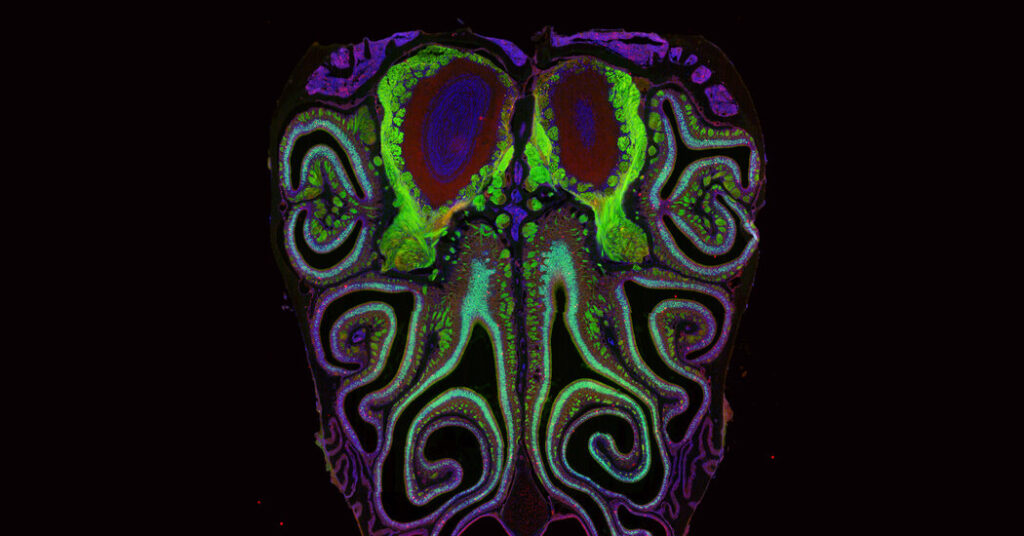
Over the last century, scientists have mapped several of the body’s sensory systems in microscopic detail, discovering that the cells that process sight, sound and touch are arranged in predictable spatial patterns.
It has been much harder to navigate the complex landscape of the nose, with its enormous array of scent receptors. For years, many scientists believed that these receptors were distributed mostly at random.
Now, two teams of scientists have managed to map the nose of a mouse. Using advanced genetic sequencing and imaging techniques, the researchers found that each of the 1,100 different types of olfactory receptors in the mouse nose occupied a distinct and predictable position, consistent from mouse to mouse.
The findings, which were published in a pair of papers in the journal Cell on Tuesday, represent the first comprehensive, fine-scale maps of odor receptors in the nose. They suggest that topographic maps may be as fundamental to olfaction as they are to other senses.
“The organization of information in space is a major organizing principle for all sensory systems, and that is what has, until now, made olfaction super weird,” said Sandeep Robert Datta, a neurobiologist at Harvard University and an author of one of the new papers. “We have, to some extent, unveiled this long lost map for smell.”
Scientists have not yet demonstrated that the same sort of map exists in the human nose and do not yet understand why the receptors are arranged in the way that they are. But the research sheds light on how the olfactory system develops and paves the way for a better understanding of an often overlooked sense.
“Having this comprehensive understanding, this broad understanding of the organization of the main olfactory system is absolutely essential to understand how we process scent,” said Catherine Dulac, a molecular biologist and neuroscientist at Harvard University and an author of the other paper.
Topographic maps preserve key sensory information about the world and help the brain process that information more efficiently. In the ear and the auditory cortex, for instance, adjacent cells detect adjacent sound frequencies. In the eye and the visual cortex, neighboring neurons process information from neighboring points in the visual field.
But scientists have not been able to detect equivalent maps in the nose, which contains a staggeringly diverse array of olfactory receptors. These receptors are specially shaped proteins that sit on the surface of neurons and bind to complementary odor molecules. Humans have several hundred different types of these receptors, but some species, including mice, have 1,000 or more. Each receptor type binds to a different set of odor molecules, and each neuron in the nose carries just one type of receptor.
Scientists had previously discovered that the nose could be divided into several broad zones, containing different sets of olfactory receptors. But within those zones, experts long believed, the receptors were distributed randomly. “Basically, the vibe is, ‘Things are super random, and you can’t make any predictions, and there’s no real spatial structure in the nose,’” Dr. Datta said.
In their new study, Dr. Datta and his colleagues analyzed neurons from mouse noses to determine exactly which genes — of the many in the mouse genome — were active, or expressed, in each individual neuron.
That data revealed which particular olfactory receptor each neuron was expressing. But the scientists also identified hundreds of additional genes, with a variety of different functions, whose activity seemed to vary from neuron to neuron, depending on which receptor type was present.
Some of these genes were known to be active only in certain regions of the nose, while others were known to help guide neuron development in physical space. The researchers hypothesized that these genes might help determine which receptor any given neuron expressed — and that they might do so based on where that neuron was located in physical space.
To test their hypothesis, the researchers analyzed larger samples of mouse nasal tissue, using advance spatial imaging technology to pinpoint where, in physical space, these various genes were expressed.
Dr. Dulac’s team had been using the same imaging technology for a separate project, part of a federally funded effort to build a detailed cellular atlas of the entire mouse brain. For their study, Dr. Dulac and her colleagues mapped the expression of olfactory receptor genes in tissue samples from both the nose and the olfactory bulb, which is the brain structure that receives information from the nose. (The Datta team incorporated some of this data into its research but also analyzed tissue samples from a separate set of mice.)
Ultimately, the teams ended up producing similar maps, with the receptors in consistent locations. They also found that the map of neurons in the olfactory bulb mirrored the map in the nose.
“It’s extraordinarily satisfying,” Dr. Dulac said.
In subsequent experiments, Dr. Datta’s team also found that chemical gradients in the nose seemed to help guide the formation of this map, in effect “telling” sensory neurons where they are positioned in space and, ultimately, which type of olfactory receptor to express.
“I think this is really a highly tenable hypothesis,” said James Schwob, a neurobiologist who studies smell at Tufts University and was not involved in the new research. The study provides “a deeper molecular understanding of how position in the nose is encoded genetically,” he added, “and also what mechanisms in the tissue might be responsible for setting that.”
Linda Buck, a neurobiologist who shared a Nobel Prize in Physiology or Medicine for discovering olfactory receptors and how the olfactory system was organized, described the new research as “groundbreaking.” Dr. Buck, who now studies olfaction at the Fred Hutchinson Cancer Center in Seattle, said that she was particularly excited about the discovery of hundreds of genes that might play a role in regulating the receptors that neurons express. “This is an important discovery that opens the way to future experiments to further understand how the olfactory system develops,” she said.
Still, the big question remains: Why are certain receptors located where they are and how might that help the brain make sense of odors? One possibility is that adjacent neurons detect odor molecules with similar chemical structures. Another is that the map is organized by meaning, with attractive odors, like the scent of one’s own offspring, detected in one area and repellent ones, like the smell of a predator, processed in another.
Both teams have begun investigating some of these possibilities. In their new paper, for instance, Dr. Dulac and her colleagues mapped the olfactory responses to some of these positive and negative social cues in mice. Such research is in early stages, and the principles that govern the map may not be straightforward.
But the new papers are a critical starting point, Dr. Datta said. “Until now,” he said, “there was no real point in trying to understand the meaning of the map in the nose, because we didn’t even know it existed.”
Emily Anthes is a science reporter, writing primarily about animal health and science. She also covered the coronavirus pandemic.
The post Scientists Unveil ‘Long Lost’ Map for Smell appeared first on New York Times.