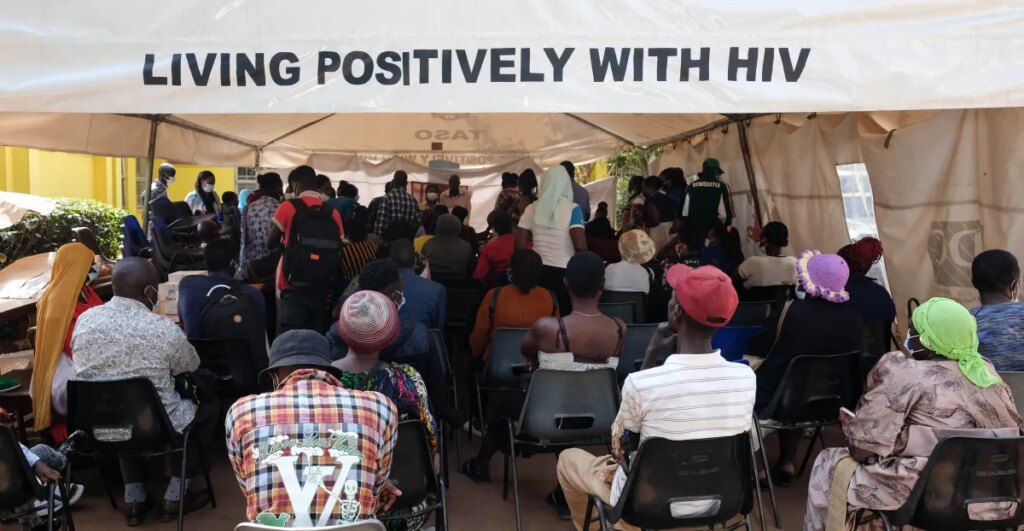
When the Trump administration began dismantling US foreign aid in January 2025, many global health experts feared that the consequences would be catastrophic, with models projecting thousands of deaths as a direct consequence of the cuts.
Across nine countries, 3.4 million fewer people were tested for HIV in just the first half of 2025, according to one report. Emergency waivers eventually restored HIV treatment, but much of the program’s prevention and outreach work remained off-limits.
It has now been more than a year since that upheaval began, and we finally have official data on what it did to PEPFAR, one of the biggest and most successful US-funded HIV programs in the world.
At first glance, the numbers offer some relief. The US still delivered HIV treatment, in the form of antiretroviral drugs, to about 20 million people from July through September 2025, the only period for which the administration has released data. That was roughly the same number of people receiving treatment as in the same period a year earlier. That is good news, and it is far better than the dire consequences many predicted.
Maintaining the treatment pipeline keeps people with HIV alive, and the State Department has framed the data that way. Jeremy Lewin, the acting undersecretary of state for foreign assistance at the State Department, said, at a conference earlier this month,“the numbers are very, very good.”
But other numbers tell a different and less positive story. A closer look at the data suggests that PEPFAR was far less successful at doing the rest of the work that keeps HIV from spreading: finding people who don’t yet know they’re positive, and stopping new infections before they happen.
The data show that fewer people were tested for HIV, fewer people newly started treatment, and far fewer started or stayed on PrEP, the drugs that help prevent infection in the first place.
PEPFAR was always more than a drug-delivery program. Part of its mission was to find new infections and help stop the virus from spreading further. And for years, that broader strategy helped push the epidemic in the right direction.
Despite the reassuring headline numbers, the data suggests that PEPFAR may be backsliding on that mission now.
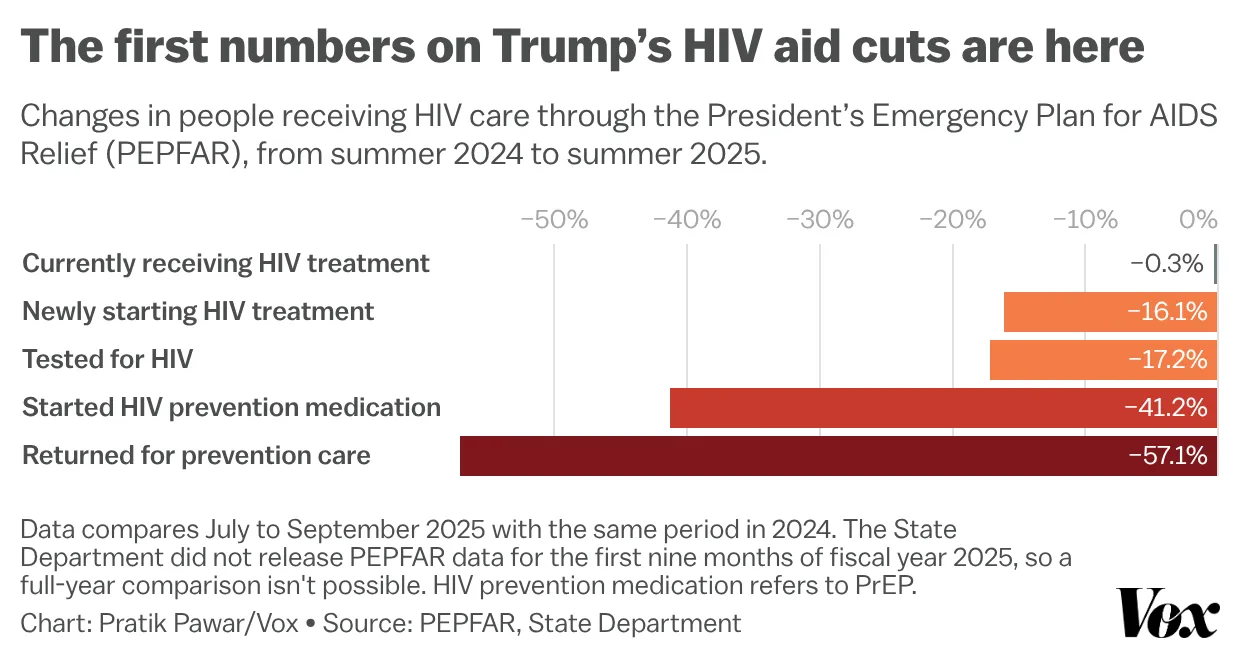
PEPFAR tested about 4 million fewer people for HIV in the last quarter of 2025 than in the same period a year before, a 17 percent drop. The number of people newly starting on HIV treatment also fell, from about 463,000 to 389,000, a decline of 16 percent. And PrEP, the daily pill that prevents HIV infections, took an even bigger hit: with new enrollments falling by about 270,000 people, 41 percent, while the number of people returning for follow-up dropped by nearly 60 percent.
Those are clear signs that PEPFAR got worse at finding HIV infections and preventing new ones.
And even that may be the best-looking part of the 2025 data. The newly released data is only for the last quarter of the fiscal year 2025 — July through September. The State Department said they did not release data for the rest of the year because of reporting and implementation challenges.
But a version of that earlier data was briefly posted on a PEPFAR development site in January 2026 before being taken down. Researchers at amfAR, a nonprofit focused on AIDS research and policy, and the International AIDS Society analyzed those unreleased numbers and found much steeper disruptions across much of the HIV response, even as people already receiving treatment were largely able to stay on it. Their analysis found an acute shock after the January foreign aid freeze, and only partial recovery later in the year.
In that big picture, the fourth quarter — the data that the State Department did release — may be the most reassuring part of a bad year.
“You could celebrate success on treatment continuity,” said Jirair Ratevosian, a former PEPFAR chief of staff. “But you could also look under the hood and see a complete architecture falling apart.”
From then to now
To understand why the treatment number isn’t the whole story, it’s worth understanding what PEPFAR — the President’s Emergency Plan For AIDS Relief — did before the Trump disruptions.
The program started in 2003, as one of the signature global health initiatives of President George W. Bush’s first term. It came near the peak of the global phase of the AIDS crisis, when the most urgent task was getting lifesaving HIV drugs to people who otherwise would have died without them. That was one of the core missions of the program.
But from the beginning, PEPFAR also aimed to prevent new infections and provide broader care. Over time, as HIV deaths fell thanks to treatment, and better prevention tools became available, PEPFAR officials realized that treatment alone was not enough. If the goal was to bring the epidemic under control, the program had to catch infections early, and prevent new ones from happening in the first place.
By 2024, PEPFAR was supporting tens of millions of HIV tests a year, providing treatment for more than 20 million people, and helping to get millions of people on PrEP. That broader strategy was part of what made the program so successful, and a major contributor to the global push to bring the epidemic under control by 2030.
Keeping treatment going for people already in care is, in some ways, the most straightforward part of an HIV program. Even during Covid, for example, PEPFAR was able to keep many patients supplied by dispensing several months of drugs at once and expanding alternate pickup sites. Testing, outreach, prevention, and follow-up are much more fragile, because they depend on the day-to-day work of finding people before they fall through the cracks.
The amfAR analysis also found that the direct service-delivery workforce fell by about 24 percent from the last quarter of 2024 to the last quarter of 2025, after the Trump administration’s foreign aid freeze. The biggest cuts were among community health workers, case managers, and others helping keep people connected to the system.
“A lot of what those staff were doing was outreach, getting to the harder-to-reach groups,” said Charles Kenny, a senior fellow at the Center for Global Development who has been tracking the PEPFAR data. Most of what PEPFAR does, he said, is not just moving drugs. “The drugs are obviously absolutely essential, but it’s the system making sure that they reach where they need to go.”
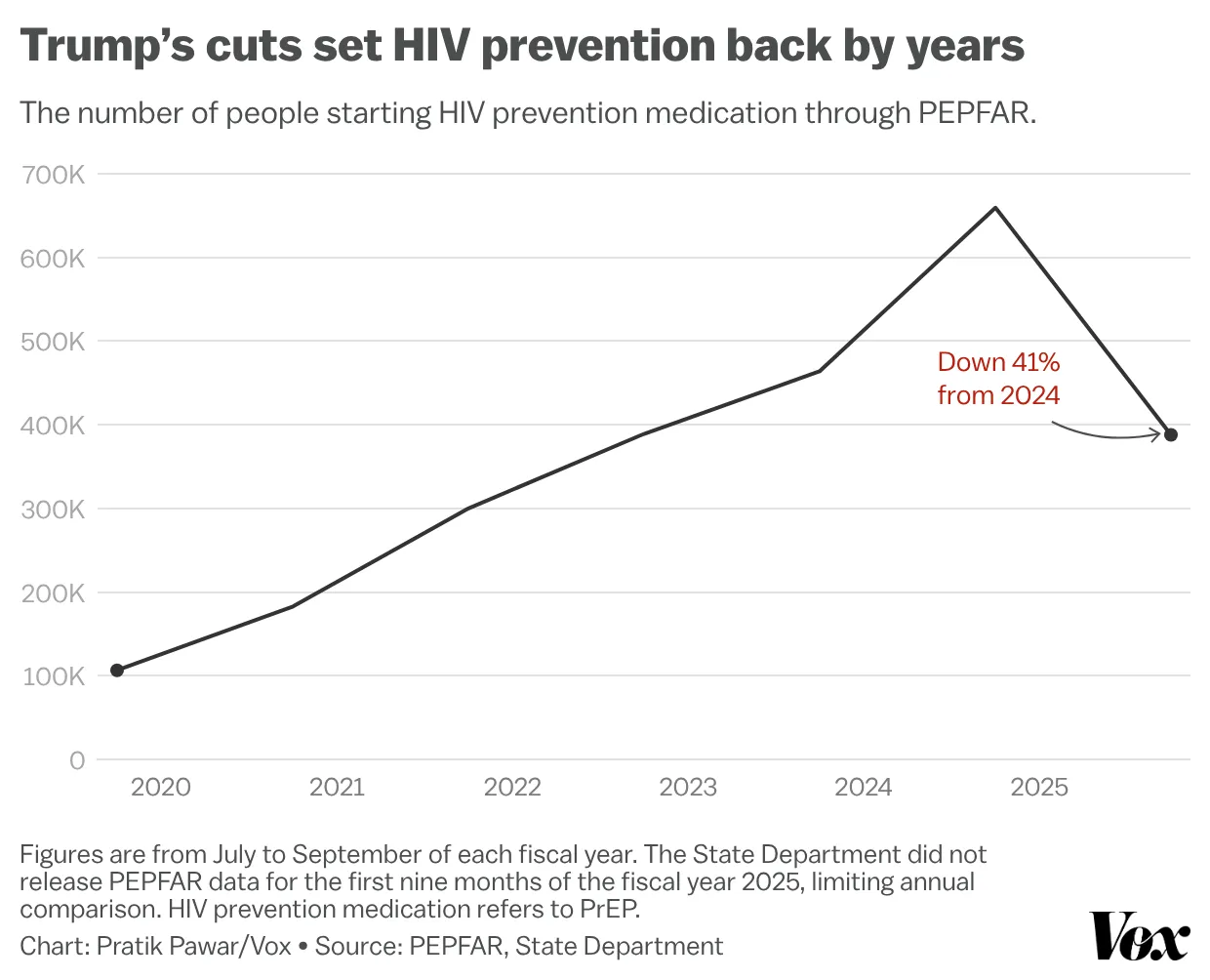
 Explore an interactive version of this chart.
A new PEPFAR
The State Department has pointed to the topline treatment number as evidence that its strategy is working.
From the start, the Trump administration said its HIV priority was keeping treatment going and preventing mothers from passing the virus to their babies. Some of that emphasis does show up in the numbers: testing of pregnant women at their first prenatal visit actually rose by 10 percent, even as many broader prevention indicators fell.
The problem isn’t that mother-to-child transmission doesn’t matter — it does. The problem is that this is too narrow a strategy, one that’s not representative of the epidemic’s current phase.
About 4,000 adolescent girls and young women are newly infected with HIV every week, most of them in sub-Saharan Africa. Globally, more than half of new infections happen among gay men, sex workers, trans people, people who inject drugs, and their sexual partners.
“Since most of the new infections occur among key populations and their sex partners, if you don’t reach them and prevent more infections, from an epi[demiological] perspective, that’s not going to help control HIV,” said Jennifer Kates, senior vice president at KFF, a nonpartisan health policy organization, who has tracked PEPFAR for more than two decades.
The new data suggest that prevention programs aimed at those populations were hit harder. PEPFAR’s DREAMS program, which was designed to help adolescent girls and young women stay HIV-negative, had nearly 2 million participants in the last quarter of 2024. A year later, that number fell to about 253,000. Its prevention programs for key populations fell from about 3 million in late 2024 to zero a year later.
That decline comes at an especially consequential moment. The Trump administration has championed lenacapavir, a twice-yearly injectable drug that is near perfect at preventing HIV, as the next frontier of HIV prevention. But bringing this new tool to people at highest risk requires exactly the kind of delivery system that the Trump cuts have weakened.
And, going forward, it will be even harder to analyze these trends because the administration has also made PEPFAR less transparent. Some of the numbers that countries once had to report every quarter are now optional — among them is measures of TB care, a major part of HIV care in many PEPFAR countries. And some public reporting on key populations disappeared altogether.
That may prove to be one of the most consequential changes of all. For years, one of PEPFAR’s strengths was its system that generated unusually granular public data about where the program was functioning well and where it wasn’t. That made it possible to spot problems and course-correct, part of what made PEPFAR so successful and helped save more than 25 million lives.
Now that picture is much thinner, with the new data release covering only the last quarter of 2025. And it is unclear whether this kind of detailed HIV-specific reporting will continue at all under the terms of its America First Global Health Strategy. Some fear it won’t in the way that it has in the past.
The risks are not theoretical. Recent New York Times reporting from Zambia found that health officials had managed to keep HIV drugs moving for many patients, even as systems around treatment had weakened. In Mpongwe, a town in Zambia’s Copperbelt region, a hospital that used to see one or two advanced AIDS cases a month saw 28 in January, 28 more in February, and seven more in March.
This is the danger of a thinner data system. The treatment numbers are good news, Kenny said. But with less testing and less PrEP, the damage may not show up right away. “There could be the start of a hidden crisis here.”
The post What really happened after Trump slashed HIV funding appeared first on Vox.