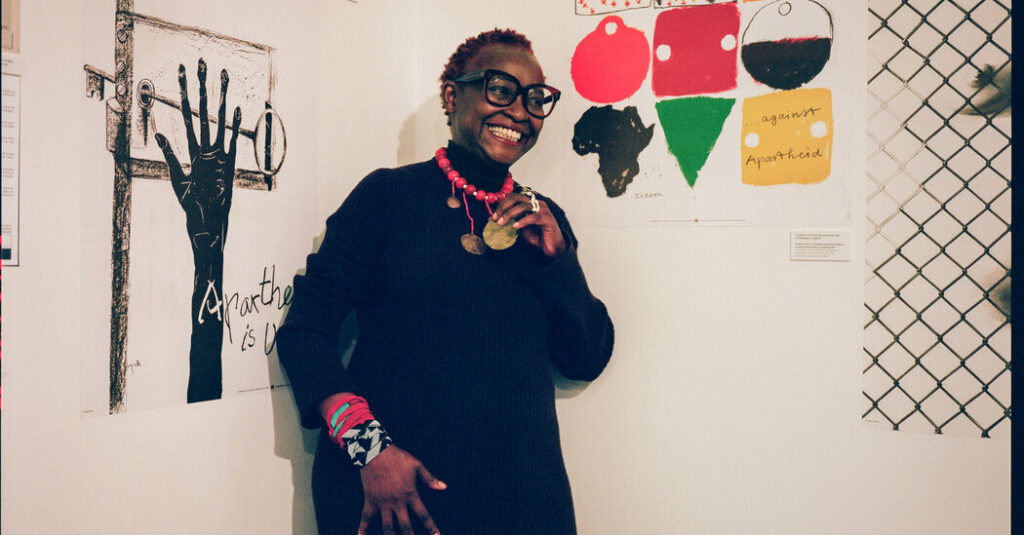
When Koyo Kouoh arrived back at the airport last May in her hometown, Basel, Switzerland, she cried as she told her husband that she had some good news and some bad news.
Kouoh had gone to see a doctor during a work trip to Senegal because she was feeling weak, and had undergone an M.R.I. scan. Kouoh, a heavy smoker, said the good news was that she didn’t have lung cancer. But the bad news was no joke: She had liver cancer.
Within days Kouoh was dead, aged just 57 and only a few months into her dream job as the curator of the central exhibition at the Venice Biennale, the art world’s most important event.
Her show was set to open almost exactly a year later.
To some art world observers, it seemed unlikely that the Biennale’s organizers would continue Kouoh’s work. Overseeing the Biennale’s main show requires months of crisscrossing the world to meet artists, commission works and charm donors.
Yet on May 9, the exhibition will open under Kouoh’s name and with her chosen title, “In Minor Keys.” In the Biennale’s main exhibition halls, a vast presentation of works by 110 artists and collectives is now coming together, with participants including Wangechi Mutu, the acclaimed Kenyan multimedia artist; Alvaro Barrington, the Venezuela-born painter; and the American installation artist Nick Cave.
To get to that point, a five-person team of Kouoh’s assistants and advisers has tried to channel her work practice and personal style. They have been guided by the plans she left behind and conversations as she developed them. But curating a large international exhibition isn’t about following a score. In many cases, her team has had to improvise.
Kouoh had outlined her vision in a three-page curatorial statement. The exhibition, she wrote, would ask the viewer to “shift to a slower gear and tune in to the frequencies of the minor keys.” It wouldn’t be bombastic, she said, or provide “a litany of commentary on world events.” Instead, it would be an invitation to reconnect with “art’s natural habitats”: “the emotional, the visual, the sensory.”
The team also had a list of the artists Kouoh wanted to feature, which her team says was finalized at a meeting in Dakar, Senegal, just before she died. Kouoh had spoken to some of the artists and discussed works that they might send to Venice. Others had no idea what Kouoh had in store for them.
‘Our Conductor’
In the last decade of her life, Kouoh rose to become one of the global art world’s most prominent figures, praised by critics her for shows that brought African and diaspora artists to the fore.
Born in Cameroon, Kouoh moved to Switzerland as a teenager and first came to international attention after founding Raw Material, an art space in Dakar. As the director of Zeitz MOCAA in Cape Town, South Africa, she ran the continent’s largest contemporary art museum and curated lauded exhibitions like “When We See Us: A Century of Black Figuration in Painting,” which some critics hailed as a landmark.
Even as Kouoh won accolades, her ambitions reached higher. Her husband, Philippe Mall, a Swiss saxophonist, said her ultimate goal was to curate the Biennale’s centerpiece exhibition, which is regarded as a bellwether for contemporary art and runs alongside dozens of smaller, independently organized shows in national pavilions.
“She always said, ‘Do that, then I’m finished,’” Mall said.
As soon as her appointment was announced in December 2024, Kouoh started asking artist friends to appear in the show. Godfried Donkor, a Ghanaian artist, said she told him, “Yeah, G, we’ll talk soon.” And Theo Eshetu, a British Ethiopian video artist, recalled her sending him a simple text: “Get ready.”
Kouoh chose a team of collaborators including the curators Gabe Beckhurst Feijoo of Britain, Marie Hélène Pereira of Senegal and Rasha Salti, who is based in Berlin and Beirut. She also asked her assistant, Rory Tsapayi, and the journalist Siddhartha Mitter, a regular New York Times contributor.
The team has declined interview requests about how it finished Kouoh’s show, and Cristiana Costanzo, the Biennale’s head of media relations, said at a news conference in February that this was because of “the exceptional situation.”
They gave some insight into their preparations, however. Salti told reporters that she and her colleagues had spent an “intense” week with Kouoh in Dakar just before her death. It was there that they agreed on plans for the show, she said, including the artist list.
“Recalling that week is like remembering a rehearsal for a musical performance,” Salti said. Kouoh, she added, “was our conductor.”
The team and Costanzo gave the impression of a done deal. Yet two previous Venice Biennale curators said they were far from such an advanced stage just a few months into the process.
Cecilia Alemani, the Italian curator who oversaw the 2022 show, said she hadn’t started contacting artists at that point. “I was still in the research phase,” she said (though she pointed out that she had more time to prepare, because her exhibition was delayed by the pandemic).
All Biennale curators have to make adjustments on the fly, she added. Even when she was in Venice near the opening of her show, Alemani said, she sometimes had only a rough idea of the works that artists would send. “I’d open a box and go, ‘Oh, great, I was expecting something pink and this is green,’” Alemani recalled. “I had plenty of surprises.”
Daniel Birnbaum, a Swedish curator who oversaw the 2009 edition, said that what will be on show in Venice would “of course be an interpretation of Kouoh’s vision.” Still, he added, “it’s probably a very true and serious one.”
Kouoh’s team is not the only one at this year’s Biennale trying to realize a posthumous blueprint. In February, Henrike Naumann, who was set to represent Germany in that country’s pavilion, died of stomach cancer at age 41.
Clemens Villinger, Naumann’s partner, said that Naumann had learned of her cancer in November but had expected to live past the Biennale, which ends on Nov. 22. She had decided to keep her diagnosis private, Villinger said — dreading “Death in Venice” headlines — and was working on finishing the work for her show from a hospital bed. He showed her photos and videos of the art works mid-fabrication, he said, then Naumann asked for changes.
But she couldn’t finish it all. Villinger said that he and Naumann’s friends had to make some small decisions on her behalf.
Filling in the Blanks
Naumann worked on her show for weeks after knowing that she had cancer, but Kouoh died within days of her diagnosis. In April 2025, she was in the United States on business when she fainted in a hotel, Mall recalled. She had called him concerned, he said, but figured that she was just dehydrated.
She then traveled to Senegal for the weeklong meeting with her curatorial team. But she was feeling weaker and weaker, Mall said, so she went for the scan that revealed the cancer. When she got back to Switzerland, Mall recalled, she went straight to the hospital for more tests. She never came out.
Mall said he assumed that Kouoh’s show would be canceled, but within days Pietrangelo Buttafuoco, the Biennale’s president, wrote to Mall and Djibril Schmed, Kouoh’s son from a prior relationship, to explain that he wanted to continue Kouoh’s project.
They agreed to let that happen. Mall said he always trusted Kouoh’s team to realize her vision. “They were very, very close friends,” he said. “They wouldn’t have done anything against her.”
Alemani said that one of the first tasks for Kouoh’s team would be to contact artists for proposals and agree on what to commission. Kouoh had already told some artists that she wanted them to take part; others, she hadn’t spoken to for years, if at all.
Last summer, for instance, a member of Kouoh’s team emailed the Congolese artist Sammy Baloji to ask him for ideas. He had already discussed a possible project with Kouoh, he said, whom he had bumped into at an event in Zurich. In April, he sent works to Venice, including three large bronze sculptures resembling historical Congolese artifacts, studded with crystals.
Some artists were more surprised to hear from Kouoh’s advisers.
Alice Maher, a multidisciplinary artist, said that Beckhurst Feijoo and Tsapayi arranged to meet her at her home in rural Ireland last summer. They looked through her studio and chose several works for the Biennale, including a series of vast drawings called “The Sibyls.”
As the pair left, Maher recalled, Beckhurst Feijoo asked about a series of orange sculptures of women’s heads lined up against a wall in her garden. Maher replied that she had once installed them bobbing in a lake like buoys. Beckhurst Feijoo asked if Maher could remake that project in Venice.
It was a quirky idea, Maher said, but Beckhurst Feijoo’s spur-of-the-moment decision would have chimed with Kouoh’s approach. “She had a great sense of humor,” Maher said.
Even when Kouoh had discussed a specific ideas with artists, the plans sometimes moved on after her death. Eshetu, the video artist whom Kouoh texted to “get ready,” said they had been talking about making an installation that would include video screens resembling tombstones.
That now seemed too morbid, Eshetu said, so he was sending an olive tree weighing over two tons that will sit on a rotating platform in the show.
Adapting to circumstances wouldn’t make the show any less Kouoh’s, Eshetu said, especially since she was a curator who wanted artists to lead her rather than the other way around. In the several exhibitions that they worked on together, “she always gave me space to interpret,” he added.
Mall said one of Kouoh’s mottos was “I’m a midwife for the artists, so the artists should be in front.”
Her relationships with many artists in her Biennale were deep and personal, according to Schmed, her son. He said he considered Otobong Nkanga, a Nigerian installation maker who has work in the show, like a family member and had spent vacations with other artists like Kader Attia, who is also exhibiting.
“She liked to work with people she had a relationship with,” Schmed said of his mother.
Kouoh was so dedicated to giving them a platform, Schmed added, that she didn’t stop until “her deathbed essentially.”
“I don’t want to be dramatic about it, but she was,” he said. That work ethic also spoke to her character, Schmed added: She “wanted to get the job done.”
Alex Marshall is a Times reporter covering European culture. He is based in London.
The post A Curator Died Suddenly. Could the Art World’s Most Important Event Be Saved? appeared first on New York Times.