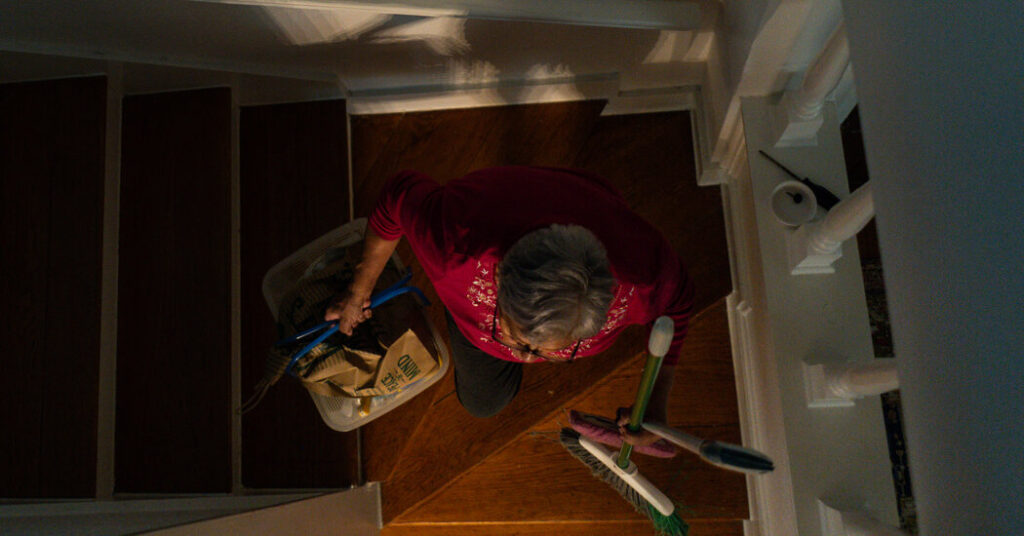
Olivia Cruz hopped carefully off a bus in an upscale San Antonio enclave framed by oak-lined streets.
On a recent day in April, Ms. Cruz brushed off a leg injury with the help of a new cane and tried to focus on the $120 payday needed to cover the rising cost of raising two grandchildren.
“You go to the grocery store to buy meat or vegetables, and the bill comes up to more than $100,” said Ms. Cruz, 68, as she limped toward her client’s home to clean. “I’ve been poor for as long as I can remember, but it feels like it is harder to be poor these days.”
Ms. Cruz’s story underscores what economists describe as the defining tension of this moment: an economy that appears strong by some measures but has failed to deliver a sustained sense of progress. San Antonio is one of the fastest-growing cities in the country in part because of its relative affordability compared with other major Texas cities. It has drawn new residents from across the state and country but unlike Austin or Dallas, the city has struggled to generate large numbers of high-paying jobs, with much of its economy anchored in lower-wage service work. The rising cost of securing a middle-class life has made opportunity feel more distant, feeding a growing belief that the economy is not working for many in the nation’s seventh-largest city.
San Antonio ranks as the third poorest among the top 25 largest U.S. metro areas, behind only Houston and Detroit, according to the latest U.S. census. In 1980, 20 percent of residents lived below the poverty rate. Today it hovers around 17 percent, higher than the state or national averages, said Monica Cruz, a special research associate with the Institute for Demographic and Socioeconomic Research at the University of Texas at San Antonio.
San Antonio’s economic woes are tied to longstanding societal setbacks that have gone unresolved by past administrations, critics say. Those setbacks include a reliance on low-wage workers; low rates of higher education; and limited access to homeownership, one of the most common ways to amass generational wealth.
Rogelio Sáenz, a professor of sociology and demography at the University of Texas at San Antonio, said the region’s poor neighborhoods had struggled to recover from redlining, a Depression-era practice in which federal housing policies and lenders labeled Black and brown neighborhoods as too risky for investments.
The practice was formalized through color-coded maps that shaped where banks issued loans, creating pockets of deep poverty and racial and economic segregation in the process, he said.
“If you don’t have the financial means to be able to purchase your home, you never build that wealth up from owning a home, and then you don’t pass that on to your children,” Mr. Sáenz said. “You see the unequal funding of education. You continue to see the inequality taking place.”
In 1968, a CBS documentary titled “Hunger in America” shocked the nation through its depictions of extreme poverty in four corners of the nation, including the west side of San Antonio, which is known today for its taquerias, small stores known as tienditas, and murals of the Virgin of Guadalupe and folklore singers who reflect the neighborhood’s Mexican American history.
Nearly six decades later, Kayla Miranda, 45, a housing activist and a mother of four children, two of whom are autistic, said the community remained stuck in a persistent pattern of poverty because of a legacy of discriminatory policies that had deprived low-income neighborhoods of investments.
“The money goes to millionaires and billionaires instead of giving money to extremely low income,” Ms. Miranda said. “A lot of people here are a car breakdown or health emergency away from becoming homeless.”
Ms. Miranda said she became stuck in this cycle after a death in the family and the temporary deportation of her children’s father forced her home into foreclosure. She became homeless for a year and a half. She has since rebounded and now lives in public housing where she cares for her two disabled sons full-time.
“I can’t hold a normal job because I have to take care of my sons,” she said. “There is this horrible stigma that people have that you are poor because you want to be.”
She said she hoped the city would address the longstanding failures that had left families like hers struggling. “The mayor and the council inherited this problem,” she said. “It was passed down to them.”
Former mayors of San Antonio like Julián Castro, who served from 2009 to 2014, and Ron Nirenberg, who left office last year after four two-year terms, said they had enacted policies that were aimed at tackling systemic poverty, knowing they would not see all of the outcomes during their tenures.
Mr. Castro championed a prekindergarten education program, tax breaks to incentivize the construction of new homes and jobs in renewable energies.
“There has been significant progress in the last couple of decades in diversifying the local economy, increasing the number of good-paying jobs,” Mr. Castro said. “But there’s still a lot of work to do.”
Mr. Nirenberg, who is running for county judge in Bexar County, which includes San Antonio, said he was playing the long game. While in office, he worked to support economic initiatives for early and college education, access to health care and affordable housing.
If he were elected as county judge, a role similar to the mayor’s at the county level, Mr. Nirenberg said he planned to work with Mayor Gina Ortiz Jones, who was sworn in less than a year ago, to see his old policies through.
In an interview with The New York Times, Ms. Jones said she was working to expand affordable housing away from decaying public housing and attract large companies in the artificial intelligence space, biotechnology and other industries to San Antonio. She recently led a delegation to Taiwan to urge businesses to invest in San Antonio.
“What I have found in speaking with companies is, they know Austin, they know Houston, they know Dallas, but they don’t know San Antonio as well,” she said. “I think we have to be much more aggressive in our economic development outreach. If they don’t know about us, then we’ll go there and share our story.”
One person familiar with San Antonio’s story was Ricardo Martinez, 46, a real estate agent from Austin who moved to the city during the pandemic in search of a home for him and his husband.
“We couldn’t find anything within our price range in Austin that wasn’t another condo,” Mr. Martinez said.
They couple found a 2,000-square-foot home for about $300,000.
“In Austin, that would have gotten us a closet,” he said. “San Antonio is a lot more affordable.”
The affordability that has attracted newcomers has not eased concerns about whether the city’s growth will translate into meaningful gains for its poorest residents.
Letty Sanchez, a prominent community activist and chair of the Historic Westside Residents Association, said she was disappointed to see some of the city’s new ventures move downtown and to other wealthier neighborhoods. Even though voters narrowly approved a proposition for an expansive sports and entertainment area known as Project Marvel during the March primaries, Ms. Sanchez said most of the jobs generated from the project were likely to be in concessions, restaurants and retail.
“It doesn’t help to lift people out of poverty,” Ms. Sanchez said. “It is not a living wage.”
Ms. Cruz, the grandmother who cleans homes, said she was unsure if she would see a prosperous San Antonio in her lifetime.
On that day in April, she knocked on the door of the house she was cleaning and was greeted with concern by her employer of many years, someone she considers part of the family, who noticed her cane and her limping.
“Are you OK?” the homeowner asked. “Are you able to work today?”
Ms. Cruz dismissed her concerns with a smile and quickly picked up a rag to start wiping a dresser by the door.
“I can’t afford not to work, even if my foot hurts,” Mr. Cruz said moments later. She had hurt herself on a rock while walking a dog.
“The bills don’t care if you are in pain,” she added with a bittersweet chuckle.
Edgar Sandoval covers Texas for The Times, with a focus on the Latino community and the border with Mexico. He is based in San Antonio.
The post San Antonio Is Booming. But Poverty Hasn’t Budged. appeared first on New York Times.