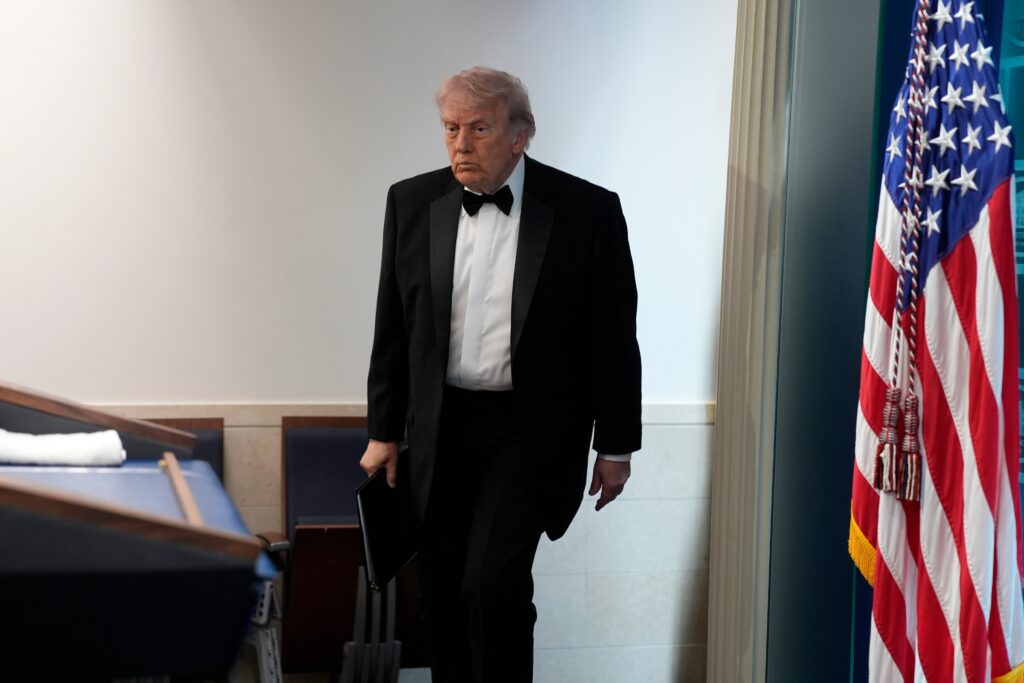
To hear Donald Trump tell it, the attempts on his life are a measure of his singularity as a president.
“The people that do the most, the people that make the biggest impact, they’re the ones that they go after,” Trump said Saturday night after a gunman rushed security at the White House Correspondents’ Association dinner, allegedly intent on assassinating the president and high-ranking members of his administration. “I hate to say I’m honored by that, but we’ve done a lot.”
There is no doubt that Trump has been impactful and historic, though the country is deeply divided over whether that has been for better or worse. Few figures in the modern era have generated both the devotion and the rage that he has.
But political violence — of which Trump has been the most high-profile recent target, but which has also been directed against figures across the political spectrum — has many roots.
And in some instances, it is hard to discern any reason at all. Authorities have yet to figure out a motive, or a set of them, behind Trump’s closest call: the shots that grazed his ear during a July 2024 outdoor campaign rally in Butler, Pennsylvania, and killed one person in the crowd and critically injured two others.
Thomas Matthew Crooks, the 20-year-old kitchen worker who authorities said fired at Trump and who was himself shot dead by a Secret Service sniper at the scene, left behind no evidence indicating why he did it or any clear partisan or ideological bent. His online history showed he had researched both Trump and then-President Joe Biden in the month before the attack, as well as the Democratic National Convention and the Republican National Convention.
But the absence of a clear motive for Crooks does not mean we lack an understanding of the forces behind politically motivated violence. Social upheaval is a primary driver, as was the case in the last big spasm, in the 1960s, when President John F. Kennedy, Sen. Robert F. Kennedy and the Rev. Martin Luther King Jr. were all assassinated, and the 1970s, when President Gerald Ford was targeted twice within the space of 17 days.
The passions of today’s deeply polarized environment are also strong. And they are made more combustible by increasingly common rhetoric that portrays political opponents as mortal threats to society, as well as the accelerant of social media.
“It is easier than ever for mentally ill individuals to become radicalized,” said Matthew Dallek, a political historian at George Washington University who has written extensively about extremist political movements. “When they’re radicalized, even if their agenda is not always crystal clear, they usually are responding to ideas and conspiracy theories circulating in the culture.”
Trump’s allies and aides have portrayed the three gun-related incidents involving him as products of a pathology unique to the left. They have bolstered their argument by citing an anti-Trump screed officials say was written by accused assailant Cole Tomas Allen, 31, shortly before he allegedly stormed the security perimeter at the White House correspondents’ dinner armed with two firearms and three knives.
Though it did not mention Trump by name, Allen’s alleged missive expressed outrage at the president’s policies, alluded to sexual misconduct and stated that he is “no longer willing” to “coat my hands with his crimes.”
At the White House on Monday, press secretary Karoline Leavitt said, “When you read the manifesto of this shooter, ask yourselves, how different is the rhetoric from this almost-assassin than what you read on social media and hear in various forums every single day?”
“The deranged lies and smears against the president, his family, his supporters have led crazy people to believe crazy things, and they are inspired to commit violence because of those words. It has to stop,” she continued.
But Trump, even as he emphasizes that he is a target of violent rhetoric, has often spread falsehoods and conspiracy theories about his adversaries, including by branding them “the enemy from within.” And his own words often invoke violence.
Meanwhile, the president and his allies have seized upon the threats against him to justify a fresh crackdown on his foes. On Tuesday, former FBI director James B. Comey was indicted by a federal grand jury for a second time, after charges lodged last year were dismissed by a federal judge. In the new case, he is charged with threatening the president by posting, and then removing, an image on Instagram last year of seashells spelling out “86 47.”
Trump is the 47th president, and “86” is slang for getting rid of something. Administration officials claimed that Comey was advocating the president’s murder. Comey said he viewed the shell arrangement, which he saw while taking a walk, as a political statement, not a call to violence.
What Trump and those around him do not mention is that prominent Democrats have also been targets of political violence in recent years. Those incidents include the 2022 bludgeoning in his home of Paul Pelosi, the husband of Rep. Nancy Pelosi (California), then the speaker of the House; a 2020 plot by members of a right-wing paramilitary group to kidnap Michigan Gov. Gretchen Whitmer; the 2025 arson of the Pennsylvania governor’s mansion, where Gov. Josh Shapiro and his family were celebrating Passover; and the 2025 killings of Minnesota lawmaker Melissa Hortman and her husband, Mark.
Americans’ tolerance for the use of violence to settle differences is the subject of growing interest and debate. The question has gotten more attention from political scientists and others since the Jan. 6, 2021, attack on the U.S. Capitol by Trump supporters seeking to overturn the results of the previous fall’s presidential election.
Some surveys have indicated that the public has become more lenient on the subject. In an NPR-PBS News-Marist poll last fall, nearly 3 in 10 adults said they agreed with the statement: “Americans may have to resort to violence in order to get the country back on track.” That number — which included 28 percent of Democrats and 31 percent of Republicans — had risen by 11 points over the previous 18 months.
But results like this hinge on how the question is framed, and other studies have found that far lower numbers of Americans excuse the most extreme forms of political violence.
The Polarization Research Lab, a multi-university collaboration, collected data in the wake of the September 2025 assassination of conservative activist Charlie Kirk. It found that fewer than 1 percent of Americans considered murder for partisan reasons acceptable. “This near-total rejection demonstrates that there is no meaningful constituency for political violence in the United States,” its report found.
However, its numbers also indicated that upward of 90 percent of Americans fear political violence. Nearly a third said they were reluctant to put a political sign in their yard or bumper sticker on their car because they were worried about being targeted.
That, indeed, may be the collateral effect of the violence that has been aimed at the country’s leaders. It has fostered a climate in which even many ordinary Americans no longer believe they can express their political ideas and disagreements safely.
The post Trump is a target of political violence, but he’s hardly its only cause appeared first on Washington Post.