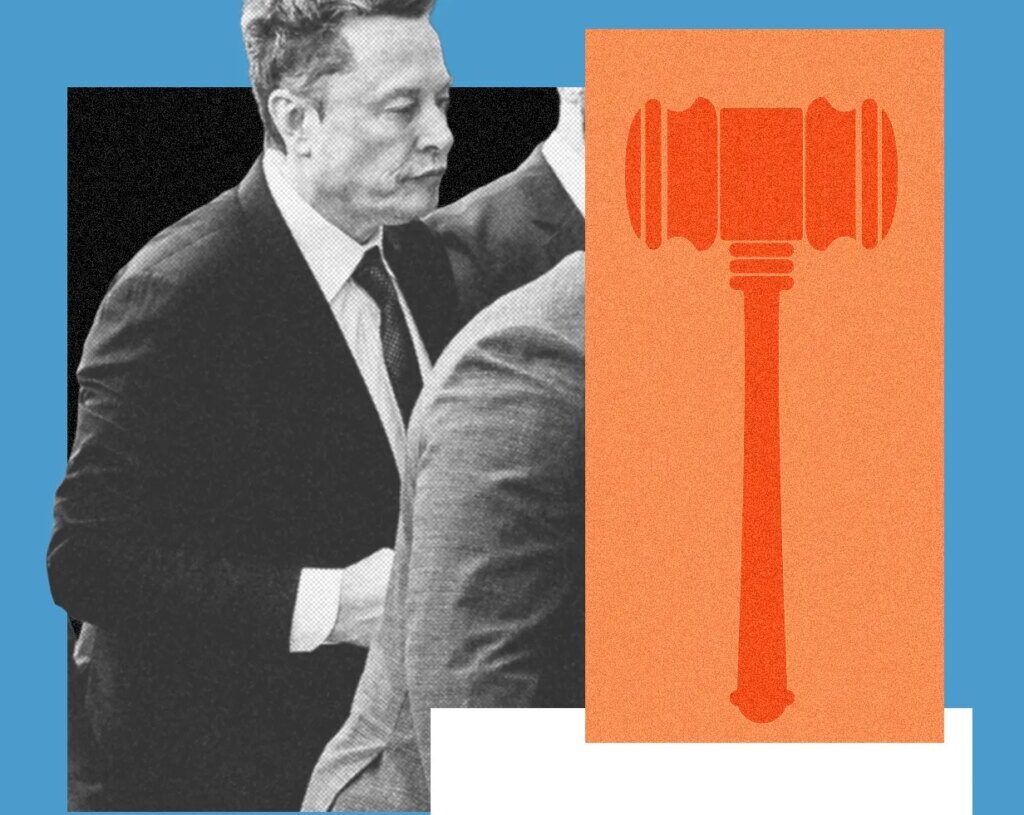
Elon Musk and Sam Altman appeared in a federal courtroom together for the first time on Tuesday as they fight over OpenAI’s decade-long evolution and what it means for the company’s future.
The trial in Musk’s lawsuit against Altman could result in financial damages and, more significantly, governance changes at OpenAI that may complicate its plans for an initial public offering as soon as this year.
As the first witness on the stand, Musk immediately sought to frame his case as more than just about OpenAI. Siding with Altman “will give license to looting every charity in America” and shake the “entire foundation of charitable giving,” Musk told a panel of nine jurors advising US District Judge Yvonne Gonzalez Rogers on how to rule.
Musk has been concerned about computers becoming smarter than people “since he was a young man in college,” his attorney Steven Molo told jurors. Molo explained that Musk lobbied governments to pass regulations addressing the prospect of so-called artificial general intelligence, including meeting with then-President Barack Obama in 2015. “But the government was not stepping up,” Molo said. “Elon felt he had to do something.”
Around the same time, Musk met with Altman, a then-30-year-old investor “whom he didn’t know very well,” Molo said. They soon launched OpenAI together as a nonprofit. Google’s unchecked progress on AI development had sparked concerns for both OpenAI cofounders, and they wanted to create a competing lab with a greater focus on safety. “My perspective is [OpenAI] exists because Larry Page called me a speciesist for being pro-humanity,” Musk said, referring to the Google cofounder. “What would be the opposite of Google? An open-source nonprofit.”
While Musk believes AI could cure diseases and generate prosperity for humanity, he also told the court that he thinks the technology could veer off into catastrophic scenarios straight out of science fiction. “It could also kill all of us … the Terminator outcome. I think we want to be in a movie … like Star Trek, not a James Cameron movie,” Musk said. (While Musk has long raised alarms about AI safety, his current firm, xAI, has been criticized by researchers at other AI labs for its “reckless” safety culture.)
As OpenAI began notching some of its own successes, Musk and Altman agreed that a for-profit arm with fixed returns for investors was necessary to raise extraordinary sums of money needed to fund hiring and computing, according to Molo. He compared it to a nonprofit museum that receives some proceeds from a for-profit store. “I was not opposed to there being a small for-profit as long as the tail didn’t wag the dog,” Musk said on the stand.
Musk felt that the approach had gone too far when Microsoft, another defendant in the trial, agreed to invest $10 billion in 2023, and OpenAI increasingly moved intellectual property and staff to the for-profit company. “The museum store sold the Picassos so they were locked up where no one could see them,” Molo said.
OpenAI’s Rebuttal
William Savitt, an attorney for OpenAI, told jurors that OpenAI never promised Musk that it would remain a nonprofit and publish all its code. “The evidence here will show what Musk says happened did not happen,” Savitt said.
He added that Musk knew about plans to raise corporate investment exceeding $10 billion as far back as 2018. Musk even raised concerns about Microsoft’s involvement in a 2020 tweet. But he didn’t file a lawsuit until he founded a competitor, xAI, in 2023.
Savitt asked the jury to invalidate Musk’s claims on the basis that the time limit for pursuing them had expired in 2021, when Musk was well aware of the issues he’s now raising. “It’s too late to gin up something to harm a competitor,” Savitt said.
In OpenAI’s telling, it was Musk who didn’t live up to promises. He had pledged to invest up to $1 billion in the startup. Instead, he delivered about $38 million over five years. And while he professed a desire to keep superintelligence out of the hands of a single organization or individual, he proposed that himself or his car company, Tesla, have control over OpenAI. “When OpenAI refused to be absorbed into Musk’s empire, he just picked up his marbles and left,” Savitt said. Musk testified he wanted temporary control to ensure advancement in the “right direction.”
In the courtroom, Musk sat among his lawyers at a table in front of the judge taking sips of water from a plastic bottle and blankly staring toward a monitor. Altman and OpenAI President Greg Brockman, a co-defendant, were about 10 feet away in the public gallery behind their attorneys, with Altman alternating between looking at the judge and down toward the floor. Altman left just before Musk testified. OpenAI didn’t immediately respond to a request for comment on his departure.
The day started with an OpenAI attorney complaining to the judge about “a barrage of tweets” posted and boosted by Musk on Monday they said were “inflammatory” and promoted “a nasty article,” apparently referring to a recent New Yorker profile questioning Altman’s character.
When the judge questioned Musk about his activity, he said that he had been responding to earlier posts from OpenAI. The judge then called for a clean slate, and Musk and Altman agreed to stand down on social media for the duration of the trial. “Try to control—all of you—your propensity to use social media to make things worse outside the courtroom,” Gonzalez Rogers said.
The trial forced Altman to miss a marketing event Amazon Web Services held with OpenAI in San Francisco on Tuesday to unveil new efforts in agentic AI development. “Sorry I couldn’t be there in person but my schedule got taken away from me,” Altman said in a video recording played to the audience.
Musk’s team repeatedly experienced problems with their wireless microphone during opening statements, bringing a moment of levity to an otherwise quiet and tense courtroom. “We are funded by the federal government,” Gonzalez Rogers said of the technical challenges, drawing laughs from the courtroom.
“Is this the Microsoft cloud?” Molo asked.
Musk will return to the stand on Wednesday, when OpenAI’s attorneys will get a chance to cross-examine him.
This is an edition of Maxwell Zeff’s Model Behavior newsletter. Read previous newsletters here.
The post Elon Musk Testifies That He Started OpenAI to Prevent a ‘Terminator Outcome’ appeared first on Wired.