The U.S. military has ramped up attacks against boats in the Caribbean Sea and eastern Pacific Ocean this month, flying more attack aircraft than ever before in its campaign to kill people the Trump administration accuses of smuggling drugs at sea, according to a U.S. military official and a person briefed on the strikes.
The latest attack on Sunday, which the Pentagon said killed three people in the eastern Pacific, was the seventh this month and 54th overall since the campaign started in September. The strikes have accelerated particularly in the past two weeks, and Sunday’s attack raised the death toll to at least 185.
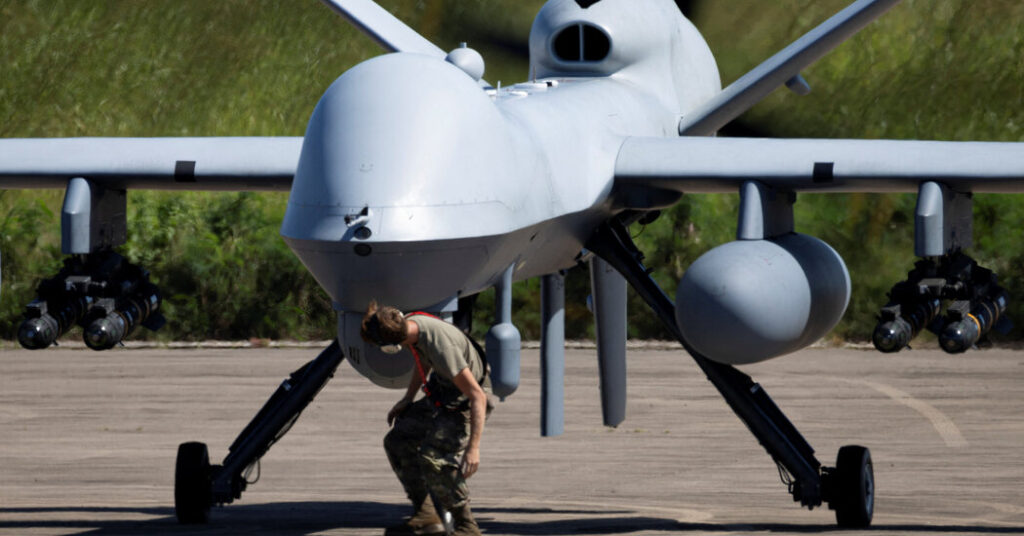
In the past few weeks, the military has without public notice increased the number of secret fixed-wing attack aircraft and armed MQ-9 Reaper drones operating from bases in El Salvador and Puerto Rico, allowing the military to accelerate the strikes, the two people said, speaking on condition of anonymity to discussion operational matters.
The precise number and type of aircraft involved remain classified — as does so much of the boat strike campaign — and the two people declined to quantify the increase in aircraft other than to say there were now sufficient planes and drones based in the Caribbean and the eastern Pacific without having to move aircraft between the two regions.
Before the increase in aircraft, a suspected drug boat might have had a 50 percent chance of evading the military, the military official said. Now that is down to about 25 percent, said the official, who declined to describe how the military determines which boats to sink and which to allow the Coast Guard to board and seize — as it has done for decades with drug traffickers.
The descriptions pointed to a military campaign that has grown larger and more lethal, even as it has receded from public consciousness, overshadowed by President Trump’s war in Iran. And they deepened questions about a campaign that many legal experts have said has been a series of illegal, extrajudicial killings.
The increased commitment of military resources to the boat strikes, even as the Iran war has drained supplies of critical munitions and equipment from commands in Europe and the Indo-Pacific, also underscores the rising prominence of the Western Hemisphere in Mr. Trump’s second term.
But the spike in deadly strikes this month comes even as Gen. Francis L. Donovan, who is overseeing the operation as the head of the military’s Southern Command, has acknowledged that the attacks are not a long-term solution to the nation’s drug problem.
General Donovan, in testimony to the Senate Armed Services Committee, said last month that the strikes had forced narco-terrorist groups in the region to change their operational patterns but added that they were not a silver bullet. “Boat strikes aren’t the answer,” he said.
The strikes carried out by the military’s elite Joint Special Operations Command with General Donovan’s approval are shrouded in secrecy.
The Trump administration says those aboard each of the blasted vessels were smuggling drugs to the United States, but it has offered little evidence to support that claim. Experts on the use of lethal force have said that the strikes are illegal, because the military cannot deliberately target civilians who do not pose an imminent threat of violence — even if they are suspected of engaging in criminal acts.
Senator Jack Reed of Rhode Island, the top Democrat on the Armed Services Committee, said on Tuesday that he had “serious concerns” about the boat strikes.
”Our service members have been ordered to strike and kill hundreds of suspected criminals in the open ocean over the past eight months, placing them in legally and ethically perilous circumstances,” Mr. Reed said in a statement at a hearing, in part, to examine Special Operations missions.
The administration has claimed the killings are lawful because Mr. Trump “determined” that the United States is in a formal armed conflict with a secret list of 24 Latin American drug cartels and criminal gangs, even though Congress has not authorized any war. A secret Justice Department memo approving the campaign is said to rely on that claim as a premise.
Neither the military nor the administration has disclosed the type of weapons used, the aircraft flying the missions, the bases used to conduct the strikes or information about the people who were killed.
Instead, in a grim recitation, the Southern Command, which oversees the operations, releases a short statement and accompanying video after each strike that shows a boat — either bobbing in the water or zooming along — bursting into flames.
In the same language statement after statement, the command says how many “narco-terrorists” were killed — so far all those cited have been men — and adds that the vessel was traveling along “known narco-trafficking routes.” The command does not provide evidence for those claims in the statements.
In November, The New York Times examined video of more than 40 strikes and consulted military aviators and weapons experts, finding that the U.S. military used a variety of munitions delivered through an operation that relied on both drones and manned aircraft in a departure from traditional stop-and-board operations.
Questions still persist about the specific aircraft the military is using.
In January, The Times reported that the Pentagon used a secret aircraft painted to look like a civilian plane in its very first attack on a boat that the Trump administration said was smuggling drugs, killing 11 people on Sept. 2. The aircraft also carried its munitions inside the fuselage, rather than visibly under its wings.
The nonmilitary appearance of the classified aircraft raised questions in closed-door briefings in Congress, according to people familiar with the matter. The issue is that if one accepts the administration’s disputed claim that a legal state of armed conflict exists, it is a war crime to feign civilian status to fool adversaries into dropping their guard so they neglect to take necessary precautions, and then to attack and kill them.
In that first attack, the aircraft swooped in low enough for the people aboard the boat to see it, according to officials who have seen or been briefed on surveillance video from the attack. The boat had turned back toward Venezuela, apparently after seeing the plane, before the first strike.
Two survivors of the initial strike later appeared to wave at the aircraft after clambering aboard an overturned piece of the hull, before the military killed them in a follow-up strike that also sank the wreckage. It is not clear what anyone on the boat thought the aircraft was, or whether the initial survivors understood that the explosion on their vessel had been caused by an attack.
The military has since switched to using recognizably military aircraft for boat strikes, including MQ-9 Reaper drones, although it is not clear whether those aircraft have flown low enough to be seen. However, in a boat attack in October, two survivors of an initial strike took evasive action — swimming away from the wreckage — and avoided being killed by a follow-up strike on the remnants of their vessel. The military rescued them and returned them to their home countries, Colombia and Ecuador.
General Donovan, a four-star Marine Corps officer with an extensive background in Special Operations missions, told lawmakers last month that since taking over the command in February, he had started building a more comprehensive approach to the counterdrug mission, working with regional allies like Ecuador.
“Boat strikes will be one of the main tools, and probably not the most effective,” he said.
Charlie Savage contributed reporting.
Eric Schmitt is a national security correspondent for The Times. He has reported on U.S. military affairs and counterterrorism for more than three decades. Contact him securely on Signal: ericschmitt.36.
The post Military Quietly Accelerates Boat Strikes, Deploying More Aircraft appeared first on New York Times.