The central premise of the federal charges filed last week against the Southern Poverty Law Center is that the storied civil rights organization defrauded its donors and betrayed its stated mission to fight hate groups by paying secret informants inside extremist networks.
On Tuesday, however, the law center pushed back firmly against the accusation that it sought to promote, not dismantle, far-right groups, asserting in court papers that information gleaned from its informants was shared at least three times with law enforcement agencies, including the F.B.I., resulting in arrests and prosecutions.
In fact, just two weeks before the Justice Department unsealed its indictment against the Southern Poverty Law Center, its lawyers met with prosecutors on the case in an effort to persuade them that the informant program, which was closed three years ago, had not been used to fund hate groups, but to hold them accountable.
During the meeting, the court papers said, the lawyers showed prosecutors evidence that the work of an S.P.L.C. informant helped the Justice Department during President Trump’s first term to secure a six-month prison term for a member of the white supremacist group Vanguard America who had lied to federal agents about his extremist ties during a background check for a security clearance.
Informants for the Southern Poverty Law Center also provided information to the F.B.I. about a member of a neo-Nazi group, the Atomwaffen Division, who had discussed attacks against Jews, gay people and others in Las Vegas and ultimately pleaded guilty to weapons charges, the court papers said. And their work formed the basis of a 45-page dossier that the S.P.L.C. gave the bureau, correctly warning that violence might erupt at the white nationalist “Unite the Right” rally in 2018 in Charlottesville, Va.
“The Department of Justice is well aware that the S.P.L.C. provided helpful information, through the use of its confidential informants, to law enforcement,” the papers said. “The Department of Justice also knows that these confidential informants helped law enforcement put violent extremists in jail.”
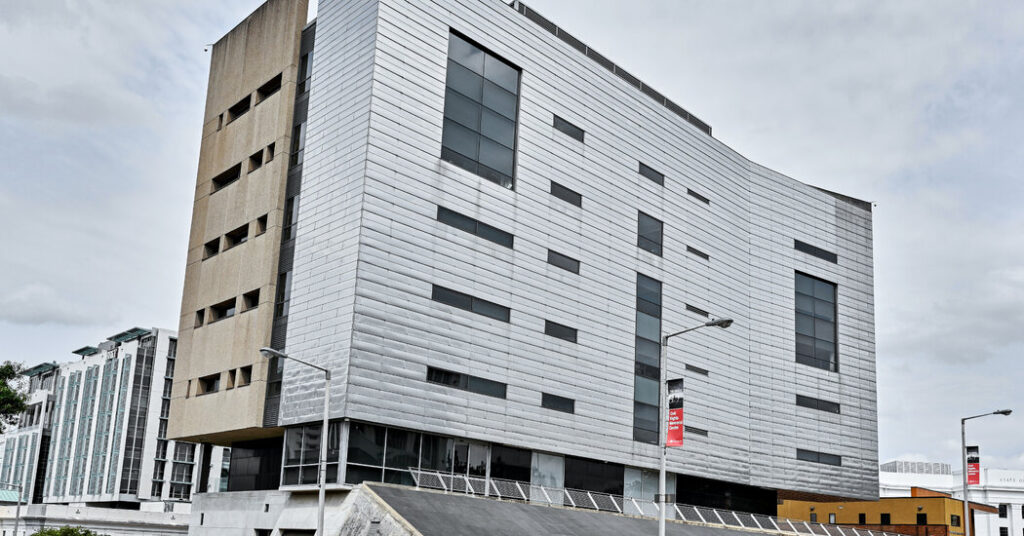
The two sets of papers, filed in Federal District Court in Montgomery, Ala., were the law center’s first legal response to the 11-count indictment charging it with wire fraud, lying to banks and a conspiracy to commit money laundering.
One of the filings asked Judge Emily C. Marks, who is handling the case, to bar prosecutors from making any false or misleading statements about the charges that could prejudice potential jurors. The other asked Judge Marks to allow defense lawyers to see the sealed grand jury proceedings in the case in an effort to determine whether prosecutors misled the panel that voted to return the indictment.
Both requests could face an uphill battle with Judge Marks, who was appointed by Mr. Trump. But taken together, they suggested that the S.P.L.C. was planning to mount a vigorous defense and would challenge not only the structure of the charges it is facing, but also the larger story of deceit and hypocrisy the Trump administration has been telling about the case.
In one of the filings, the law center’s lawyers accused Todd Blanche, the acting attorney general, of falsely stating that the Justice Department was unaware that information gleaned from the group’s informants had been shared with the government.
“There’s no information that we have that suggests that the money they were paying to these informants and these members of these organizations, they then turned around and shared what they learned with law enforcement,” Mr. Blanche said on Fox News on the evening the indictment was returned. “To the contrary, or else we would have known, from their own words, that they had given this money to these guys. And we didn’t know.”
But the law center’s legal team, led by Abbe Lowell, who is fighting the Trump administration in several politically tinged cases, said that statement was untrue, pointing to the meeting that defense lawyers had on April 6 with Kevin P. Davidson, the acting U.S. attorney for the Middle District of Alabama. The lawyers say that they also sent Mr. Davidson a letter one day after the indictment was released detailing how Mr. Blanche’s remarks were incorrect, but the government refused to retract or clarify them.
Mr. Blanche was not the only administration official who has made what the papers claimed were “false factual assertions” about the Southern Poverty Law Center and its informant program. Several Trump officials have overstated the accusations in the indictment, suggesting that the $3 million the S.P.L.C. is said to have paid its informants in recent years was tantamount to underwriting almost the entire far-right movement in the United States.
The papers pointed out that Karoline Leavitt, the White House press secretary, baselessly claimed that the indictment showed the Charlottesville rally was a “hoax” perpetrated to discredit Mr. Trump. Kash Patel, the F.B.I. director, has said that the S.P.L.C. engaged in “the ultimate hypocrisy” by funding hate groups they were supposed to be fighting.
And during a recent interview on “60 Minutes,” Mr. Trump himself asserted that “Charlottesville was all funded” by the Southern Poverty Law Center, adding without evidence that the violent rally, at which a young protester was fatally run over by a white supremacist’s car, was “part of the rigging of the election.”
The S.P.L.C. was formed in 1971 in Alabama and is best known for investigating groups like the Ku Klux Klan and other white supremacy organizations. In recent years, Republicans have accused the group of unfairly targeting more mainstream conservative and Christian organizations, labeling them as extremists.
In October, Mr. Patel announced that the F.B.I. was severing its ties with the law center, claiming that it “long ago abandoned civil rights work and turned into a partisan smear machine.” Around the same time, Mr. Patel also cut the bureau’s ties with the Anti-Defamation League, a group that fights antisemitism.
The court papers filed on Tuesday indicate that lawyers for the S.P.L.C. tried several times to persuade the Justice Department that the basic accusations in their case were incorrect.
Days before the indictment was unsealed, the group gave prosecutors 15,000 pages of records about its informant program in response to a grand jury subpoena. Defense lawyers claimed in their papers that the information they handed over to the government was not reflected in the charges that were ultimately filed.
For that reason, among others, they want Judge Marks to break the traditional secrecy of the grand jury process and give them access to transcripts of what took place behind closed doors. The lawyers wrote that they want the material because there are indications “that the grand jury was not merely misled by the government’s presentation of the law, but likely that it was actively weaponized to facilitate such charges.”
Requests for grand jury transcripts are rarely successful, but they have been made more and more as the Justice Department under Mr. Trump has pushed the boundaries of normal criminal procedure in an effort to satisfy the president’s demands to bring charges against those he perceives to be his enemies.
In November, a federal magistrate judge in Virginia agreed to give defense lawyers for James B. Comey, the former F.B.I. director, all of the grand jury materials used to indict him on charges of lying to Congress. The magistrate judge, William E. Fitzpatrick, ruled that the inexperienced prosecutor picked by Mr. Trump to oversee the matter had made a series of unusual errors in front of the grand jurors.
The magistrate judge raised the issue of whether the charges against Mr. Comey would have to be thrown out because of “government misconduct.” But the case was ultimately dismissed by another judge for another reason: because Lindsey Halligan, the prosecutor who filed the case, had been improperly in her job.
Alan Feuer covers extremism and political violence for The Times, focusing on the criminal cases involving the Jan. 6 attack on the Capitol and against former President Donald J. Trump.
The post F.B.I. Knew Civil Rights Group Informants Helped Bring Down Extremists, Lawyers Say appeared first on New York Times.