Justice Department officials late Monday asked a federal judge to lift his order halting President Donald Trump’s planned $400 million ballroom, contending that Saturday’s attack at the White House correspondents’ dinner proved why the space is needed.
“After the Saturday night attempted assassination, which could have never taken place in the new facility, reasonable minds can no longer differ — The injunction must be dissolved,” acting attorney general Todd Blanche and two other top Justice Department lawyers wrote in the filing to U.S. District Judge Richard Leon, who ordered a halt to aboveground construction on the project.
The Justice Department’s motion — which is unusually written for a government legal filing and resembles Trump’s Truth Social posts — was one of several documents filed to the court late Monday night. The motion also criticizes the National Trust for Historic Preservation, the nonprofit that brought the lawsuit, writing that the group’s “name is FAKE” and claiming that “they suffer from Trump Derangement Syndrome, commonly referred to as TDS.”
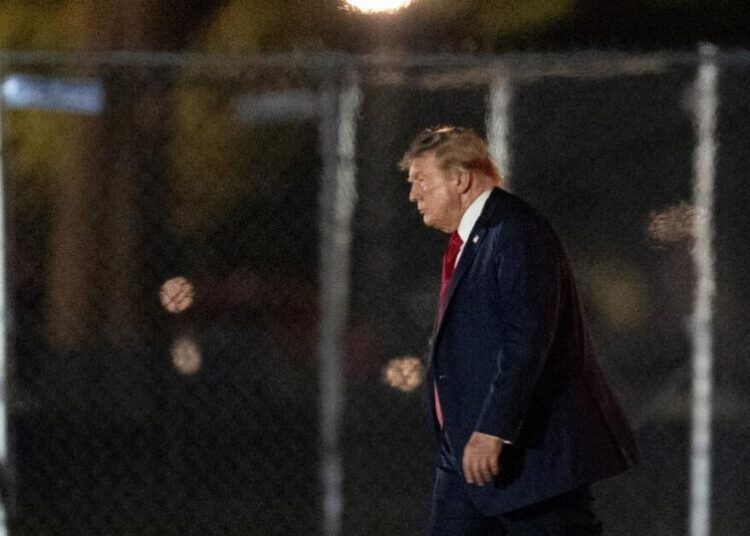
Trump has stepped up his efforts to build the ballroom in recent days, claiming in public remarks and on social media that such a facility would have prevented a would-be shooter from getting close to him. Cole Tomas Allen, of Torrance, California, was charged Monday with attempting to assassinate Trump. He is accused of charging a security checkpoint leading to the gala with a shotgun and a pistol.
The National Trust on Monday said that it would not drop its lawsuit, contending that its challenge is focused on whether the president has the executive authority to unilaterally demolish parts of the White House and build new facilities, and not related to national security. It also noted that the group had consistently called for any court injunction to allow continued construction of any underground bunker.
It is not clear whether the White House Correspondents’ Association, a private organization, would seek to hold its annual celebration in the White House ballroom.
Leon, an appointee of President George W. Bush, last month paused construction on the ballroom until Trump secures congressional authorization for his plan, making an exception for work “strictly necessary” to ensure White House security. Trump argued that the judge’s exception covered the full project; Leon disagreed and ordered a halt to aboveground construction. An appeals court stayed Leon’s order while it considers the case.
Other Trump administration officials offered support for the president’s project on Monday.
Matthew Quinn, deputy director of the Secret Service, laid out the case to build the ballroom in his own late-night legal filing, citing Saturday’s incident. The ballroom “is a key component of providing a secure environment for the President to fulfill his duties,” Quinn wrote.
Stanley Woodward, the No. 3 official in the Justice Department, is now representing the administration in the case, according to another late-night filing.
Trump has prioritized the ballroom for months, sometimes mentioning the project more frequently than other major policy priorities. But his efforts have ramped up since Saturday’s incident, and a growing number of GOP lawmakers and allies are now touting the need for a secure space, too.
Trump has also repeatedly mocked Leon and his ruling, calling him a “Trump Hating Judge” in social media posts.
The post DOJ cites attack, ‘Trump Derangement Syndrome’ in seeking ballroom approval appeared first on Washington Post.