The shots were heard just as the salad course was wrapping up. People ducked under table after table, taking cover as it became clearer that the noise, which President Donald Trump later said he initially misinterpreted, was not that of a clattering tray. The ballroom hosting the White House correspondents’ dinner — attended by more than 2,000 of Washington’s most visible journalists and politicians — fell silent.
Soon, the blocks surrounding the Washington Hilton were cordoned off with yellow tape as one of the city’s most distinguished venues became, again, a crime scene. Just as it was 45 years earlier, when a different president came under threat and a different suspect was pinned to the ground.
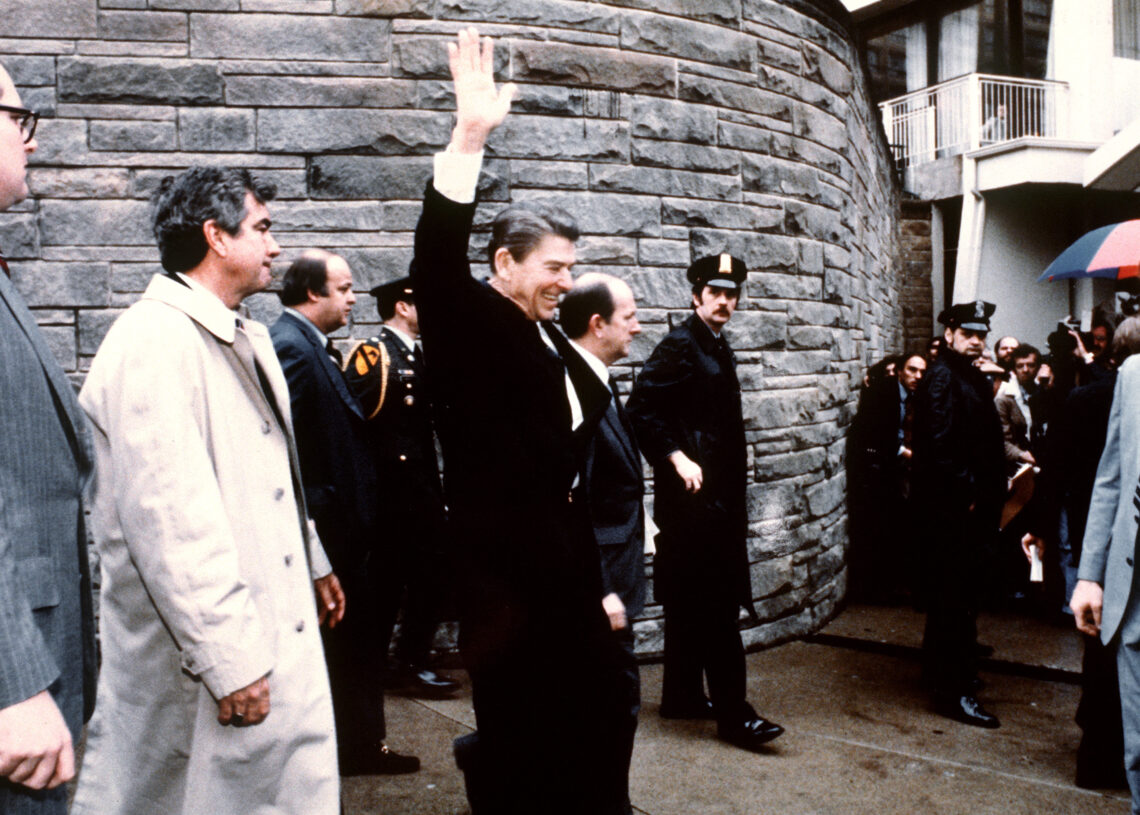
At 2:25 p.m. on a rainy late March day in 1981, President Ronald Reagan emerged from a side door at the Washington Hilton wearing a blue suit. He had just given a speech to the AFL-CIO, appealing for support for his economic programs and lamenting an increase in violent crime that was “making neighborhood streets unsafe and families fearful in their homes.” It was 69 days into his presidency, and it was routine business — until it wasn’t.
A crowd of more than 100 people watched the president wave as he headed toward his armored limousine. Print and television journalists captured his departure. An Associated Press reporter began to ask a question.
“Mr. President —.”
Pop. Pop. Pop. Pop. Pop. Pop.
In 1.7 seconds, six bullets shot out from the end of a blue steel revolver. There was a slight pause between the second and third shots, The Washington Post reported a day later in a front-page piece headlined, “The Shooting.” A woman screamed. A Secret Service agent yelled: “Get back. Get back.”
Other agents immobilized a blond man holding a handgun against the wall of the hotel. Reagan stood “transfixed,” according to The Post. “The smile just sort of washed off his face,” a witness said.
The Washington Hilton is in a prime location in the nation’s capital. Three years after it opened in 1965, it attracted the White House Correspondents’ Association dinner, which has taken over the 36,000-square-foot ballroom every year since.
But the hotel, partly owned since 2007 by NBA great Earvin “Magic” Johnson, has also accommodated concerts by the Doors and Jimi Hendrix, a drag gala (in the ’60s!) and the annual National Prayer Breakfast. It has played host to Howard University homecoming events, libertarian conventions and an annual dog swim to close out its pool season. An uncountable number of tweens on school trips have made it their temporary home base.
Its wall of presidential portraits was the inspiration, Trump said in August, for his Presidential Walk of Fame in the West Wing. The night before the correspondents’ dinner on Saturday, protesters projected a montage tying Trump to late convicted sex offender Jeffrey Epstein on the side of the hotel.
The hotel, situated between the neighborhoods of Kalorama and Adams Morgan, caters both to people with power and wealth and families visiting college students for Parents’ Weekend.
On Saturday night, attendees in tuxedos and ball gowns began scrambling for an understanding of what had occurred. Journalists interviewed one another. Some gathered on street corners beyond police lines. A suspect, identified as 31-year-old Cole Tomas Allen, was taken into custody, and Trump was escorted by Secret Service agents back to the White House.
Before the attempt on Reagan’s life, the hotel had prepared for presidential appearances. It opened just 16 months after the assassination of President John F. Kennedy, with a special feature: a secure entrance for high-powered officials and their security teams. The secret passage leads from the main ballroom to the door from which Reagan emerged moments before the assassination attempt.
The man whom agents pinned to the hotel’s exterior wall, and soon shoved to the ground, was John Hinckley Jr. His attack caught four men in the crossfire, including press secretary James Brady, who lived despite the bullet that pierced above his left eye. “Blood dripped from his head across the grate and down the sidewalk toward the hotel entrance,” The Post wrote at the time.
Reagan survived with a bullet puncture to his lung. “You’re ruining my suit,” he told the medics trying to reach his wound, according to Lyn Nofziger, assistant to the president for political affairs. “Honey, I forgot to duck,” he later told his wife, Nancy. He returned to the White House after 12 days in the hospital.
The assassination attempt contributed to Reagan’s popularity, skyrocketing his approval rating to 70 percent. Hinckley was found not guilty by reason of insanity. Experts determined he had schizophrenia and an obsessive belief that killing the president would attract the affection of actress Jodie Foster. He was confined to St. Elizabeths Hospital in D.C. until his release into his mother’s care in 2016 — a decision that Reagan’s daughter Patti Davis wrote in The Post “sickened” her. She discussed an interview she conducted with Hinckley’s attorney, Barry Levine, in 2000.
“The pope forgave the man who shot him,” Levine told her.
“That’s why he’s the pope and I’m not,” she responded.
On Saturday, reporters and politicians were not permitted to go back into the ballroom to retrieve coats, cellphones and other belongings — which had become part of the active crime scene.
In 1981, The Post wrote of an object left behind:
“Two hours after the shooting, the laboratory van from the FBI was at the scene, the crowds were still milling around, the rain was pouring down. A buttoned umbrella that may have belonged to one of the wounded was lying in the gutter, untouched. The rain by then had washed away the blood which had spotted the sidewalk where Brady fell.”
At a White House news conference after the Saturday shooting, Trump spoke of the need for a new location for gatherings to come — the planned East Wing ballroom the president has increasingly discussed.
“We looked at all of the conditions that took place tonight, and I will say, that’s not a particularly secure building, and I didn’t want to say this, but this is why we have to have all of the attributes of what we’re planning at the White House,” he said. “It’s actually a larger room, and it’s much more secure. It’s got bulletproof glass. We need the ballroom. That’s why the Secret Service, that’s why the military are demanding it.”
He spoke from a briefing room named after Brady, who died in 2014 of complications from the head wound he received the last time a shooting occurred near a president at the Washington Hilton.
The post Before Trump, a different president faced a threat at the Washington Hilton appeared first on Washington Post.