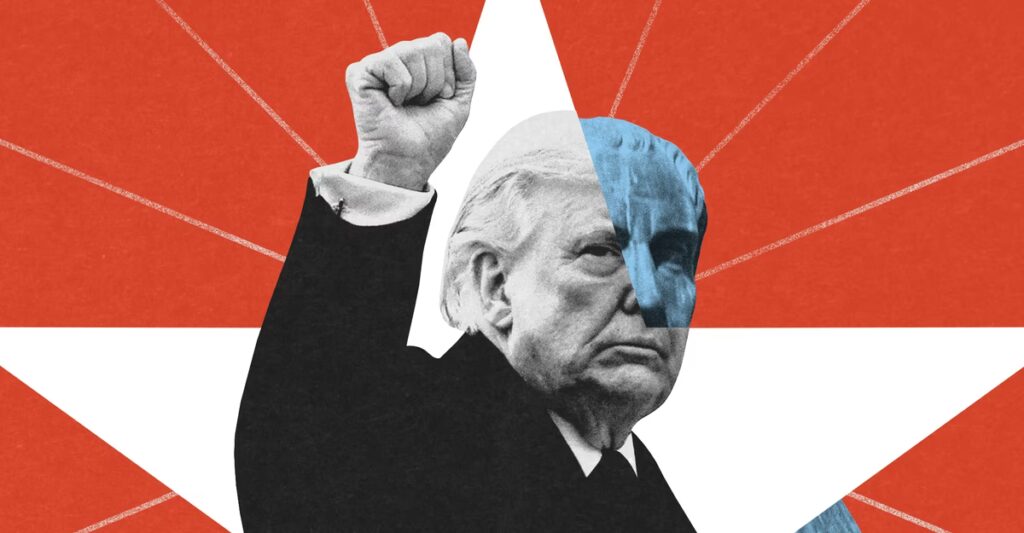
Julius Caesar styled himself as a servant of the republic, claiming to speak for the people even as he disregarded laws and norms to govern by caprice. The Roman republic did not survive him.
The second Trump administration has revealed American Caesarism in nearly full bloom. Despite ambitions to fundamentally change the course of the country, this administration has no real legislative agenda. Instead, the president governs by executive orders, emergency decrees, and extortionate transactions, using his power to reward his friends and punish his enemies. He’s launched foreign military adventures and full-blown wars seemingly based on personal whim, and has made the military a political prop and a tool for domestic law enforcement. With Congress sidelined and the courts reluctant to check Donald Trump’s excesses, America has been left with what some legal scholars have described as an “executive unbound”—and with a president who threatens to supplant the republic in all but name.
Trump’s most fervent supporters justify his approach in terms reminiscent of Caesar’s. The White House Deputy Chief of Staff Stephen Miller has remarked that “the whole will of democracy is imbued into the elected president.” Many Republicans argue that Trump’s policy preferences deserve support because he has a “mandate,” and they heap scorn on the “unelected” judges who have had the temerity to rule against him.
[Peter M. Shane: This is the presidency John Roberts has built]
This is not American democracy. The central premise of the Constitution is that liberty requires divided authority. The accumulation of power in one branch of government is, as James Madison warned, “the very definition of tyranny.” Americans are already feeling the consequences of this imbalance: Because executive orders, emergency declarations, and unilateral action lack the durability of legislation passed by Congress, policies swing wildly from one administration to the next. Families and businesses cannot plan ahead, which undermines investment, growth, and prosperity.
American Caesarism did not emerge overnight with the election of Trump, but over the course of decades. And though conservatives alone did not create this state of affairs, many were key proponents of a vision of politics centered on one commanding figure—a vision that is now destabilizing our country. I have spent my career in the conservative legal movement, which has included advising Senate Republicans on judicial nominations. I have become convinced that if the Madisonian republic is to endure, conservatives must reckon with our role in bringing the nation to its current breaking point, and work to reestablish the checks and balances that we helped erode.
For much of American history, conservatives were the nation’s fiercest skeptics of executive power, warning that a swelling presidency could threaten liberty by displacing the authority of Congress and the courts. By the 1970s, a rise in what conservatives saw as judicial activism had shifted their focus to overreach by the courts. To those on the right, the Supreme Court’s decision in Roe v. Wade was emblematic of a Court operating far beyond the bounds of the Constitution to usurp policy making. The courts of the era also reshaped criminal law, ordered busing to desegregate schools, redefined the relationship between church and state, and even waded into tax-and-spending issues. Convinced the judiciary had slipped its constitutional leash, the conservative legal movement dedicated itself to preventing what it called “legislating from the bench,” through scholarship, advocacy, and organizing.
But this focus on reforming the judiciary, combined with the politics of the period, meant that comparatively little attention was paid to the other two branches of government—and, in particular, to the slide toward rule by presidential fiat. Many of the leaders of the modern conservative legal movement had served in Republican administrations and had lived their entire lives against a backdrop of seemingly unbreakable Democratic control of Congress. (The future judicial superstars William Rehnquist, Robert Bork, and Antonin Scalia all held senior legal roles in the Nixon and Ford administrations.) In the 1970s, they saw the presidency humbled by the Watergate scandal and subsequent reforms. To a conservative of this era, the presidency must have seemed the only viable instrument of policy making, and its relative weakness a cause for concern.
Over time, sympathy for executive authority hardened into theory, and the legal movement once known for “strict construction” of the Constitution found a great deal of elasticity in it. Some began to advance the view that Article II, which vests “executive power” in the president, gave him any authority not expressly limited by the Constitution. The duty to “take Care that the Laws be faithfully executed” came to be seen not as a restriction on the president’s policy making but as a grant of leeway to reinterpret the law. Most important, many conservatives came to believe that the president’s role as “commander in chief” gave him sweeping, unilateral authority in matters of national security—a view that has significant implications in a nation perennially on a war footing, including against non-state actors.
During the Reagan administration, conservative legal thinkers also embraced the “unitary executive theory,” which asserts the president’s sole control over the executive branch. In the past few years, this theory, reasonable at its core, has gained traction in the courts. The Supreme Court seems poised to allow Trump’s removal of a member of the Federal Trade Commission, which could set the stage for broader, more dubious rulings. The most extreme interpretations of this theory could allow the president to fire any federal employee at will, ignore civil-service protections, and eliminate the independence of the Federal Reserve.
While legal conservatives were developing theories of enhanced executive power, their political compatriots gained a congressional majority for the first time in decades. The new Republican majority, distrustful of Congress after decades of liberal control, undertook “reforms” that undermined the power of the institution. They slashed congressional staff (particularly nonpartisan and expert staff), weakened committees, and imposed term limits on committee chairmen, eroding important points of leverage over the executive branch.
By the 1990s, the courts were changing too. The new generation of conservative judges, intent on reining in the judiciary, empowered the executive. They embraced doctrines that instructed courts to defer to the administrative agencies’ interpretation of their own authority, and others that tended to insulate the executive from meaningful judicial review. (The “presumption of regularity,” for instance, assumes that the president and his agents act in good faith.) Courts also tended to uncritically accept presidential determinations in matters of foreign affairs and national security.
The conservative bench’s focus on preventing a weak presidency arguably reached its zenith in 2024 with the Supreme Court’s decision in Trump v. United States, which concerned Trump’s potential criminal liability for his role in the January 6 attack on the Capitol. The majority, rather than being rattled by a president who had attempted a coup, labored to protect the country from the hypothetical danger of a presidency rendered impotent by specious criminal prosecutions. Never mind that if such a future materialized, Congress or the Court could resolve it. Instead, breaking with foundational conservative legal principles, the majority created sweeping presidential immunity out of whole cloth.
In recent years, the Supreme Court has shown signs of being open to another path, ruling against the administrative state in several major cases. However, the judiciary remains less willing to confront executive overreach outside of the regulatory context, especially in matters of purported national security. Conservative judges, in particular, continue to indulge presidential power at the expense of Congress.
Last year, an appellate court overturned the president’s invocation of wartime authorities to expedite the deportation of Venezuelans on the sensible grounds that Venezuela was not, in fact, invading the United States. A conservative judge dissented, writing that “the President’s declaration of an invasion, insurrection, or incursion is conclusive. Final. And completely beyond the second-guessing powers of unelected federal judges.” This type of deference to the executive, which relies on presidential good faith, now amounts to judicial abdication.
Similarly, the recent decision striking down Trump’s tariffs relied solely on the determination that the emergency authority at issue does not authorize tariffs. The justices did not wrestle with the president’s invocation of a national emergency to impose his policy agenda, nor did they say that Congress could not hand such legislative powers over to the president in the first place. Even still, with this modest holding, three conservative justices dissented. Justice Clarence Thomas, a favorite of conservatives, wrote separately to argue that Congress could give any of its powers to the president, so long as they were not “core legislative powers.”
If America is to preserve its liberty, conservative legal scholars and judges will need to adjust to a new reality and revisit doctrines that no longer serve to protect the constitutional structure. Some conservatives have already begun moving in this direction. In its recent rulings ending deference to the administrative state, the Court explicitly abandoned the stance of an earlier generation of conservatives. The lawsuit challenging Trump’s tariffs was brought by veterans of the conservative and right-of-center legal movements, who argued that the president had exceeded his authority. These are promising developments—but we need to go further.
Courts should refuse to read broadly any executive power not firmly tethered to the language of the Constitution, and reject clearly pretextual claims of national emergencies. They might, as the conservative legal scholar Yuval Levin has suggested, adopt a doctrine that resolves ambiguous legal questions in favor of republican government, which would mean pushing policy disputes to the legislature rather than the executive.
The Supreme Court should also look with more scrutiny at the White House’s use of the “emergency docket” (or “shadow docket”), whereby the Court issues interim rulings on urgent cases. The Trump administration has filed dozens of emergency requests to freeze adverse lower-court rulings while litigation continues. The Court’s tendency to side with the White House in such cases, if only temporarily, has allowed serious constitutional harm to continue, and has, in some cases, done irreparable damage. This seeming deference to executive interests is particularly difficult to justify in an administration willing to flout court orders.
[Yuval Levin: The missing branch]
Courts cannot restrain the executive alone; they have too narrow a function and work too slowly. Congress must rediscover its role—and conservatives who wish to preserve our original constitutional structure can help make this a reality by supporting expanded funding for the legislative branch and championing rules reforms to make Congress more effective. Another step would be to establish a congressional version of the Justice Department’s Office of Legal Counsel. The OLC issues opinions that, though not law, guide executive-branch behavior and influence both the judiciary and the public’s understanding of contested legal questions. A well-funded congressional office of legal counsel could weigh in on such questions as well, so that executive-branch lawyers would not be the only ones assessing the bounds of executive power on behalf of the government.
Legislation to rein in our “unbound” executive should be a priority. Obvious first steps would include strengthening the enforceability of congressional subpoenas, protecting against politicized law enforcement, and limiting the president’s emergency powers and ability to profit from his service. America could also recover its capacity to amend the Constitution and use that power to pare back the presidency. A prime target would be the presidential pardon, a vestige of monarchy that has become a source of scandal and corruption.
The conservative legal movement once transformed the national conversation about the courts. It can do the same with executive power—but only if it is willing to redirect its intellectual and advocacy efforts in that direction. If conservatives truly believe in ordered liberty, constitutional limits, and the rule of law, then the task ahead is clear: We must help check Caesar. Not for the sake of any party, but for the sake of the republic.
The post Conservatives Need to Fight the Legal Monster They Helped Create appeared first on The Atlantic.