In the shadowy global gold industry, where terrorists, drug dealers and dictators launder illegally mined gold into the mainstream market, one major supplier says buyers can count on its product to be clean and ethically sourced.
The Royal Canadian Mint says it can trace all of its gold back to its origins, with cutting-edge technologies including a Bitcoin-like software it calls Bullion Genesis. The Mint, which is backed by the Canadian government, assures buyers that it does not refine gold linked to “illegitimate nonstate armed groups.”
“It’s all North American, predominantly Canada,” the Mint’s refining chief, Rob Sargent, said in an interview.
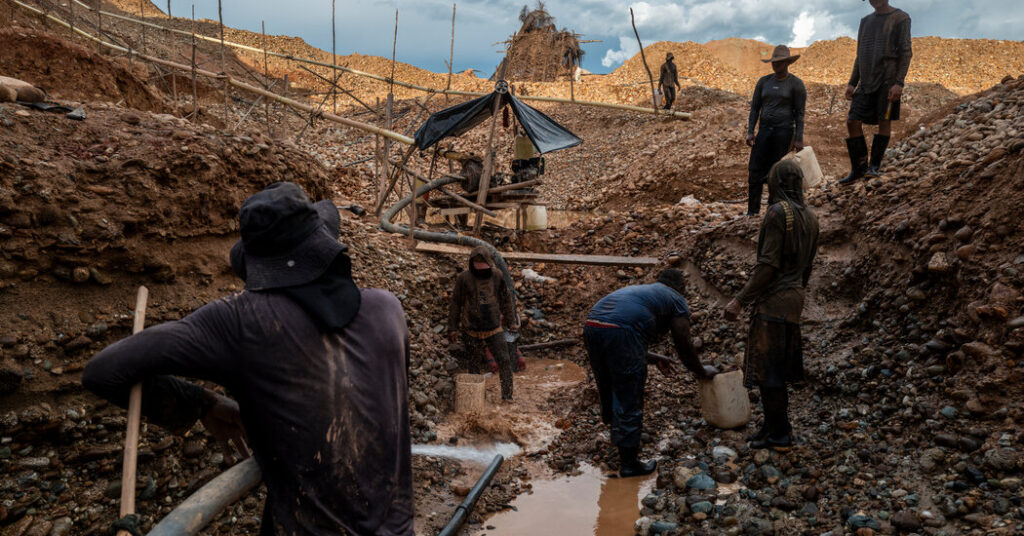
But what the Canadians call North American includes gold from a swirl of faraway sources — including Colombian mines controlled by the Clan del Golfo drug cartel.
A New York Times investigation recently showed that Canada’s counterpart in Washington, the United States Mint, has been buying gold that originated in a cartel mine.
But unlike the Americans, who have gone decades without tracking their gold supplies, the Canadians have known that they were getting it from a country where cocaine trafficking, paramilitary violence and the gold trade are intertwined.
Yet they continued to call it North American gold.
They did so, officials explained, because before the Colombian gold arrives in Canada, a Texas intermediary mixes it with American gold. In the Mint’s eyes, the resulting mix is entirely North American.
This fiction, and the fact that perpetuating it is completely legal, is an example of how even the world’s most credible dealers allow tainted gold into the mainstream market.
This isn’t just a matter of branding. Since they’re treating the gold as North American, the Canadians argue, they are not required to thoroughly investigate whether the gold was legally mined.
Instead, its general counsel, Andrea Kniewasser, explained, the Mint has relied on the due diligence of its Texas supplier. “We make sure they have an audit that is valid,” she said.
That audit identifies Colombia as a gold source for the supplier. In particular, it identifies the Antioquia region, where the Clan del Golfo cartel has well documented ties to the gold trade. But the Royal Canadian Mint did not ask for more detailed information. “It’s not our responsibility,” Ms. Kniewasser said.
Such follow-up inquiries, known as “enhanced due diligence,” are an important way for the industry to keep terrorists, drug dealers and polluters from selling gold on the legitimate market, said David Soud, an investigator with the firm Auxilium Worldwide who specializes in tracing illicit gold.
“If a refiner as prestigious as the Royal Canadian Mint is not undertaking meaningful, enhanced due diligence on mixed-origin, recycled and mined gold, then what does that suggest about the gold supply chain as a whole?” Mr. Soud said.
The industry’s major players assure the public that they keep illegally mined gold out of their supplies. But those assurances sometimes rely on head-spinning interpretations — like saying that Colombian gold is North American.
The provenance of gold matters. With prices at nearly $5,000 an ounce, it is more profitable than ever to illegally slash rainforests, pollute rivers and violently enforce claims to territory.
Ms. Kniewasser said the Mint had no idea that it was refining cartel-linked gold until it was notified by The Times. The Texas supplier provided 5 percent of the raw gold the Mint refined last year, she said. The Mint said has stopped accepting Colombian gold while it investigates.
As for the branding, she said that calling the gold North American was permissible under industry guidelines. She also said that guidance from the Organization for Economic Cooperation and Development allowed the Mint to rely on the supplier’s own due diligence.
The O.E.C.D. disagrees.
Louis Marechal, the group’s senior adviser on minerals, said refiners like the Royal Canadian Mint should “check on how the mined gold was produced to ensure it didn’t fund armed groups or human rights violations.”
“Not implementing these checks,” he wrote in an email, “would significantly deviate from both the letter and spirit of the guidance.”
Ms. Kniewasser said the Mint was changing its disclosure policies. Soon, she said, it will begin publishing a list of countries where its gold originates.
She added that the Mint was carrying out an “incident review” based on The Times’s findings.
But the stakes are low in the gold industry. Even if the Mint did not follow the guidelines, it would face no legal consequences.
Justin Scheck is a London-based reporter for The Times.
The post Canada Says Its Gold Is Traceable and Clean. So We Traced It. appeared first on New York Times.