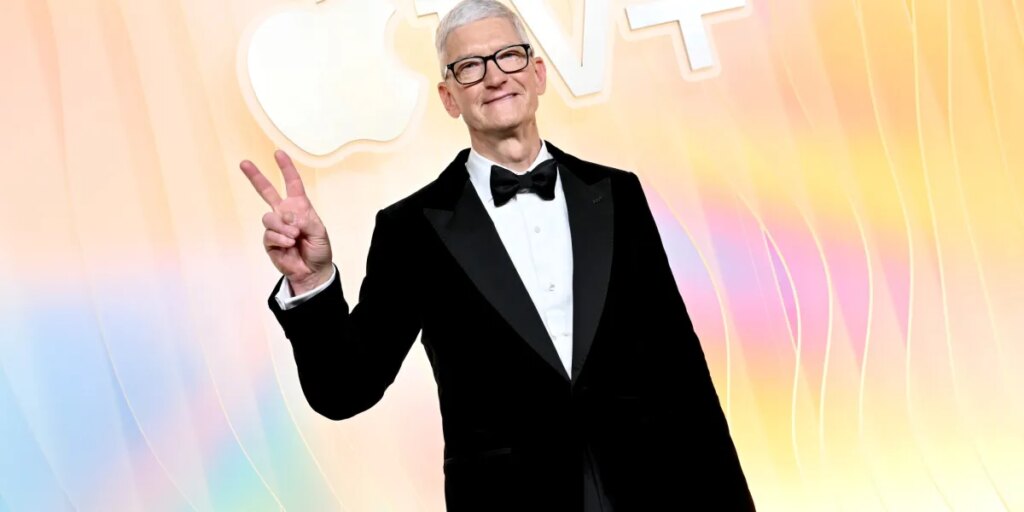
It’s been quite a run for Tim Cook. During his 15 years as the head of Apple, Cook grew the company’s market cap from $350 billion to $4 trillion and cemented its status as one of the most dominant and trusted brands on the planet. Few would dispute that his tenure has been a smashing success. Still, for those of us who knew Apple in the Steve Jobs era, it’s hard to look at the Cook era without wondering what could have been.
Unlike Jobs, Cook was not a visionary but an operator. His success lay in building out Apple’s fledgling services division into a $110 billion juggernaut and making the golden handcuffs it clasps around consumers ever tighter. What he didn’t do was build products. Yes, there were hits in the form of the Apple Watch and AirPods, but their genesis largely predated Cook. At the same time, Cook’s foray into cars became a road to nowhere, and his Apple Vision project proved an expensive flop. As for AI under Cook, the company’s efforts can be summed up by the hot mess that is Siri. Finally, there is crypto and blockchain—where Apple is nowhere at all.
Yes, Apple is not a blockchain-native company and no one expected Tim Cook to turn his attention from iPhones to Bitcoin. Still, look at other prominent Silicon Valley CEOs like Meta’s Mark Zuckerberg, who made a bold but ill-timed early bet on stablecoins, or Elon Musk, who has experimented with crypto at X and Tesla. Jack Dorsey, meanwhile, leaned into blockchain so hard he changed the name of his payments company from Square to Block.
It’s no coincidence all three of these CEOs are founders, who enjoy a level of autonomy to pursue bold visions that non-founder chief executives do not. For his part, Cook revealed in 2021 he owned crypto, but said he would not be adding any to his company’s balance sheet—as Musk and Dorsey had done—on the grounds that investors did not buy Apple shares in order to gain exposure to Bitcoin, Ethereum, or other cryptocurrencies.
Fair enough. Still, there’s so much Cook could have done on the product front with digital assets. During his tenure, his company became a massive player in payments and banking, notably with Apple Wallet and the Apple Card, and was ideally poised to make a move on stablecoins or non-custodial wallets. These would have been a natural fit given Apple’s well-earned reputation for privacy and hardware. In an alternative reality where Jobs still ran the company, it’s not crazy to imagine Apple today competing with the likes of Ledger in the field of crypto hardware wallets—either with an iPhone integration or a standalone device.
It remains to be seen if anything will change under Cook’s successor, John Ternus, who has a reputation as a decisive, product-first executive. Ternus hasn’t taken a public position of any sort on crypto, but, unlike the 65-year-old Cook, he rose to senior management at a time when Bitcoin and blockchain began to enter the Silicon Valley mainstream.
On a broader level, the power of crypto lies in its decentralized nature, and its success has never been—or should be—tied to a giant corporation. Still, it’s fun to imagine a world where Ternus or another future CEO stands up an Apple Crypto unit.
Jeff John Roberts [email protected] @jeffjohnroberts
The post Apple’s longtime CEO sat out the crypto revolution. His successor should choose a different path appeared first on Fortune.