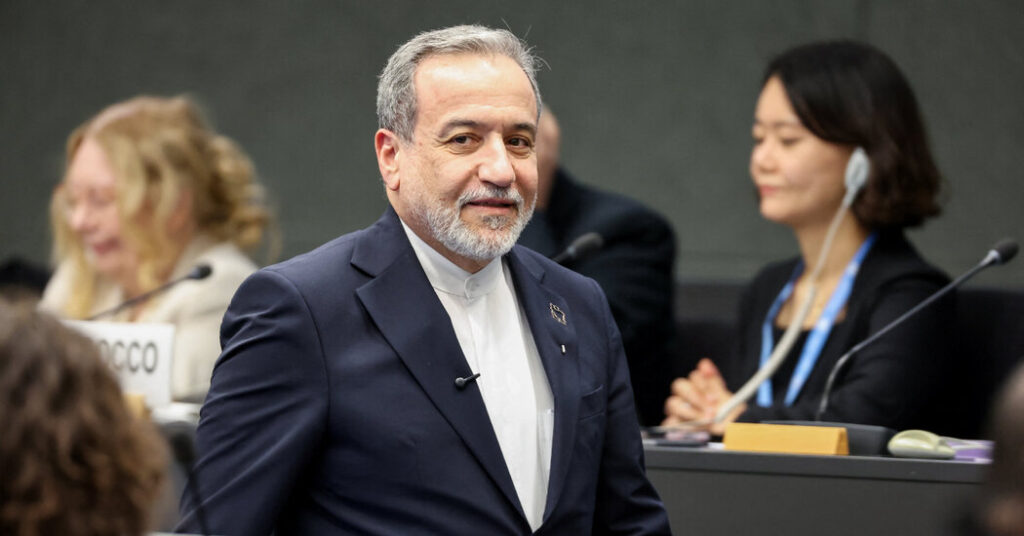
Iran’s foreign minister, Abbas Araghchi, arrived in Russia on Monday for talks with President Vladimir V. Putin on Iran’s war with the United States, as negotiations between Tehran and Washington to end the conflict appear to have stalled.
Mr. Araghchi said after he landed in St. Petersburg that he intended to discuss the war with Mr. Putin and other officials and conduct “necessary coordination,” according to Iranian state media. He traveled to Russia following stops in recent days in Pakistan and Oman, which have acted as mediators between the United States and Iran.
Russia is a key ally of Iran but has sought to avoid becoming entangled in the conflict, analysts say, as Mr. Putin hopes that President Trump will press Ukraine to accept a peace deal favorable to Moscow. Russia has also tried to maintain strong ties with Israel and the Persian Gulf countries that Iran has attacked in response to the U.S. and Israeli military offensive that began in late February.
Mr. Aragchi blamed the United States for the breakdown in negotiations to end a war that has killed thousands of people and roiled the global economy. Iran has blocked most shipping through the Strait of Hormuz in the Persian Gulf, a crucial transit route for oil and gas supplies, and the Trump administration has blockaded Iranian ports in response. Mr. Aragchi said that “safe passage through the Strait of Hormuz is an important and global issue.”
Mr. Aragchi’s trip to Russia underscored the difficult balance that Moscow has sought to strike in the conflict. Since Mr. Putin launched its full-scale invasion of Ukraine in 2022 and the United States and the European Union imposed punishing sanctions on Russia, Moscow has become more reliant on the United Arab Emirates and Saudi Arabia as conduits for trade and financial transactions.
Shortly after the United States and Israel attacked Iran, Russia condemned the strikes as a “deliberate, premeditated and unprovoked act of armed aggression.” Moscow has also provided intelligence to Tehran, including satellite imagery showing the locations of American warships and military personnel, according to U.S. officials. European officials have warned that Russia may be preparing to deliver advanced drones to Iran.
Moscow has also provided diplomatic cover for Iran at the United Nations, vetoing a resolution that called for countries to cooperate to open the Strait of Hormuz, and Mr. Putin and Sergey V. Lavrov, Russia’s foreign minister, have maintained regular contact with their Iranian counterparts. Russia and Iran do not share a border, but they trade via the Caspian Sea, a link that has become more important since the American blockade of Iranian ports.
Russia, however, has avoided actions that could escalate the conflict or threaten its own long-term interests.
“There is a fairly complex equation here: It includes the U.S. and Israel, with whom there is still some hope regarding Ukraine, and it includes the Persian Gulf countries,” said Nikita Smagin, a Russian expert on Iran in an interview with Riddle, a news outlet focused on Russian affairs. “For now, Israel and the U.S. aren’t yet afraid enough of Russian support for Iran.”
Mr. Smagin pointed out that Moscow-linked facilities in Iran, including the Bushehr nuclear plant where Russia is building two reactors, have been attacked at least four times, according to Iranian officials. In March, Russia’s foreign ministry said that a consulate in Isfahan, a city in central Iran, was damaged in an attack and that a Russian Orthodox church was damaged in Tehran this month. Russia has condemned the attacks but did not retaliate.
Moscow has been one of the major beneficiaries of the energy crisis sparked by the conflict. Russian oil and gas revenues have plummeted since last year, partly because of Western sanctions, but a surge in global energy prices has provided a windfall for Moscow.
Sanam Mahoozi contributed reporting from London.
Ivan Nechepurenko covers Russia, Ukraine, Belarus, the countries of the Caucasus, and Central Asia.
The post Top Iranian Official in Russia for Talks With Putin on Middle East War appeared first on New York Times.