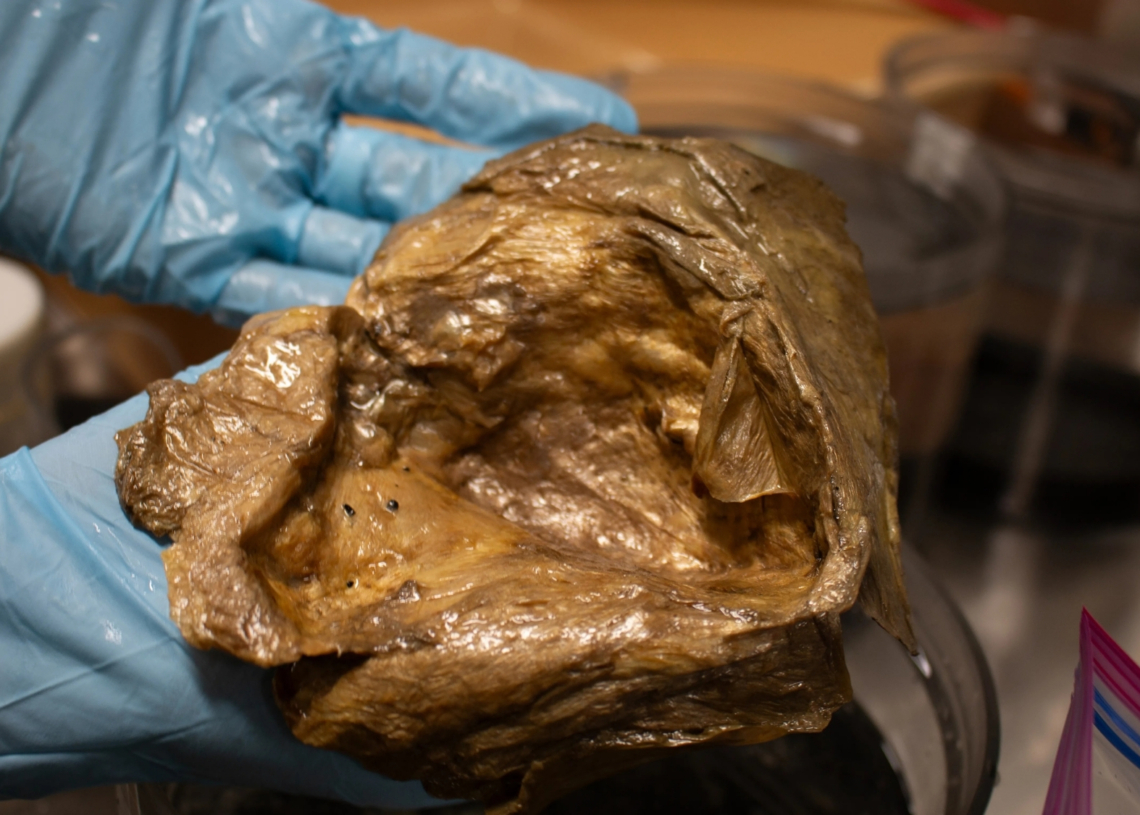
In 2023, a remotely operated vehicle called Deep Discoverer was cruising about 2 miles below the surface of the Gulf of Alaska when it stumbled upon something no one could explain. Stuck to a rock in total darkness, under pressure that would flatten a human being, was a shimmering golden orb about four inches across with a hole punched in one side. The scientists watching the live feed reacted the way any of us would.
“It’s definitely got a big old hole in it, so something either tried to get in or tried to get out,” one researcher said in the live feed. Another chimed in: “I just hope when we poke it, something doesn’t decide to come out. It’s like the beginning of a horror movie.”
They poked it anyway. Collected it, brought it to a lab, and then spent the next three years trying to figure out what on earth it was.
That Mysterious Golden Orb Found in the Deep Sea Was Somehow Even Weirder Than Expected
Early money was on an egg case left behind by some unknown deep-sea creature. Logical guess, but completely wrong. The specimen was fibrous and packed with cnidocytes, the stinging cells found in corals and anemones, specifically a type called spirocysts, which occur only in the Hexacorallia class of cnidarians. That narrowed the field considerably, but getting to a real answer required more than a basic DNA swab.
“We work on hundreds of different samples, and I suspected that our routine processes would clarify the mystery,” said zoologist Allen Collins of NOAA Fisheries’ National Systematics Laboratory. “But this turned into a special case that required focused efforts and the expertise of several different individuals. This was a complex mystery that required morphological, genetic, deep-sea, and bioinformatics expertise to solve.”
Standard DNA testing kept hitting dead ends because the blob was essentially a microscopic apartment complex full of other organisms. It took full genome sequencing to finally land on a match—Relicanthus daphneae, a deep-sea anemone first described in 2006, with tentacles that can stretch over six feet long.
The golden orb turned out to be a cuticle, a thin, multilayered coating that some anemones secrete from their outer tissue. Made primarily of chitin, the same tough material found in beetle shells and fungal cell walls, it forms flexible sheet-like structures that can detach and stay on the seafloor while the animal moves on. The anemone, in other words, just got up and left its own skin behind.
Why it did that is still being worked out. One theory is that the orb is the remnant of a botched attempt at asexual reproduction, a process called pedal laceration, where the base of the animal detaches, the upper portion walks away, and the leftover stump theoretically regrows into a new animal. Whether that’s what happened here remains unknown.
What researchers are more confident about is that the discarded cuticle wasn’t just collecting dust. The density of microorganisms found on it suggests it functions as a hotspot of microbial activity, with microbes breaking down the decaying tissue as part of the nitrogen cycle. The anemone bailed on its own skin, and an entire microscopic ecosystem quickly moved in.
Three years of work, a full genome sequence, and a small army of specialists to solve a mystery that started with a horror movie joke. The deep ocean continues to be exactly as strange as advertised.
The post Scientists Finally Identified That Weird Golden Orb They Found in the Deep Sea appeared first on VICE.