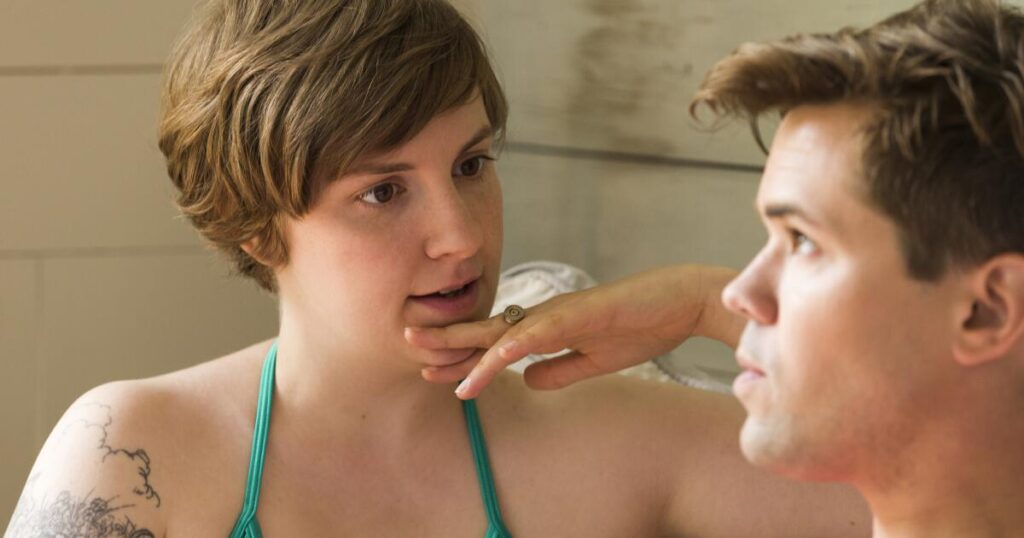
Whenever I think of “Girls,” the hit HBO series that ran from 2012 to 2017, I think of a scene in which Lena Dunham’s character Hannah furiously rides her bicycle down a country lane in the North Fork of Long Island wearing nothing but a green string bikini, her chubby body bouncing and jiggling as she pedals along.
In fact, she spent most of that 2014 episode in her string bikini, completely un-self-conscious, at a moment when extreme thinness and thigh gaps were all the rage.
I thought then — and still do — that it was one of the bravest things I’d ever seen on TV, even braver than the jackhammer sex she frequently had with her TV boyfriend, played by the inscrutable Adam Driver.
As has always been the case for Dunham — really, for anyone who does not conform to the cultural beauty ideal and has the gall to be exceptionally talented to boot — the internet went to work. She’d often been flayed by haters, but never developed skin thick enough to survive and flourish in the public eye.
After the triumphant first season of “Girls,” Dunham writes in “Famesick,” her perfectly titled new memoir, “I scanned my own name on Twitter, but all that stood out were pronouncements about my bad body, irritating voice, clearly horrific politics, inability to walk in heels, poor sense of style, and the fact that anyone — literally anyone — was more deserving of all this than I was.”
This, she describes, as “the ‘why her?’ of it all.”
As Dunham’s fame grows, everything gets complicated; old friends withdraw, requests for favors pile up, the stress is making her sicker and sicker, she has trouble saying no, and her artist parents struggle with the fact that their child has become a commodity whose infirmities are a huge if understandable problem for HBO, because at least 200 people depend on the show going on. “If you make yourself out to be a bottomless resource,” she writes, “people will frack.”
After she withdraws from a project with the famously abusive producer Scott Rudin because she is overwhelmed with Season 2 of “Girls,” his emails to her are so vicious that she dissociates.
“‘Don’t you get it,’” Dunham’s mother tells her. “‘He sends 70 of these a day. He won’t remember next week!’ But I would, I told her. I would.”
Putting a recent college graduate, even one as gifted as Dunham, in charge of a television series, a notoriously high-intensity undertaking, was a huge bet for HBO. The network paired her with an experienced producer, Jenni Konner, with whom she bonded like a baby duckling.
For a woman who discloses practically everything about herself — the good, the bad, the anal — Dunham is curiously reticent about an event she describes as “the one thing in my career, in my life, about which I felt — feel, still — genuine shame.” On Nov. 17, 2017, she writes, while she was in a post-hysterectomy drug haze, she and Konner did what she will only describe as “the big bad thing.”
(A Google search reveals that Dunham and Konner put out a deeply misguided statement defending Murray Miller, a “Girls” writer-producer who was accused by an actress of sexual assault when she was 17 and he was 35. The backlash was immediate, intense and humiliating. Dunham apologized profusely; Konner never did, and the episode seems to have had a corrosive effect on their friendship.)
Of course, HBO’s bet paid off hugely for the network. But it nearly destroyed Dunham.
Through six seasons of “Girls,” and after, Dunham suffers from colitis, bladder infections, voice loss, joint pain, a collapsed ear drum, multiple surgeries for debilitating endometriosis, “shocking constipation,” a shattered elbow and a terrifying sense of dissociation from her own body. Oh, and after she breaks up with her boyfriend of five years, the indie rock star Jack Antonoff, she accidentally sets herself on fire with a candle in a London hotel room, requiring treatment at a Los Angeles burn center.
Years into her health problems, after countless surgeries, ambulance trips and hospitalizations, Dunham is finally diagnosed with Ehlers-Danlos Syndrome, an often debilitating chronic disease with no cure, and undergoes a hysterectomy to deal with a decade of pelvic pain caused by lesions and cysts. By that time, she has become addicted to anti-anxiety medication and in 2018 will end up in rehab.
At 27, with a best actress Golden Globe under her arm, Dunham became the first comic actress to appear on the cover of Vogue, shot by Annie Leibovitz. Immediately after, she was hustled off to host “Saturday Night Live.” At the time, she is suffering with a fungal infection on her face (“a waterfall of golden blisters”) and painful shingles sores on her belly. “Your immune system is telling you something,” a doctor says. Screaming at the top of its lungs, actually.
Very few people will ever reach the same intoxicating peaks of success that Dunham has, especially in their twenties. Her talent has earned her a charmed life in so many ways. Director Judd Apatow offered himself as a producer after HBO greenlighted “Girls.” Out of the blue, Nora Ephron befriends her and becomes a mentor. The late New York Times journalist David Carr does as well. Dunham’s suffering, which she knows is tacky to complain about, is palpable. And yet it’s clear; she’s lucky to be alive.
Dunham turns 40 next month. She’s living in England with her British/Peruvian husband Luis Felber, a musician. After she meets him, she writes, “I told him two things: I was sick and people did not like me.” Maybe that’s changing.
Since her memoir was published on April 14 — and is already a bestseller — I’ve read two pieces whose themes are “We owe Lena Dunham an apology. We hated on her because we were jealous.”
Not everybody got the memo.
Just this week, this headlineran in the Daily Mail: “Lena Dunham is not a genius or an inspiration. She’s a morbidly obese, self-obsessed mediocrity… with a very disturbing past.”
At this point, who cares? As Dunham’s father once told her: “Don’t you get it? You’re only 28, and you’ve been called a racist, a fat whore, an ignorant rich girl and a child molester. What else is left? Nothing. You’ve won.”
Bluesky: @rabcarian Threads: @rabcarian
The post Millennial sensation Lena Dunham paid a high price for being famous, young and female appeared first on Los Angeles Times.