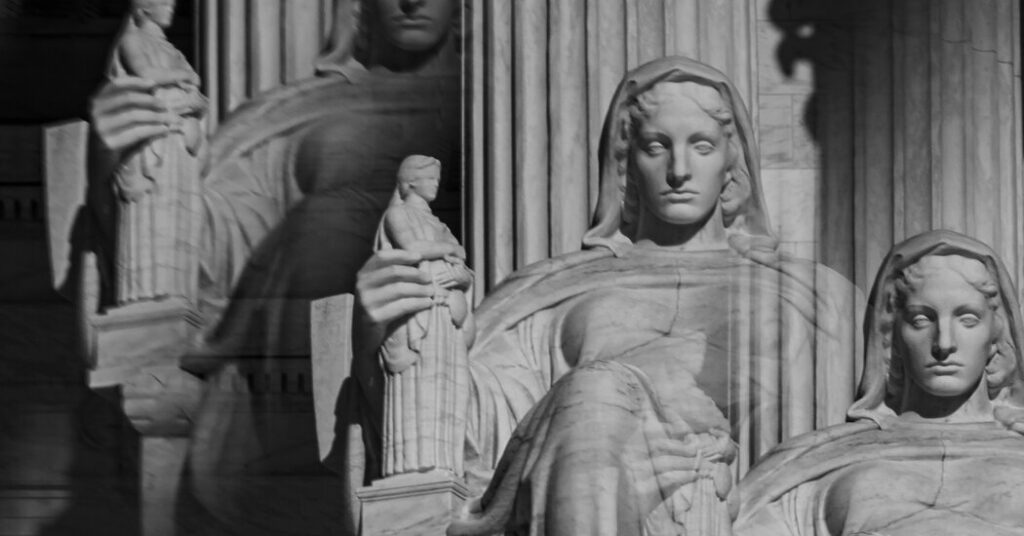
For most of American history, Supreme Court justices have done their best to stay out of the news. But more often in recent years, as the court itself has become a political lightning rod, justices have drawn scrutiny — for questionable ethical conduct, for perceived spats among their ranks or for what were seen as overtly political remarks.
In the past few weeks, two Supreme Court justices offered comments that were greeted with outrage and condemnation.
The episodes were unrelated, but together they offer a revealing glimpse of the state of the Supreme Court, on the verge of momentous rulings in the weeks ahead. Only one justice issued a public apology — the wrong justice.
In the first instance, during an event at the University of Kansas, Justice Sonia Sotomayor, one of the court’s three liberals, made critical personal remarks clearly aimed at a conservative justice, Brett Kavanaugh (though she never mentioned him by name). The remarks focused on a ruling from the emergency docket last fall in which the court voted to allow racial profiling by “roving patrols” of immigration officers in Los Angeles.
Let’s stipulate that Supreme Court justices should resist the temptation to take personal swipes at one another (or anyone else) in public. But even if Justice Sotomayor’s comments were ill advised, they were pointed and narrow.
In the other instance, Justice Clarence Thomas, another conservative, chose to use a national platform to unleash his contempt for “progressivism” — both as a historical reform movement and as a modern political identity shared by tens of millions of Americans.
His remarks, at the University of Texas, Austin, ostensibly to mark the 250th anniversary of the Declaration of Independence and broadcast live on C-SPAN, dealt yet another blow to the institutional integrity of the Supreme Court, which is suffering nearly record-low public-approval ratings.
Justice Thomas has often seemed to take a perverse pleasure in thumbing his nose at concerns regarding his professional conduct. (At the Austin event, he made a point of acknowledging Harlan Crow, the billionaire Republican donor who has lavished numerous, and until recently undisclosed, luxury gifts on the justice over the years.)
But even by his standards, these remarks demonstrate a shocking lack of judgment. They display the sort of ideological arrogance and intellectual incoherence that have become characteristic of the right wing of the court under Chief Justice John Roberts. This is particularly true in some of the most high-profile cases the court is currently considering, such as those concerning the administrative state.
Justice Thomas’s attack on progressivism, which he claimed “seeks to replace the basic premises of the Declaration of Independence and hence our form of government,” is the latest expression of his longstanding disdain for a movement that he blamed for, among other horrors, the rise of “Stalin, Hitler, Mussolini and Mao.”
Putting aside the historical illiteracy of these claims, what his attack on “progressivism” ignored was that the Progressive Era resulted in no fewer than four amendments to the Constitution, including one that allowed Americans to vote directly for senators and another that gave women the right to vote. These reforms were, by definition, supported by supermajorities of both Congress and Americans in every part of the country. In both process and substance, they were not an attempt to replace the Declaration and its egalitarian ideals, they were a triumph of democracy and a vindication of it.
But Justice Thomas’s attack was not limited to progressives from another century. He spoke in the present tense, going after those who “can mouth the words of the Declaration and parrot its principles” but who fail to grasp the true meaning of the phrase “all men are created equal.” No one, apparently, is equal to Clarence Thomas in understanding the Declaration.
The harm of Justice Thomas’s comments becomes that much more glaring when held up against those of Justice Sotomayor.
In her Kansas talk, Justice Sotomayor took aim at a shadow-docket ruling by the court last September that temporarily allowed immigration officers to consider race and apparent ethnicity in deciding to arrest and detain people they suspected to be illegal immigrants. The court offered no explanation for its ruling, but Justice Kavanaugh wrote separately to justify what he called “brief investigative stops.” (Critics of this policy would come to refer to them as “Kavanaugh stops.”)
Justice Sotomayor emphasized the drastic real-world consequences of these “brief” stops for working-class targets, then went after Justice Kavanaugh in personal terms: “This is from a man whose parents were professionals and probably doesn’t really know any person who works by the hour or the piece like I do.”
It was perhaps an unfair dig at a colleague. At worst, Justice Sotomayor violated the court’s informal code of silence, which restrains the justices from attacking their colleagues in public. Or so we are led to believe. You might recall Justice Antonin Scalia’s constant and withering mockery of justices he disagreed with. In his dissent from the court’s 2015 ruling legalizing same-sex marriage, Justice Scalia wrote that he would “hide my head in a bag” before signing on to such an opinion, which he described as a collection of “straining-to-be-memorable passages” filled with “the mystical aphorisms of the fortune cookie.”
The point is that the justices are grown-ups, and a little intemperate criticism, even from a colleague, is a small price to pay for having one of the most powerful jobs in the world.
Still, in the aftermath of these recent episodes, Justice Sotomayor called her remarks “inappropriate” and said that she had personally apologized to Justice Kavanaugh.
Justice Thomas has apologized to no one.
We’ve come to expect diatribes against entire swaths of the country from the Trump administration, but to hear a Supreme Court justice do it is somehow more chilling.
All Supreme Court justices are at risk of huffing their own fumes. It comes along with the lifetime appointment, the endless cosseting and flattery. It’s easy for them to forget that they play a unique role in American life, and are held to a higher standard of behavior than the rest of us. In 2016, Justice Ruth Bader Ginsburg made inappropriate and highly prejudicial public comments about Donald Trump, then a presidential candidate. (She also said she regretted those comments. Why does it always seem to be the women who have the courage to say that they made a mistake?)
These days, the Supreme Court sometimes feels as if it is slowly coming apart, the victim of both its own members’ arrogance and the hardball politics that Senate Republicans used to pack the court with right-wingers over the past decade.
Now, in these latest incidents, two justices gave us two visions of the court. One was of a court that would work for America: tough-minded, passionate and willing to admit error. The other was of the court we have: smug, unapologetic and gleefully divisive.
Meanwhile, the millions of Americans who are no less devoted than Justice Thomas to the egalitarian principles of the Declaration must wonder where they might go for an apology.
Jesse Wegman, a contributing Opinion writer, is a former member of The New York Times editorial board, a senior fellow at the Kohlberg Center at the Brennan Center for Justice and the author of the forthcoming “The Lost Founder: James Wilson and the Forgotten Fight for a People’s Constitution.”
The Times is committed to publishing a diversity of letters to the editor. We’d like to hear what you think about this or any of our articles. Here are some tips. And here’s our email: [email protected].
Follow the New York Times Opinion section on Facebook, Instagram, TikTok, Bluesky, WhatsApp and Threads.
The post Is the Supreme Court Coming Apart at the Seams? appeared first on New York Times.