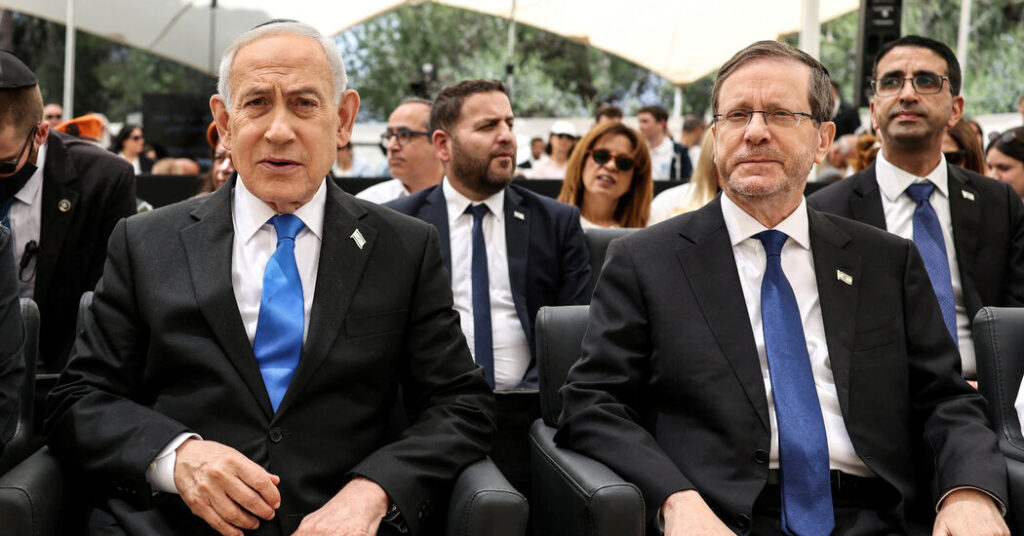
For months, President Isaac Herzog of Israel has deliberated over the politically fraught question of whether to grant Prime Minister Benjamin Netanyahu a pardon in his long-running corruption trial. It’s a highly contentious issue that has divided Israelis and drawn pressure from President Trump, who has aggressively intervened on Mr. Netanyahu’s behalf.
But Mr. Herzog does not plan to give Mr. Netanyahu a pardon anytime soon. Instead he will first try to initiate a mediation process to reach a plea deal, according to two senior Israeli officials with direct knowledge of Mr. Herzog’s thinking.
Mr. Herzog, the officials said, believes that there are many options beyond the binary pardon-or-no-pardon choice, and that the main role of Israel’s president is to foster unity. So he does not plan to say yes or no to Mr. Netanyahu’s request for a pardon at this stage, the officials said, preferring to try to resolve the issue through negotiations.
The officials spoke on the condition of anonymity because the issue is so politically sensitive.
In response to a request for comment, Mr. Herzog’s office said in a statement: “President Isaac Herzog has stated on several occasions that he regards reaching an amicable solution between the parties as an important public interest. As for the decision on the pardon request, the president will act solely in accordance with Israeli law, guided by his conscience, and in the best interests of the state of Israel.”
The prime minister’s office and Mr. Netanyahu’s lawyer did not immediately respond to requests for comment.
Mr. Netanyahu, 76, a conservative, has been on trial for almost six years. Charged with bribery, fraud and breach of trust, he is battling three separate but interlocking cases centered on accusations that he arranged favors for tycoons in exchange for gifts and sympathetic media coverage of him and his family.
He denies all wrongdoing and says he is the victim of a political witch hunt by a liberal “deep state,” finding a kindred spirit in Mr. Trump in that regard. The American president has pressed Mr. Herzog hard for a pardon and called him “disgraceful” and a “weak and pathetic guy” for not already granting one.
Israel is deeply divided over the issue. Polls indicate that about half of all Israelis oppose a pardon. Opinions are split roughly along political lines, with conservatives more sympathetic to the prime minister.
Mr. Herzog is acutely aware that the atmosphere in the country is tense, the officials said, because of the wars in Gaza, Iran and Lebanon, and with national elections slated to take place within six months.
Though the president’s role in Israel is largely ceremonial, one of the few powers Mr. Herzog has is granting pardons. A decision either way would be momentous and defining for both his and Mr. Netanyahu’s legacies and for the country’s future trajectory.
The officials who spoke of Mr. Herzog’s plans declined to elaborate on the potential outlines of a deal at this point, before the sides were even on board with mediation.
A plea agreement usually involves an admission of wrongdoing by the defendant and some kind of sanction. Israeli legal experts have said that any plea deal should be conditioned on Mr. Netanyahu agreeing to resign from public office.
Mr. Netanyahu has so far shown no inclination to admit any wrongdoing or to quit political life.
“Netanyahu knows the option of a plea bargain is always available to him,” said Yohanan Plesner, the president of the Israel Democracy Institute, an independent research group based in Jerusalem. “An admission of guilt, expressing remorse and agreeing to leave — or not to run for — office would be the essence of any plea bargain,” he said, adding, “If you are giving up on a prison sentence, that’s the minimum that should be required.”
Still, the officials said, Mr. Herzog believes that with good will, the legal landscape leaves room for creativity and innovation and that mediation would be the only way to heal the rifts threatening to tear Israel apart.
Mr. Netanyahu submitted a formal, pre-emptive request for a pardon midtrial last November. Though he said he would prefer to prove his innocence in court, Mr. Netanyahu argued that canceling the trial would help alleviate Israel’s divisions and free him to attend to the crucial affairs of state without the distraction of court hearings.
His request came amid a persistent pressure campaign by Mr. Trump for a pardon. During a visit to Israel in October, the American president turned to Mr. Herzog on the podium in the Knesset, Israel’s Parliament, and said, “Mr. President, why don’t you give him a pardon?” A month later, Mr. Trump made the same request in a letter to Mr. Herzog. Two weeks later, Mr. Netanyahu made his formal request.
Mr. Herzog, who worked as a lawyer before entering politics and previously led the Labor Party, called the pardon request “extraordinary.” Critics — including legal experts, liberals in Israel, Mr. Netanyahu’s political opponents and nongovernmental watchdogs — said granting it would run counter to the rule of law.
The general rule in Israel, according to legal experts, is that a president can pardon people who have been convicted. They say that a request for a pre-emptive pardon subverts a cornerstone of Israeli democracy: the principle of equality before the law.
In line with procedure, Mr. Herzog sought an opinion from the Pardons Department of Israel’s Ministry of Justice. The department issued a detailed response last month saying there was no legal basis for a pardon unless Mr. Netanyahu admitted some guilt, took responsibility by resigning or was found guilty in court. It said it was unable to conclude or recommend that the presidential authority for pardoning should apply in this case.
But the department also said it did not have the tools to consider the nonlegal aspects of Mr. Netanyahu’s request, such as the implications for national security and the rifts the trial was causing in the country.
The officials with knowledge of Mr. Herzog’s thinking said that he was assessing an alternative opinion submitted by Amichay Eliyahu, a far-right member of Mr. Netanyahu’s coalition, on behalf of the government.
Mr. Eliyahu’s opinion took the Pardons Department to task for examining the issue through what it described as the narrow, technical lens of the law. It argued that the president had the authority to take a broader approach and a historical view that goes beyond the usual realm of the justice system.
Mr. Herzog is now waiting for his office’s legal counsel to study all the material and make a recommendation, according to the officials. The general assessment in the president’s circles, they said, is that he does have the authority to pardon Mr. Netanyahu but that such a decision would need to pass judicial review and would most likely be challenged in the Supreme Court, creating further strife.
A decision not to pardon Mr. Netanyahu would most likely fire up his supporters before the election with claims that the prime minister was being persecuted by the liberal establishment, and fuel their crusade against the courts.
Mr. Netanyahu has done nothing to suggest that he will meet the usual conditions for a pardon. He appears to be campaigning for the next election rather than thinking of resigning, and if he decides to call more witnesses, he could stretch out the trial for years.
Mr. Herzog is proposing a way out of the conundrum, the officials said, by seeking to hold informal talks under presidential auspices, with the state prosecution and the attorney general on one side and Mr. Netanyahu’s lawyer on the other.
At least one prior effort to reach a plea deal in Mr. Netanyahu’s case was unsuccessful. A former Supreme Court president tried to arbitrate an agreement in late 2021 and early 2022 under a previous attorney general who had served the indictment against Mr. Netanyahu, who was then the leader of the opposition.
But the sides failed to agree, and time ran out as the former attorney general was coming to the end of his term.
Asked if those favoring or opposing a pardon might see a negotiation as weakness or a cop-out, the officials dismissed that as a factor. Even if there is only a slight chance of success, they said, it is worth trying to resolve the predicament without acrimony.
Isabel Kershner, a senior correspondent for The Times in Jerusalem, has been reporting on Israeli and Palestinian affairs since 1990.
The post Israel’s President, Putting Off Decision on Pardon for Netanyahu, Will Push for Plea Deal appeared first on New York Times.