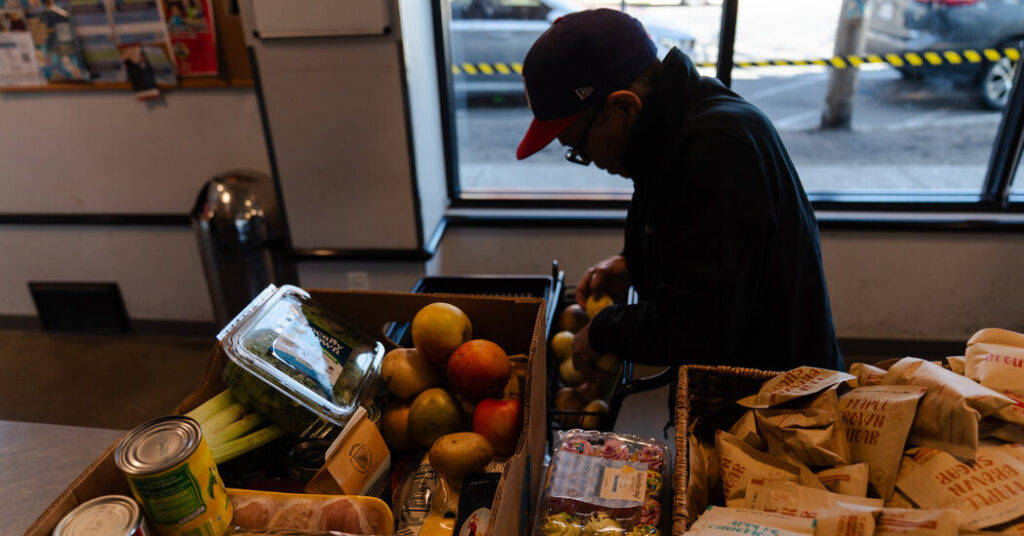
President Trump and his top officials have cast a sharp decrease in the number of food stamp recipients over the past year as evidence of economic progress and increasing self-sufficiency.
But the decline of more than three million participants since Mr. Trump took office to December 2025 is the result of some of the most consequential changes and the largest funding cut to the program since its inception.
Through legislation and regulatory tweaks over the past year, the administration and its allies in Congress have achieved a long-held conservative goal of shrinking the safety net, reshaping how the federal government defines need for low-income beneficiaries of the Supplemental Nutrition Assistance Program.
Among the alterations: who is eligible, who must work to receive benefits, how much beneficiaries will receive, what can be purchased, what grocery stores that accept SNAP must stock on shelves, how states and counties administer the program and how much localities are paid by the federal government.
Combined, the moves signal a shift in the program’s goals and how it has historically operated, said Tracy Roof, a professor at the University of Richmond, in Virginia, who is writing a book on the political history of food stamps.
“This is major,” she said. “The program is really, really changing.”
Supporters argue that the revisions will rein in a bloated program by encouraging able-bodied participants to work and to eat healthy food, and by incentivizing states to reduce paperwork errors, while keeping SNAP benefits generous.
In an opinion essay in April, Brooke Rollins, the agriculture secretary, wrote that SNAP had “turned into a handout that threatens to trap Americans in a vicious cycle of government dependence.”
“From Day 1, the Trump administration has been tirelessly fighting to reform this broke program so that it serves families who need it most,” she wrote.
In the early 1980s, the Reagan administration tried to cap the program by tightening eligibility and reducing benefits. But whereas those efforts were more explicit about their end goals, the Trump administration has added bureaucratic hurdles, shifted costs to states and made other changes that are “really, probably, long-term, a way to cut the program” as well, Ms. Roof said.
Mr. Trump’s signature domestic policy bill, signed into law last July, made some of the farthest-reaching moves. It enacted stricter work requirements for a broader swath of people, eliminated eligibility for certain lawful immigrants like refugees, capped future increases to benefit amounts, altered how deductions for utilities and internet bills are calculated and phased out funding for a nutrition education program. Altogether, the changes amounted to the largest cut in federal funding for SNAP, $186 billion, or 20 percent over a decade.
The Agriculture Department, seeking to carry out the Trump administration’s “Make America Healthy Again” agenda, has also modified how benefits are administered. It began last May to approve waivers allowing states to prohibit purchases of sugary drinks and proposed a regulation in September requiring retailers that accept food stamps to stock more varieties of staple foods.
Even more changes may be on the horizon. The Agriculture Department has drafted, but not yet issued, a regulation narrowing a policy that allows states to automatically enroll participants who already qualify for other types of government assistance. By one estimate, that would remove six million more people, including 1.8 million children, from SNAP.
The administration has taken a fundamentally different approach to SNAP than many of its predecessors, not hesitating to cut off the program or use it as a political cudgel. The agency declined to fund full SNAP benefits during a federal government shutdown last fall, disrupting the program for the first time. It has also repeatedly asked states to turn over sensitive personal data on SNAP participants and threatened to withhold benefits if they do not comply.
Proponents of smaller government often argue that SNAP has expanded in recent years at an unjustifiable rate, possibly outpacing need. The changes enacted by the administration are sorely needed to tame a ballooning program, they say.
Over the past 20 years, as more and more eligible people have begun to participate, annual enrollment has increased from 25 million people in 2005 to over 40 million in the years since the Great Recession, while annual expenditures have tripled to over $100 billion. And in the past decade, the participation rate in the program has surpassed the poverty rate.
Anna Kelly, a White House spokeswoman, said in a statement that the president was “strengthening SNAP for the Americans who need it by ensuring these programs are sustainable for future generations.”
Since January 2025 to December, the month with the latest available data, SNAP participation has declined from nearly 43 million to under 40 million. That number is likely to tumble further as the data accounts for the new restrictions taking effect and as states absorb more of the cost. Millions of households will also receive smaller benefit amounts, have more limited purchasing options or face additional barriers to obtaining their benefits.
The Congressional Budget Office estimated that the domestic policy law’s stricter work requirements would reduce monthly participation by about 2.4 million people. (Under the law, adults under 65 without children under 14 can receive benefits for only three months every three years unless they work, volunteer or participate in work training for at least 80 hours a month.)
In South Carolina, Mandee Wyrick, a single mother to two teenagers, said her household’s monthly benefits had decreased by a third, or around $250. She became ineligible for SNAP last month because she no longer meets those work requirements. Ms. Myrick, who used to do contract work for homeless advocacy organizations in Oregon before she moved, has tried in vain to find a new job, applying to anything that would allow her to continue to home-school her 14-year-old son. (“He just missed the cutoff,” Ms. Wyrick said.)
The family has already increased its reliance on charities and has tried to stretch its remaining benefits. With no job or volunteer opportunities on the horizon, she said, “I think this will probably be the last month that I’ll be able to push it.”
Under another provision of the law, some categories of legal immigrants — like refugees, asylum grantees and victims of domestic abuse or trafficking — are no longer eligible for SNAP. The move, the Congressional Budget Office estimates, will reduce eligibility by about 90,000 people a month.
Wafaa Alhaj Ali, her husband and six children are among them. Since fleeing Syria as refugees in August 2023, the family had received about $850 a month in benefits. Now, with no food assistance at all, Ms. Ali said in Arabic, “I have to beg charities for bread.”
“If I could go back to Syria, I would because it’s getting too much,” she said. “How am I going to feed my kids?”
For state and local officials administering SNAP, the volume of changes and the short window to enact them have been difficult to manage. Under the domestic policy bill, states and counties will also bear a greater share of administrative costs this October and may pay for a portion of benefits next October — the first time in SNAP’s history.
To make all the adjustments, California will need to add 2,500 employees focused on eligibility to a work force of about 25,000, estimated Carlos Marquez III, the executive director of the County Welfare Directors Association of California, which represents human services directors in the state. But with no guarantee of additional funding and anticipating budget cuts instead, some counties are eliminating vacant positions or freezing hiring.
“On the one hand, we are facing a doubling, in some cases, of the workload, and on the other hand, fewer resources to actually fund that workload,” Mr. Marquez said.
Though California will not enforce the work requirements until June, the changes have already strained resources and instilled fear and anxiety among beneficiaries, adding red tape even for those who still qualify.
Debbie-Ann Anderson, the director of human services in Union County, N.J., and the president of the National Association of County Human Services Administrators, stressed that the tight deadlines and impending costs were hampering local workers from carrying out all the changes.
If the goal of the overhaul to SNAP is to increase self-sufficiency among recipients, “we don’t have enough time to do everything that you need us to do,” she said. “We are not saying that we don’t want to, right? But we need the time to do it in a way that doesn’t become an overwhelming administrative burden for counties.”
In her own county, Ms. Anderson estimated that 65 percent of some 4,000 people subject to the new work requirements would be able to meet and document their compliance. Ms. Anderson doubted that there were enough jobs or volunteer positions available for all 4,000 people and that all would be willing to make the effort to prove their eligibility.
“Many of our recipients work, but to find copies of this or that paperwork — your rental agreement, your lease, your utilities, your everything — to come in for a small amount in benefits?” she said. “Some people may not feel that it’s worth it anymore.”
Whether SNAP can still provide adequate food assistance will be a more difficult question to answer, given the Agriculture Department’s decision last fall to cancel its long-running food insecurity report, Ms. Roof of the University of Richmond pointed out. “We’re not even going to know how big the gap is between people who need help and people who are getting help.”
The level of need now is “the worst I have ever seen,” said Catherine D’Amato, the president and chief executive of the Greater Boston Food Bank. For several years, the food bank has distributed over 100 million pounds of food annually — a number that has stayed steady despite the end of the coronavirus pandemic and a relatively low unemployment rate.
Ms. D’Amato noted a shift in the “face of hunger.” Today, she said, visitors are often working families who cannot keep up with the cost of living and inflation.
“Federal policy is really driving this,” she said, adding that changes to SNAP would only push more hungry people to charities and food pantries.
For Ms. Wyrick in South Carolina, the food pantries she frequents now already seemed stretched thin.
“Starving people won’t get them back to work faster,” she said. “They have no idea what the reality is like for the rest of us that are looking to work and just trying to survive.”
Rachelle Bonja contributed translations.
Linda Qiu is a Times reporter who specializes in fact-checking statements made by politicians and public figures. She has been reporting and fact-checking public figures for nearly a decade.
The post The Trump Administration Has Changed Almost Every Aspect of Food Stamps appeared first on New York Times.