Nilufa Easmin arrived most days at the D&D Convenience Store by 6 a.m.
Wearing a head scarf, she murmured a brief Muslim prayer before her shift selling snacks, cigarettes and gas in a blue-collar neighborhood of Fort Myers, Fla. After 3 p.m. she drove to her second job at a 7-Eleven, hours of more work stretching before her.
Ms. Easmin, a 51-year-old from Bangladesh, had held many such jobs since arriving in the United States in the 1990s, blending into South Florida’s vast immigrant work force. What had been a life of determination and perseverance ended in a horrific act of violence on the morning of April 2, when a man beat her to death with a hammer.
The suspect, Rolbert Joachin, 40, was himself an immigrant, smuggled by boat from Haiti to the Florida Keys four years ago.
The killing was thrust into the national spotlight a week later, when President Trump posted gruesome surveillance footage of it on Truth Social. It was the latest proof, he wrote, that liberal immigration policies had allowed “millions of criminals” into the country to run amok.
To advance his anti-immigration agenda, Mr. Trump focused on Mr. Joachin, barely mentioning Ms. Easmin as he blasted the Biden administration for extending a program that shielded Mr. Joachin and other Haitians from deportation. Mr. Trump, who has made disparaging comments about Haitian immigrants for years, wants to end the program, Temporary Protected Status, for some 350,000 Haitians; the Supreme Court will hear oral arguments in the matter this week.
A day after the president’s post, a Homeland Security official offered reporters a single detail about Ms. Easmin’s immigration status: that she had obtained citizenship “the right way.”
But Ms. Easmin’s life and death tell a different and more nuanced story than Mr. Trump and his administration portrayed — one that reflects the challenges many immigrants face when they get here, and the lengths they go to try to stay. To forge a life here, Ms. Easmin appears to have resorted to a sham marriage, according to divorce records and interviews, that under other circumstances the White House might condemn.
But the nation’s long-broken immigration system makes legal immigration to the United States exceedingly difficult, and immigrant journeys rarely simple.
Ms. Easmin arrived from Bangladesh in 1996 to join her older brother, Mohammed Hossain, he said in an interview. He had immigrated five years earlier, after winning a visa lottery that allowed him to live and work in the United States and obtain a green card. He found his sister a job in the same network of South Florida convenience stores and gas stations that employed him.
He had not realized that she was pregnant when she arrived. She had married in Bangladesh, where the baby’s father still lived, according to Mr. Hossain. Ms. Easmin gave birth to her first child, a daughter, months after her arrival in South Florida.
Mr. Hossain said that Ms. Easmin later returned to Bangladesh for several years, where she gave birth to a second daughter in 2004. Then she returned to the Miami area. Her husband eventually joined her.
Working constantly, Mr. Hossain said, “We didn’t have that much time for fun.”
Naturalized immigrants in the United States may sponsor siblings for green cards, but annual caps for such petitions have created a huge backlog. A petition for a sibling in Bangladesh currently faces an 18-year wait.
Mr. Hossain said he did not sponsor his sister for a green card because he could not afford it. He said she entered the United States as a tourist, and that an attorney and an employer helped arrange her legal residency.
But court records in Miami-Dade County tell a different story: They suggest that Ms. Easmin obtained legal residency by claiming to be married to her brother. It is typically much faster to get a green card as a spouse than as a sibling.
In the records, Ms. Easmin said she was married to someone with her brother’s name, Mohammed Hossain. The records show they were divorced in Miami in 2002.
Her brother denied that the man listed in the records was him. But they show that the Mohammed Hossain married to Ms. Easmin had the same middle name, address, phone number and lawyer as her brother.
Another brother in Bangladesh, Salahuddin Manik, told The New York Times that his younger siblings had disguised themselves as a married couple in the United States.
“This is a personal family matter,” Mr. Hossain said on Friday, declining to answer further questions about the marriage.
Mr. Hossain and others who knew Ms. Easmin said that the father of her daughters — and husband of many years — is Md Jahangir Alam Bhuiyan.
According to Mr. Hossain, that marriage was troubled, in part because Ms. Easmin and Mr. Bhuiyan had lived continents apart until he came to Miami. In 2018, Ms. Easmin filed for what became a long and contentious divorce from Mr. Bhuiyan.
In court filings, Ms. Easmin accused Mr. Bhuiyan of threatening her with a gun after an argument about money in 2018. A judge later issued a restraining order, the records show. Mr. Bhuiyan sought alimony from her, saying that he was disabled. At the time of her death, the divorce was still in process, according to the records.
Mr. Bhuiyan declined to comment about Ms. Easmin’s death. He later did not respond to requests for comment about the marriage and divorce.
The couple’s older daughter, now 29 and working at a convenience store as her mother had, did not respond to requests for comment. Their younger daughter, a 21-year-old college student, declined to comment.
Ms. Easmin became an American citizen in 2022, according to Homeland Security officials, almost three decades after her arrival.
Sometime in the past year, she relocated to Southwest Florida, Mr. Hossain said, looking for a fresh start. She had hoped to buy a business but lost money in a scam, he said; instead, she worked evenings at a 7-Eleven and mornings at the D&D convenience store in Dunbar, a neighborhood of Fort Myers where crime has sometimes flared.
Until November, Ms. Easmin had lived in a house in Cape Coral, near Fort Myers, according to Yasmeen Fatima, who lives there now. Ms. Fatima said that she had briefly met Ms. Easmin as she was moving out.
“Work was very frustrating for her,” she said. “She was just a single mom looking out for her two kids.”
Details of Mr. Joachin’s life remain scant; there is little trace of him in public records, and a search of criminal records in Florida and Texas, where he may have briefly lived, showed no prior arrests. His public defenders in the murder case declined to comment.
He entered the country with other Haitians near Key West on Aug. 6, 2022, part of a surge of migrants who sailed to South Florida that year. Border Patrol agents took him into custody and transferred him to a detention center in Texas. A judge ordered him removed from the country about a month later, but instead, for reasons that neither federal officials nor court records explained, he was released that October.
Mr. Joachin applied for Temporary Protected Status, which he received in 2023. That status, which allows migrants from certain unstable countries to live and work in the United States for a limited time, expired for Mr. Joachin in 2024. He applied to renew it, extending the protections.
He spent at least part of 2024 in Lakeland, Fla., about 120 miles from Fort Myers. Marcel Joseph, a fellow Haitian immigrant who lives there, said that he let Mr. Joachin sleep on his living room floor for a couple of months after the place where Mr. Joachin had been living burned down.
Mr. Joseph described Mr. Joachin as quiet, adding that he would walk to the local Salvation Army “to find things to eat, to find clothes.” He did not remember Mr. Joachin having a job, and said that he moved out after someone found him work in Texas. Mr. Joseph never heard from him again.
Ms. Easmin appears to have first encountered Mr. Joachin on March 31, two days before her murder.
It is not known when or why he had found his way to Fort Myers. He appeared to have no recent fixed address.
She was working her usual morning shift when Mr. Joachin arrived at the store and tried to use the A.T.M., according to Arif Ahmed Ashraf, the property owner. When the machine did not dispense money, Mr. Joachin complained.
Ms. Easmin looked at his A.T.M. receipt and told him he had used the wrong PIN. Mr. Joachin demanded the money but eventually left, Mr. Ashraf said.
“He didn’t show that he was mad,” he said. “He didn’t say, ‘I’m going to come kill you.’”
But Mr. Joachin apparently did return, just after 7 a.m. on April 2, armed with a hammer. Security camera video showed a man the police identified as Mr. Joachin smashing the windshield of a black S.U.V. parked outside the convenience store.
The car was Ms. Easmin’s, Mr. Ashraf said. The video showed her coming out of the store in a pink shirt and black head scarf before the man attacked her.
Witnesses saw him flee, and the police quickly disseminated his photograph. At least three officers quickly recognized him as Mr. Joachin, according to the arrest report. One said he had seen Mr. Joachin “four or five times through his professional duties.” The police did not elaborate.
He was arrested later that day. Police officers wrote in the report that he had confessed to killing Ms. Easmin. Chief Jason Fields of the Fort Myers Police Department declined to discuss the investigation.
He is being held without bond and faces charges of first-degree murder and third-degree property damage. His arraignment is scheduled for May 4.
Mr. Ashraf said that Ms. Easmin’s daughters would need financial help in the wake of her death. He said he had helped pay for her funeral and would help her younger daughter make an upcoming tuition payment.
The Haitian and Bangladeshi communities in Southwest Florida have urged the public not to use Ms. Easmin’s brutal murder to make a political point.
“We want to strongly condemn this kind of act,” said Samir Bahadur Syed, the president of the Bangladesh Association of Southwest Florida, who set up a GoFundMe page to raise money for Ms. Easmin’s daughters. “But just because one guy did a very bad thing, it doesn’t mean that everybody in that community is bad.”
Mr. Hossain, however, said he was grateful that the president had written that his sister’s family deserved justice. He also said he agreed that some immigrants were bringing crime to the United States.
“Mr. Donald Trump, thank you,” said Mr. Hossain, who described himself as having voted for Democrats in the past but for Mr. Trump in 2024.
He cannot get the security camera video out of his head. “I cry,” he said. “I can’t sleep.”
“She was good,” he said of Ms. Easmin. “She was a nice person, loved her family, loved those two kids.”
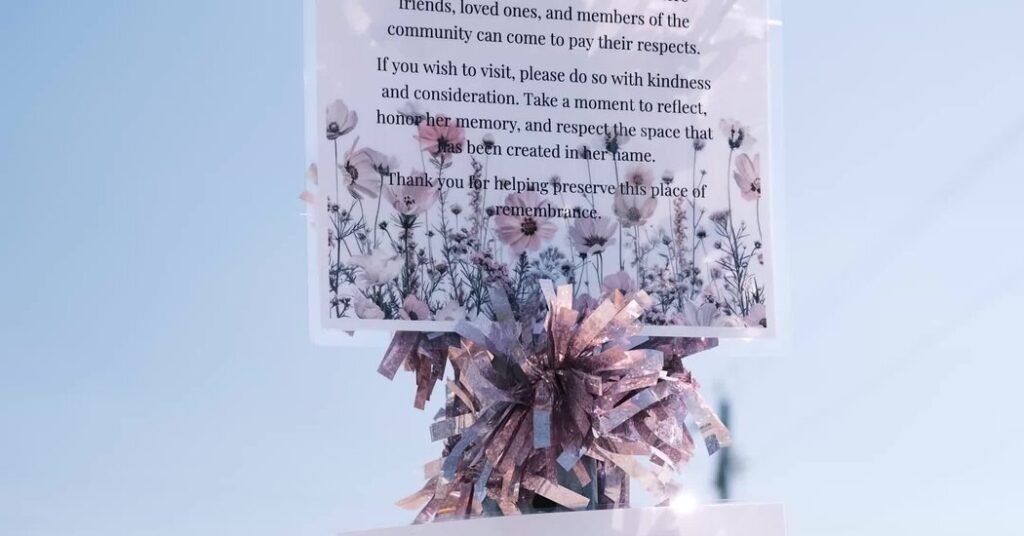
Outside the convenience store after her death, a laminated sheet of paper hung in Ms. Easmin’s memory. It featured a photograph of her looking sideways into the camera. Above it was a Muslim prayer.
“O Allah,” it began, “have mercy on her, forgive her, and grant her peace.”
Reporting was contributed by Saif Hasnat from Dhaka, Bangladesh; David C. Adams and Andrea Zarate from Miami; Valerie Boey Ramsey from Lakeland, Fla.; Fahima Haque from New York; and McKenna Oxenden from Fort Myers, Fla. Kitty Bennett and Georgia Gee contributed research.
Patricia Mazzei is the lead reporter for The Times in Miami, covering Florida and Puerto Rico.
The post The Hard Life of an Immigrant Whose Killing Became a Symbol for Trump appeared first on New York Times.