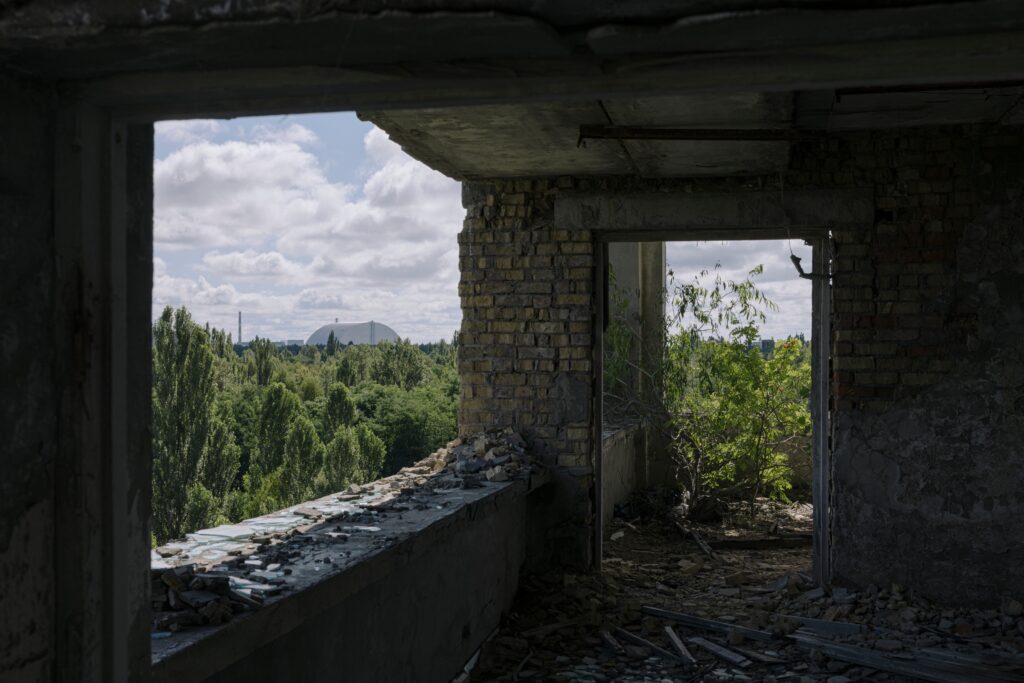
CHORNOBYL, Ukraine — After the Chernobyl nuclear disaster, 40 years ago Sunday, more than 300,000 people fled the towns surrounding the destroyed Unit 4 reactor that spewed lethal radiation. In 2019, Nadiia Mudryk-Mochalova fled to Chornobyl, as the Ukrainians spell it, for work — after moving to Kyiv with her daughters to escape the armed men who occupied their town in the eastern Luhansk region near the Russian border.
Checkpoints were set up, and military equipment began arriving from Russia. Mudryk-Mochalova worked in local media and said that speaking openly from a pro-Ukrainian position was dangerous. She thought she and her daughters, then 9 and 12, would be away just a few weeks, until Ukrainian authorities restored control. They never went home. Just like those who fled Pripyat, the town closest to the reactor, in 1986.
“We left as if for a short time,” she said. “The people from Pripyat also left thinking they would come back.”
In the Chornobyl Exclusion Zone, where she now works as “head of the visitor access support sector” for the Central Enterprise for Radioactive Waste Management, a state entity, Mudryk-Mochalova views the abandoned homes through her own displacement. The still-vacant Pripyat apartments and village houses and the discarded toys, family photographs, school notebooks, letters and greeting cards all made her think about what she had left behind in Luhansk.
“When I see someone’s things there, I always think about mine,” she said. “About what remained in my home. About the life that was interrupted.”
The nuclear disaster, she said, cannot be measured only in radiation levels or the tons of concrete and steel used to create the sarcophagus that now covers the site. “It is someone’s health,” she said, “someone’s time, someone’s family.”
Initially, Mudryk-Mochalova’s job was to explain what the zone has become: a restricted territory of radioactive waste, where scientists, firefighters, guards and other workers managed the disaster’s long aftermath alongside self-settlers who came to build new lives.
The exclusion zone also developed a public life: official tour routes, foreign visitors, media projects and Lampochky, an amateur group of workers who wrote scripts and poems, played music, made costumes, and staged performances. However, Russia’s full-scale invasion in February 2022 ended much of that.
During a period of Russian occupation, offices were destroyed, equipment was looted, more than 300 vehicles were lost or damaged, and tourism stopped. Some of Mudryk-Mochalova’s colleagues and friends from the zone joined the military and were later killed. Others died during the occupation or in shelling. Some are still fighting. “We used to gather for rehearsals, for songs, for holidays,” she said. “Now we gather at funerals.”
Ukraine’s experience with Chernobyl, she said, also shapes how she understands the war. “We overcame radiation,” she said. “We will overcome Russia, too.”
(When the disaster occurred, and Ukraine was part of the Soviet Union, the plant was known by its Russian spelling. Now, the town is commonly referred to by the Ukrainian spelling.)
Mykhailo Shylo, a former primary school teacher, lives on an abandoned street in Chornobyl, among houses overgrown with bushes and trees, where, he says, a lynx can sometimes be seen. He bought his house after returning to the exclusion zone in 2000 but grew up nearby. He was born in 1937 in Koshivka, in the Chornobyl district, and said his family’s roots in the area go back generations.
Shylo’s father was killed in World War II. During the Nazi occupation, Shylo hid in the forest with his mother and other Chornobyl residents. In 1943, when he was 6, he was wounded during a bombing while walking with a friend toward the Pripyat River. Shrapnel fragments remain in his right knee, he said, almost apologetically, explaining why he now walks with a cane.
After the nuclear disaster, Shylo was among about 116,000 people evacuated that year from areas around the plant. Roughly 220,000 more were later moved from contaminated territories in Ukraine, Belarus and Russia. Shylo said he and others were told to take only essentials because they would return in “three days.” They did not. Some later came back without permission, refusing to stay away.
Known as self-settlers, or samosely in Ukrainian, they numbered more than 1,200 in the first years after the accident. By 2018, about 130 remained. Now there are about 50, agency officials said, almost all elderly.
For Shylo, the return came because his wife could no longer bear living away from home. “She could not stand it anymore,” he said. “She was drawn back here. She said we have to return.” They came back to Chornobyl in 2000. She later died of cancer, and he has remained alone. The cancer is almost certainly connected to the nuclear catastrophe, but it is impossible to know for certain.
Chornobyl’s documented history reaches back centuries, with its first known written mention in 1193 and older archaeological layers from the 10th and 11th centuries. Shylo connects that history to the New Testament reference to Wormwood — the name of a fallen star that poisons the Earth’s waters.
The Ukrainian word for the common mugwort, a plant in the wormwood family, is chornobyl. “Only a bastard could build a nuclear power plant in a place with such a name,” Shylo said. “The tragedy was already laid down in the name itself.”
His house also became a private museum. Over the years, he has collected objects exposed by spring water and erosion along the banks of the Uzh River: helmets, ammunition boxes, fuel canisters, horse gear, Soviet household items and tools from rural life. Many objects date from World War II and earlier conflicts. Shylo spoke readily about those wars — about his father, the Nazi occupation and Soviet power, but was more reticent to talk about the recent Russian occupation.
One detail he shared concerned his gate. Before 2022, it was painted blue and yellow. When he learned Russian troops were approaching, he painted it red. It remains red.
Up the overgrown street from Shylo’s red gate stands a former college that now houses the Institute for Safety Problems of Nuclear Power Plants, one of the institutions still operating inside the exclusion zone.
The institute serves as a scientific supervisor for the decommissioning of the Chernobyl plant and for the long effort to transform the sarcophagus over the destroyed the Unit 4 reactor, now known as the “New Safe Confinement,” into an environmentally safe system. The institute’s staff members collect and analyze samples; monitor the confinement; study groundwater, forests and radioactive waste; and assess safety risks across Ukraine’s nuclear sector.
Fedir Cherpak, 62, who lives in Slavutych and works rotational shifts in Chornobyl as head of a maintenance unit at the institute, is responsible for roofs, windows, doors, staff housing and repairs.
Since he joined the institute in 2019, he said, the zone has grown emptier. Fewer organizations remain, more buildings stand unused, and even those still needed require constant upkeep. “Time takes its toll on everything,” Cherpak said. Russia’s war added another layer. After the occupation in 2022, damaged institute buildings had to be sealed with plywood and chipboard before proper repairs could begin.
Inside one laboratory, Liudmyla Chykur, 75, a leading radiochemistry engineer who has worked in the zone for 30 years, analyzed samples: water, soil, air and materials taken from around the remains of the Unit 4 reactor. After the New Safe Confinement was placed over the old sarcophagus, less water entered the shelter and emissions declined, she said. Monitoring has continued. “Chernobyl is my life,” she said.
In a basement room, robots used to collect data stand idle. They were built for places people still cannot reach, to measure and transmit information from inside the damaged reactor’s most dangerous spaces. For Anatolii Nosovskyi, 72, the institute’s director and a nuclear safety specialist who worked on the sarcophagus in 1986 and 1987, this remains Chernobyl’s central technical problem.
Radioactive materials inside the destroyed reactor still have to be retrieved, packaged and stored. Some are breaking down into radioactive dust, creating new long-term risks. “I want to see, in my lifetime, real work that will finally eliminate the consequences of the accident,” Nosovskyi said.
Those risks became harder to manage after a Russian drone struck the New Safe Confinement on Feb. 14, 2025, damaging the structure built to contain the Unit 4 reactor. The International Atomic Energy Agency said the attack pierced a hole through the roof and caused fires inside the structure.
Officials with the Chornobyl Nuclear Power Plant later said the strike damaged the outer cladding and inner sealing membrane. Greenpeace Ukraine warned that without urgent repairs, the damage could increase the risk that the old sarcophagus underneath will collapse. Nosovskyi said the New Confinement was weakened. “Russia’s actions around nuclear sites are acts of nuclear terrorism,” he said.
Mykola Panasiuk, 72, head of the Laboratory of Geoecological Research, studies groundwater and surface water, including the Pripyat and Uzh rivers. Panasiuk said radionuclide levels have generally declined, while contamination still travels through water and sediment.
Dmytro Horodetskyi, 68, a senior researcher focused on environmental impact assessments, says forests are part of that circulation: Roots, fungi and trees draw radionuclides from the soil, store them, return them through decay, and release them through fire.
Fires pose special danger. Russian drones and missiles cross the exclusion zone in waves, and when they are shot down or crash into dry forest, they can ignite contaminated ground. Air defenses are now part of the zone’s environmental protection along with general military defense.
Members of a mobile air defense team — identified only by the call signs Navigator, Levelheaded and Nikos, in accordance with military rules — said their work is shaped by the damaged plant’s critical infrastructure. Crews operate within defined sectors, choosing positions and angles so that a falling target or other debris does not strike the plant, the New Safe Confinement, waste facilities or other sensitive sites.
The Russian drones often continue flying toward Zhytomyr or western Ukraine, they said. “People are the most important thing,” one soldier said. “But here, if these objects are damaged, the consequences would be much more critical.”
The post 40 years after Chernobyl, war brings new rounds of disaster and displacement appeared first on Washington Post.