The Washington garden party might have changed the course of World War II — if the British ambassador’s wife had been more diplomatic with the guest list.
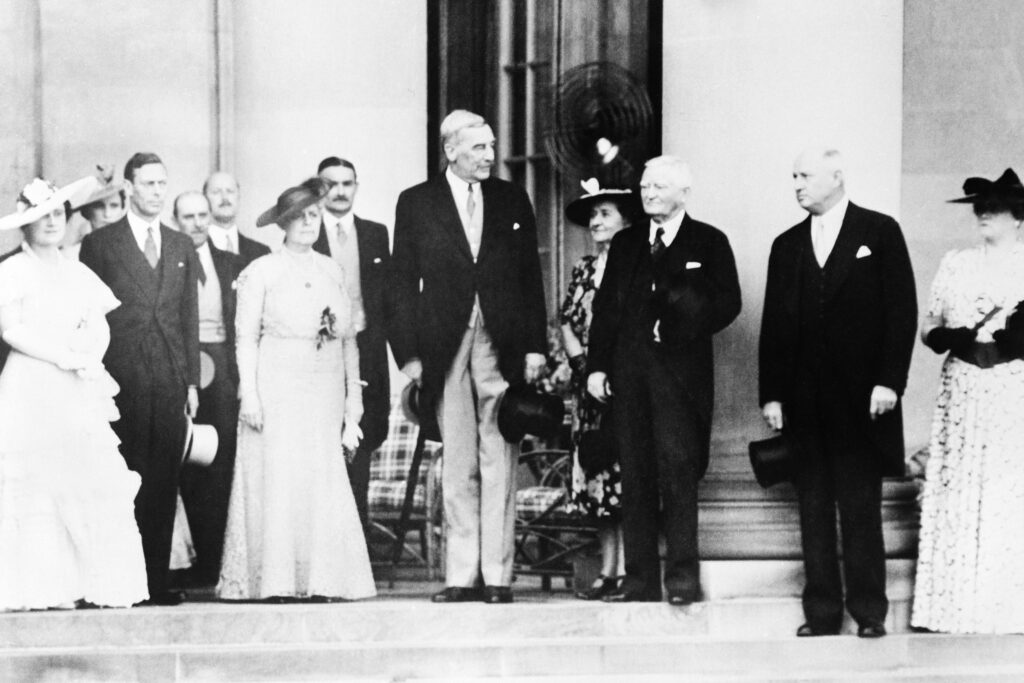
The June 1939 visit of King George VI, the first by a reigning British monarch since the United States declared its independence in 1776, was cause for anticipation — and anxiety.
Some Washington politicians “were exceptionally excited about the opportunity,” said Katherine Scott, the Senate historian. “And also very worried about not doing the right thing, not knowing and following protocol. We want to show them that we’re independent, but also we don’t want to appear as country bumpkins.”
Adding to the pressure, the world was careering toward global conflict. American isolationism had strained relations between Britain and the United States. Nazi Germany was menacing Europe, and London was pushing Washington to pick a side.
This week, George’s grandson, King Charles III, visits Washington confronting similar concerns: Growing fears of spreading war. A rising America First movement. A mission to restore Anglo-American bonds.
When George visited, Hitler had invaded Czechoslovakia and was threatening Poland. Britain had promised to defend Poland but would need American airplanes, guns and ammunition.
Americans, however, were split over whether to get involved. Selling arms to the Allied powers is what had dragged the United States into World War I: German U-boats began sinking American merchant ships carrying supplies across the Atlantic.
“That is very much in the memory of these folks who are serving in the United States Senate and in the United States House of Representatives in the 1930s,” Scott said. “Barely a generation had passed since peace had been declared.”
More than 100,000 Americans were killed in 1917 and 1918 and another 200,000 wounded. Congress, wary of a sequel, passed the Neutrality Act in 1935, barring U.S. weapons manufacturers from selling “arms, ammunition, and implements of war” abroad.
By 1939, President Franklin D. Roosevelt was pushing Congress to revise the legislation so the United States could again help Britain and France fight Germany. But standing in his way were the isolationists.
“What we call neutrality legislation is not neutrality legislation; it is what might be called peace legislation,” Sen. William Borah, an Idaho Republican on the Foreign Relations Committee, told reporters. Some members of Congress were pushing to adjourn early in June, which would prevent action until the following January.
Ordinarily when Congress adjourns, members return to their states and districts. But in 1939, no one was going anywhere. The British were coming.
The diplomatic objective of the royal visit was to charm the Americans on whom their country’s survival might depend. The first stop was Washington, where the British Embassy would host a garden party for some 1,300 elites. The task of choosing the guests fell to the wife of British Ambassador Sir Ronald Lindsay, Lady Elizabeth Lindsay.
The event quickly became the fixation of social Washington. Newspapers debated royal decorum: dress code, skirt length and whether curtsying before the queen was a betrayal of American democracy or merely the polite thing to do. The caterer ordered 2,700 sandwiches and 25,000 strawberries, The Post reported.
But when the invitations went out, it became clear that the British mission had made a diplomatic misstep. More notable than who made the guest list was who didn’t. Congressional wives, in particular, were aghast to learn that most of them had been left off. There was talk of a “second American Revolution.”
“They managed, in one fell swoop, to insult half the Senate, three-fourths of the House, and all of the Washington press,” the journalist Helen Lombard wrote in her 1939 book “The Washington Waltz.”
Neither Senate Minority Leader Charles McNary, an Oregon Republican, nor his wife had merited an invite. Nor had Sen. Hiram Johnson, a California Republican and an influential isolationist. “After all, the Senate is merely the treaty-making body of the United States and not the Social Register,” he sniffed.
The White House, State Department and British Embassy were flooded with phone calls and letters of appeal. Congressional wives worried about what their husbands’ constituents would think. The Washington Post published “The Art of Crashing,” a column that proposed techniques for sneaking into the party: disguising oneself as a delivery driver, or whitening one’s hair to appear elderly.
Sir Ronald, speaking with reporters, promptly made matters worse. “The garden party is just like heaven, you know,” he said. “Some are taken and some are not.”
Lady Elizabeth was similarly unmoved. “My head is bloodied but unbowed,” she said.
In a final gambit, Senate wives appealed to second lady Mariette Garner to impress upon her husband, Vice President John Nance Garner, the political importance of reopening the guest list. Days before the party, Lady Elizabeth extended invitations to the remaining senators and their wives. “The home life of a good many United States Senators became somewhat less complicated today when word got around that they and their wives would get to attend the garden party for King George and Queen Elizabeth, after all,” The Evening Star reported.
House members, however, were still mostly left out.
Charles is scheduled to arrive Monday with his consort, Queen Camilla. The British Embassy is planning another garden party. The current British ambassador, Sir Christian Turner, sympathizes with his predecessors.
“There is nothing that is a greater honor than hosting a state visit for one’s head of state, one’s monarch, as an ambassador. There’s probably also nothing more nerve-racking,” he said. “Guest lists are something of a nightmare because everyone wants to be part of these extraordinary occasions and there are always limits on space and size.”
His wife, Lady Claire Turner, like Lady Elizabeth before her, is involved with planning. “Lots of thought going into the menus, how are we showcasing sort of a typical English tea,” she said. “So we’ve got smoked salmon sandwiches, English beef, and then we’ve got, as you would expect, scones and clotted cream and jam.”
Asked about the guest list, she laughed. “Well, that’s beyond my pay grade. But it’s been a tough one, yes, because obviously it’s a hot ticket, but hopefully we’ve included as many people as possible.”
In 1939, hundreds of thousands of people gathered along Constitution Avenue to greet George and his consort, Queen Elizabeth. (Their 13-year-old daughter, the future Queen Elizabeth II, remained home at Windsor Lodge.) Whatever outrage had gripped social Washington had not trickled down to the American public.
The media declared the garden party and the tour a success. “A Master-Stroke of Diplomacy,” England’s Huddersfield Examiner claimed.
But was it? Congress didn’t revise the Neutrality Act. “By originally injuring the feelings of a majority of the Senate,” The Post reported at the time, “the British Embassy was slighting men who hold the key to whether Congress can revise the neutrality law this year to aid Great Britain and France, some observers pointed out.”
It wasn’t until after Nazi Germany invaded Poland on Sept. 1 and Britain and France entered the war that Congress lifted the arms embargo. Two years later, Japan attacked Pearl Harbor and the United States entered the war.
“The Garden Party had come and gone,” Lombard wrote. “The instrument to measure the effect of wounded vanity on world history has not yet been invented. That famous event would have been an interesting first experiment.”
The post The 1939 royal visit and the party that tested U.S.-British relations appeared first on Washington Post.