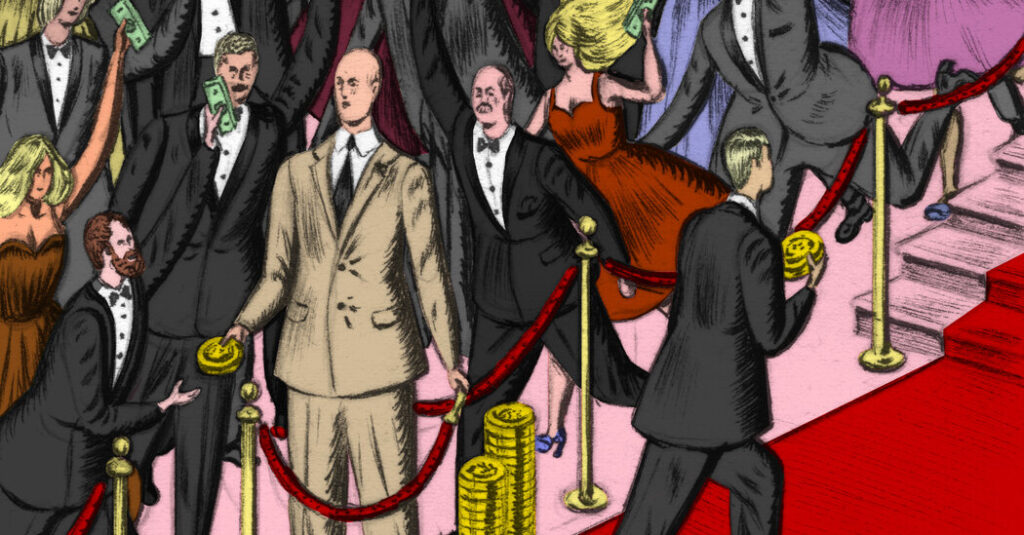
A year ago, hundreds of tuxedo-clad crypto investors descended on the Trump National Golf Club in Northern Virginia, marching past crowds of protesters to claim an expensive prize — dinner with the president. They were the winners of a contest that offered access to President Trump in exchange for investing in his $TRUMP memecoin.
On Saturday, Mr. Trump did it all over again, welcoming an even larger group of $TRUMP investors to his Mar-a-Lago estate in Palm Beach, Fla., for a daylong event marketed as “The Most Exclusive Conference In The World.”
But circumstances had changed.
Once hailed as heroes by crypto traders, Mr. Trump and his family have come under fire over the plunging value of their digital coins, the complex financial maneuvering of one of their crypto companies and an escalating business dispute with a billionaire crypto partner. As shuttles ferried the investors to Mar-a-Lago on Saturday, the price of $TRUMP hovered at $2.83, down about 80 percent from last April.
Even I managed to win a seat. Six weeks ago, I approached my editors with an idea: Would The New York Times give me a few thousand dollars to buy $TRUMP? My plan was to write about the event and then sell the coins, donating any profits to charity.
While I report on crypto for a living, I’m no day trader. But with my bosses’ blessing, I was soon funneling thousands of dollars from my bank account to a crypto app called Phantom, clicking past boldface warnings about scams, and frantically Googling for ways to override deposit limits and other guardrails meant to protect me.
It did not turn out to be a profitable investment. Memecoins, a novelty product based on viral jokes or celebrity mascots, are notoriously volatile. But my $TRUMP purchases offered a window into the exhilarating highs and frustrating lows of participating in Mr. Trump’s crypto ventures, at a time when some industry experts have grown pessimistic about their future.
“I don’t think anyone cares about” the $TRUMP coin, said Morten Christensen, an investor who runs the crypto website AirdropAlert.com and won a spot at Mar-a-Lago. “This one clearly died and is never going to go back up.”
The White House declined to comment, and the organizers of the $TRUMP competition did not respond to emails for comment.
Since the 2024 presidential campaign, Mr. Trump has embraced virtually every aspect of crypto. He started a crypto company, ordered an end to a regulatory enforcement campaign and promised to make the United States the “crypto capital of the world.”
But few of his crypto actions have attracted as much attention or scrutiny as his memecoin.
Unveiled three nights before the presidential inauguration in January 2025, $TRUMP emerged from a partnership between Mr. Trump and a longtime associate, the serial entrepreneur Bill Zanker. When the coins went on sale, the Trump family and its business partners collected a fee on each transaction, totaling at least $320 million in the first few months.
Last April, the coin’s backers tried to drive more sales by inviting investors to compete for 220 seats at an “intimate private dinner” with Mr. Trump at the Virginia golf club. In effect, the contest gave crypto enthusiasts and even foreign investors a way to funnel money into the Trump family’s coffers, with no public disclosure requirements.
The night of the event, protesters gathered near the club, led by Senator Jeff Merkley, Democrat of Oregon, who called it “the Mount Everest of corruption.” Inside, Mr. Trump railed against the Biden administration as investors dined on filet mignon and “Trump organic field green salad.”
The president appeared undeterred by the backlash. This year, he hosted an even bigger contest.
On March 12, the $TRUMP coin’s official X account announced plans for the conference at Mar-a-Lago, featuring Mr. Trump as a lunchtime speaker alongside Mike Tyson, the former heavyweight champion, and Paolo Ardoino, who runs the crypto firm Tether. Attendees were also promised Trump-branded perfume, a commemorative Trump poster, a collectible Trump trading card and a “red beauty watch” emblazoned with the president’s name.
The contest’s rules were convoluted. For every coin purchased, investors would receive a point on a public leaderboard. Every hour the investors held onto those funds, another point would be awarded for each coin, a system designed to discourage anyone from selling. The contest was slated to end on April 10, with the top 297 investors earning spots at Mar-a-Lago; the top 29 would also get access to a smaller reception with Mr. Trump.
I started with a $1,000 purchase on March 21, which was enough to put me in 297th place, the final spot. After another $500, the magic of compounding points catapulted me into the top 200, an experience that was surprisingly thrilling.
But as the deadline approached, my ranking plunged to 234, even as I kept buying more coins. Still, I remained confident I would make it across the finish line.
Then the organizers changed the rules. They extended the contest’s deadline by four days, driving more investment in the coin and giving my competitors time to move up the rankings.
It was the sort of seemingly self-interested decision that has begun to irritate investors in Mr. Trump’s crypto empire. Justin Sun, a crypto billionaire, filed a lawsuit this past week against Mr. Trump’s other crypto venture, World Liberty Financial, accusing the company of trying to prop up its coin’s price by preventing early buyers from selling.
David Wachsman, a World Liberty spokesman, said the firm was “deeply committed to building and maintaining the long term value of its ecosystem to benefit the entire community.” World Liberty’s chief executive has called Mr. Sun’s claims “entirely meritless.”
The deadline extension only strengthened my resolve to win the contest. With my editor’s grudging approval, I spent another $4,000 on $TRUMP, putting my total outlay at about $9,000, enough to finish 206th.
“You are officially invited to join The Most Exclusive Conference In The World with President Donald J. Trump,” the organizers wrote to me later that day. “We can’t wait to see you.”
After a little back-of-the-envelope math, I concluded that I had overspent for my seat. If I had bought $2,500 of $TRUMP on the first full day of the competition, I would have finished with more than enough points to make it into the top 297.
Last year, The Times calculated that contestants had invested a total of $191 million to qualify for the Virginia dinner. This year’s numbers appear much lower, though not all the relevant data is public, according to a report by the crypto analytics firm Nansen. The firm found that some participants simply bought and flipped their coins, suggesting that “demand just isn’t sticking.” In interviews, contestants said this year’s event was cheaper to get into.
Mr. Christensen, the crypto investor, finished in 207th place, one spot behind me. He said he bought his coins on the crypto exchange Bybit, while simultaneously shorting $TRUMP to hedge his bets. The whole exercise cost him only $500.
Vincent Deriu, another $TRUMP investor who won a spot at Mar-a-Lago, said he was a believer and had held on to a stash of coins since last year. This month’s competition was “a lot more accessible,” he said.
But not for me, it turned out. After filling out a required background check, I received a terse email: “Thank you for participating. This is a private event closed to the press.”
On Saturday morning, Mr. Deriu, Mr. Christensen and the other $TRUMP investors, dressed in suits and ties, arrived at a hotel in West Palm Beach to pick up credentials for the conference. Each lanyard was emblazoned with “Fight Fight Fight” — the words Mr. Trump uttered after he was shot in Butler, Pa., and the name of a Delaware limited liability company created by Mr. Zanker.
A few hours later, Mr. Trump addressed the faithful at Mar-a-Lago, attacking the Biden administration’s white-collar enforcement efforts, according to a video obtained by The Times.
“Top respected businessmen and women were under indictment,” Mr. Trump said.
I had just sold my $TRUMP memecoins, at a roughly $850 loss, including fees. But I had my sights on another potential windfall.
Locked out of the conference, I sent an email to the contest’s organizers: Would I still receive the Trump perfume, the Trump poster, the Trump trading card and the Trump watch?
No one responded.
David Yaffe-Bellany writes about the crypto industry for The Times from New York. He can be reached at [email protected].
The post A Year Later, Trump’s ‘Most Exclusive’ Memecoin Event Is a Lot Less Exclusive appeared first on New York Times.