On, the Swiss running-shoe company, is moving fast.
Founded in 2010, when it made its first prototype shoe with garden hose, On now has annual sales of $3.8 billion and sells gear that can be worn from head to toe. In the last five years, it started trading on the New York Stock Exchange, its work force more than tripled and, in addition to the Swiss tennis champion Roger Federer, it added Zendaya, FKA twigs and Burna Boy to its roster of spokespeople.
In gyms, in malls, in airports and on sidewalks around the world, the shoes — with a sole that looks from the side like a happy kindergartner’s gaptoothed smile — are hard to miss. Hellen Obiri won the most recent New York City Marathon wearing a pair of Ons — and expects to don a new prototype on Sunday for the London Marathon. Middle-aged dads, with more modest athletic aspirations, fill their closets with the sneakers as well.
But having made the leap from start-up to established name in performance footwear, the company finds itself at a critical juncture: How does it stay true to its roots as a brand for serious athletes while keeping up its breakneck growth, which it can do only by appealing to the mainstream?
This is a dilemma other companies have botched. In pursuit of growth, brands start introducing new products, selling their wares in mass-market stores and losing sight of what their devoted niche followings want, analysts say. One risk is that they start holding back on investing in new technology.
The footwear industry is rife with cautionary tales. Nike, for instance, started to cater more to fashion and focus less on developing better running shoes after a big pandemic growth spurt. The sneaker giant flooded the market with shoes people didn’t want, and sales fell. Now the chief executive, Elliott Hill, is trying to re-establish Nike’s relationship with the sports world to regain ground. Then there was Adidas, which, seeking more cachet, linked its fortunes to the rapper and designer Ye — but had to run from the lucrative deal after he made antisemitic comments.
When Allbirds, the sustainable-footwear company, went public in 2021, it was worth $4 billion and had a strong following among tech bros. Then it opened 60 stores across the world and started selling a dizzying array of products, including leggings and jackets. In late March, Allbirds said it would sell all its assets to a management company for $39 million. It has since — if you can believe it — pivoted to A.I. data centers.
“The history of apparel and footwear companies, especially public ones, sometimes they start to feel the pressure to live up to Wall Street expectations,” said Jay Sole, a retail analyst at UBS. “The ones that really stand the test of time continue to just do what they know is right for their brand and their customers”
On’s leadership is aware that it is entering a tricky period. Analysts praise the company for having “grown tremendously fast without losing control,” as Mr. Sole put it, and see it as a bright spot in the retail industry’s malaise. (Hoka, the fast-growing sneaker brand owned by Deckers, is going through a similar spurt.)
But the company has decided that, despite its stellar performance, this is the moment for a change at the top: In May, two founders will become co-chief executives. It’s a bid, said David Allemann, who will run the business with Caspar Coppetti, to protect the “entrepreneurial speed” that made On what it is. They will replace Martin Hoffmann, who will step down for a “planned hiatus,” after running the company through its last five years of rapid growth.
Part of the plan is to increase its fashion appeal and cultural cachet — hence the collaboration with Zendaya for a line of shoes and clothing. If that seems like the kind of move that hurt other companies — leaning on pop cultural figures to expand their appeal beyond serious athletes — Mr. Allemann insists the company can do both.
“We want to always be about performance and innovation because we’re a sports company,” he said. “Of course, a footwear piece, an apparel piece, has to look great as well.”
Innovation and Expansion
Mr. Allemann, Mr. Coppetti and Olivier Bernhard started On with the goal of making the best running shoe. Their target customers were elite runners, in part because Mr. Bernhard was an Ironman triathlete. (Mr. Bernhard, like his co-founders, is still a member of On’s executive board.)
The three men started scrappy. Mr. Bernhard was the one who tinkered with putting pieces of garden hose on the bottom of a shoe. Eventually, the On team developed a cushioning system called CloudTec. It acts as a spring and provides runners with a soft landing when their feet return to the pavement. Many of On’s shoes, whether for running, hiking trails or loafing around, now incorporate this technology.
But it is not enough. “If On wants to maintain the strong progress that it’s already achieved, it has to also continue leaning into performance and innovation,” said Rick Patel, a retail analyst at Raymond James.
In On’s Zurich labs, employees test shoes on a treadmill, hooked up to wires that measure the employees’ biometrics. Pro athletes drop by to do workouts and offer opinions. A wall of failed shoe prototypes reminds engineers that the creative process should come with some failure.
“If it fails, we are 100 percent going to learn how to get closer to where we’re heading,” Scott Maguire tells his engineers and designers. Mr. Maguire was the chief innovation officer before a recent promotion to chief operating officer.
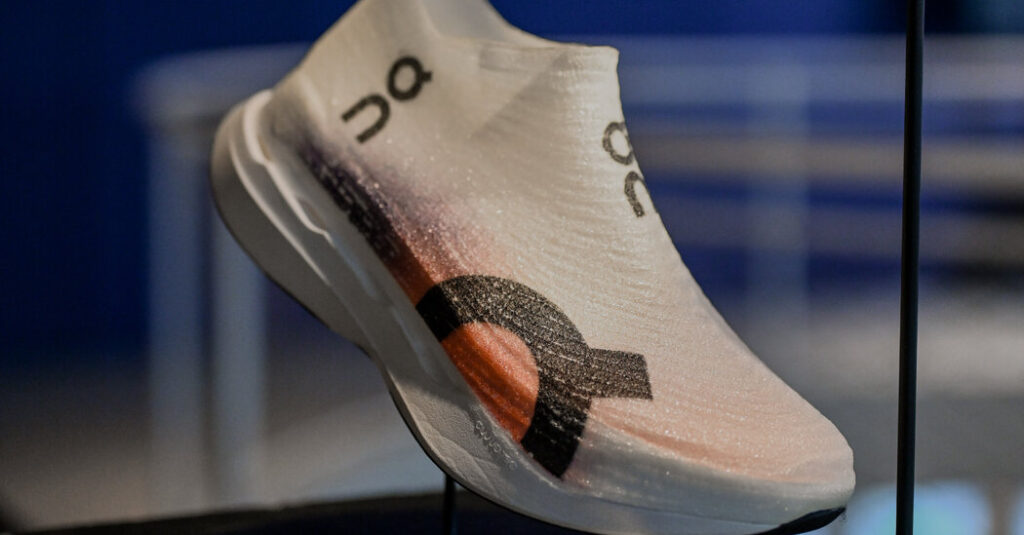
One innovation to come out of this process is the LightSpray running shoe. The company developed robots that mist the upper part of the shoe onto the sole within minutes. These crispy-thin shoes, which weigh less than half a pound, are the kind that Ms. Obiri wore when she won the New York City Marathon.
In late February, On opened a factory in Busan, South Korea, that can vastly increase LightSpray production, with the intention of selling to a broader market.
That broader market is still at the high end: The LightSpray can retail for $330. As fitness becomes ever more important, On executives say, consumers are willing to pay top dollar for the newest and most innovative products.
The company tries to maintain an aura of mass luxury. It doesn’t try to increase sales through discounting, a common retail practice, even on Black Friday. And while its sportswear appears in stores like Dick’s Sporting Goods and Foot Locker, it also operates stand-alone stores in key markets like New York and Shanghai to showcase its assortment in an upscale environment.
‘Hey, Run Free’
To keep up its reputation as an innovator, the company has beefed up the team that focuses on research and development. In early 2020, On had about 30 workers on its product team. It now has more than 550, about 14 percent of the work force.
Like any performance athletic brand, On will need to compete with Nike. In addition to running, On is known in tennis, though analysts say it needs to expand into sports where Nike is most present, such as basketball and soccer.
Executives at On often recount how they connected with Mr. Federer, who is now an investor in the company and has his own line of shoes. When the tennis star posted a photo of himself wearing the brand’s shoes at the French Open, executives took that as an “invitation to a date,” Mr. Allemann said.
“On is still at the beginning of what it can become,” Mr. Federer said in a statement.
The company insists that having the two founders step in to replace Mr. Hoffmann, is a sign of forward thinking and not turmoil.
“It’s more getting ahead of potential pitfalls that are not here yet, but that could be here,” Mr. Allemann said.
Analysts seem to accept that pitch. “They’ve never done things in the traditional way,” Janine Stichter, a retail analyst at BTIG, said.
Britt Olsen, who has been with On for 12 years, oversees the new revenue lines, evaluating if initiatives are side projects or real moneymaking opportunities.
“We try and always toe the line of, ‘Hey, run free, innovate, show us what you’ve got cooking,’” Ms. Olsen said. She acknowledged that it could be a hard task. The founders just keep coming up with new ideas.
Jordyn Holman is a Times business reporter covering management and writing the Corner Office column.
The post If On Shoes Are for Everyone, Are They Still Ons? appeared first on New York Times.