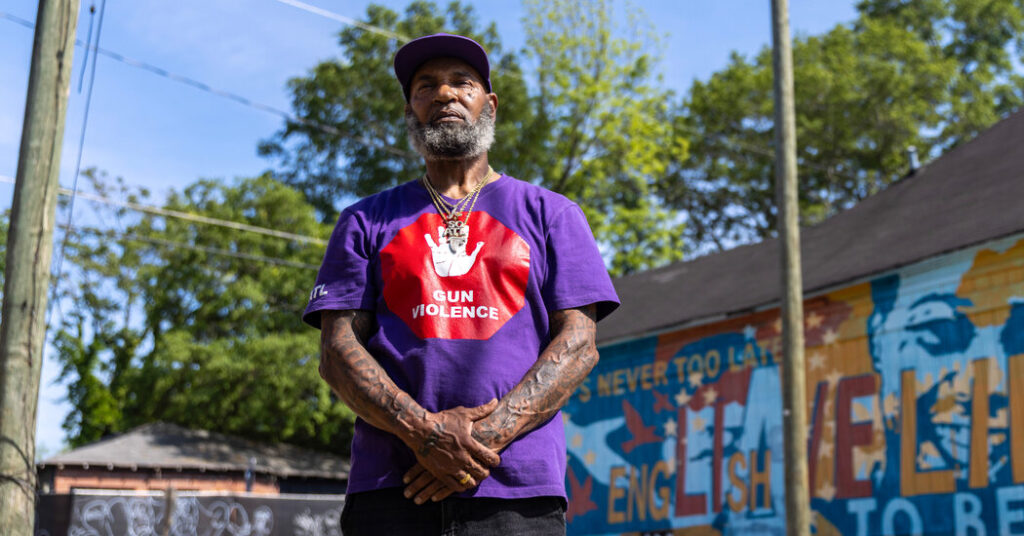
Derrick Sanders feared that if he did not return to the corners of Atlanta’s English Avenue neighborhood, more bodies would drop.
Mr. Sanders had been a street outreach worker for the Offender Alumni Association. But he was laid off in late 2025 after the organization lost $1.5 million in federal funds and was disbanded. Then, murders surged.
There were four killings the next month, Mr. Sanders said — all deaths he believes were preventable. One of the victims had been a participant in the Offender Alumni Association, the program where Mr. Sanders worked to de-escalate conflicts and mentor people at risk of committing violence. He had engaged regularly with two of the other victims in the community.
“When we were there to mediate situations, they would listen — we come to an agreement,” he said. “But when we left, that agreement left with us.”
After violent crime worsened alongside Covid-19, the federal government passed legislation including hundreds of millions of dollars in funding for community violence interventions. Community leaders and experts on crime nationwide gave some credit to these programs for helping bring homicides to historic lows in the years since. But the Trump administration withheld much of this funding upon taking office in 2025, leaving many programs scrambling to find alternative sources of support and community leaders uncertain if they can sustain the progress.
Violence prevention programs began taking root in America after lethal violence skyrocketed in the early 1990s. A new idea began to take shape in cities around the country: Treat violence like a disease, and combat it with public health techniques.
“The first step is to interrupt the transmission,” said Kwame Thompson, a violence interrupter with Stand Up to Violence in the Bronx for 11 years. Then, intervene with people in the community who are at high risk of perpetuating violence. “We identify them,” Mr. Thompson said, “and we work to help change their norms.”
Local governments and philanthropists funded pilots in cities such as Chicago and Boston, which were largely led by grass-roots organizations focused on providing resources to vulnerable individuals.
Throughout the 2000s and 2010s, homicide rates nationwide gradually but significantly fell from their heights in the 1990s.
Then, violence surged again during the Covid-19 pandemic. Community groups pushed to get relief funds for violence prevention and intervention strategies. With the passage of the American Rescue Plan and the Bipartisan Safer Communities Act, programs around the country could apply for federal funds. By 2023, the Biden administration had created a national Office of Gun Violence Prevention and invested more than $42 billion, according to Gregory Jackson, a former deputy director of the office.
With the federal support, states and municipalities established violence prevention offices, augmenting the work of police departments with programs focused on street outreach, hospitals, schools and other community pillars.
“The goal was truly to build out the prevention work,” said Rob Wilcox, a former deputy director of the White House’s now-shuttered Office of Gun Violence Prevention, adding that the funds would also help law enforcement personnel solve homicides and provide support for victim services. “That’s such a new and expansive way to think about how we address this crisis.”
Since 2022, the steep drop in homicides across the country gave credence to the effectiveness of the newly robust violence prevention paradigm. In 2025, Baltimore experienced its lowest homicide rate in 50 years. Los Angeles experienced a nearly 20 percent drop in homicides, which Mayor Karen Bass said was driven by the city’s “comprehensive approach to public safety.”
But researchers have struggled to empirically tie these improvements directly to the programs.
“The community violence intervention is so much about developing relationships with people who understandably distrust almost anybody coming to knock at the door,” said Shani A.L. Buggs, advisory chair at the Black & Brown Collective for Community Solutions to Gun Violence. “How you measure that kind of change is challenging, and that’s something that the field is still figuring out.”
Despite the constraints, some research supports the idea that these approaches can be cost-effective. A study by the University of California, Berkeley, found that for every dollar a prevention program called Advance Peace spent on intervention, cities in California that implemented the program saved more than $18 in spending on law enforcement, emergency services and other shooting-related costs. Another study produced by the Center for Gun Violence Solutions and the Johns Hopkins Bloomberg School of Public Health linked Baltimore’s Safe Streets program to a 32 percent reduction in homicides, finding that every dollar invested in the program had averted $7 to $19 in costs.
“I do believe that a lot of these programs have an effect, but we have to contend with the fact that the evidence is really weak for these programs on their own,” said Ben Struhl, executive director of the Crime and Justice Policy Lab at the University of Pennsylvania. “The evidence is strong for citywide strategies that contain these programs.”
Interventions can also be victims of their own success — less violence can mean less urgency to spend money on preventing it.
“You got to have support from local officials,” said Rodney McIntosh, a violence prevention worker in Fort Worth. “We know we save lives, but yet we have to fight every year just to be a part of the public safety ecosystem.”
Now, sweeping funding cuts at the federal level are hindering support for community violence interventions. A spokeswoman for the Department of Justice said the department is “committed to directly supporting law enforcement and victims to improve public safety and ensure the efficient use of taxpayer dollars.”
Some federal funds are still available, but they are scarce and require recipients to work with immigration enforcement officers, conditions that are deal breakers for some.
“Programs that were actively preventing shootings are now paused or dismantled,” said Monique Williams, chief executive officer of Cure Violence Global. “You have trained staff who are now laid off and trusted relationships in neighborhoods that are now broken.”
Programs that have managed to overcome cuts are leaning more heavily on local resources for support. Some cities and states have stepped in to make up for the shortfall, but the amount of federal funding that was lost is difficult to match.
With the funding cuts have come fears that violence could surge again.
“Violence prevention is important because of the human costs,” said Elinore Kaufman, a professor of surgery at the University of Pennsylvania and the medical director of a hospital-based violence intervention program. “I do expect that we’ll see increases in harm, increase in injury, increase in death, because we are taking away these essential supports that have proven beneficial.”
In Atlanta, Mr. Sanders and his team used to be a visible force in the English Avenue neighborhood, easily spotted in their purple T-shirts.
After the spate of violence that followed his program’s closure, Mr. Sanders stopped searching for another full-time job, took on part-time work and spent his free time with one of his former co-workers, trying to prevent more fighting. He said he would rather continue his intervention work unpaid than step away from the neighborhood.
“We were a daily reminder of ‘Hey, man, you don’t got to do it like that’ — it don’t take a gun to settle every situation,” Mr. Sanders said. “But now that reminder is gone.”
The Headway initiative is funded through grants from the Ford Foundation, the William and Flora Hewlett Foundation and the Stavros Niarchos Foundation (SNF), with Rockefeller Philanthropy Advisors serving as a fiscal sponsor. The Woodcock Foundation is a funder of Headway’s public square. Funders have no control over the selection, focus of stories or the editing process and do not review stories before publication. The Times retains full editorial control of the Headway initiative.
Shayla Colon is a reporter for Headway, a team at The Times that explores the world’s challenges through the lens of progress.
The post Violence Has Fallen, but So Has Funding for Prevention appeared first on New York Times.