Saulo Kasekela died of AIDS on March 7, in a small town called Mpongwe in the copper belt of northern Zambia. He was a 37-year-old security guard, admitted to the mission hospital two days earlier. After his body was wheeled out of the men’s ward, a nurse set aside his chest X-ray, a clouded smear of lungs devoured by tuberculosis, a hallmark of advanced, untreated H.I.V. infection. A scrawled doctor’s note indicated the X-ray should be saved for medical students.
Of the eight patients in the ward at day, four had AIDS. Lewis Chifuta, 33, was bone thin, feverish and barely able to recognize his siblings when they reached his bedside.
A year ago, in Mpongwe, there was one case like this each month, or maybe two. In January this year, there were 28 new cases; in February, 28 more; in March, seven more.
During President Trump’s first month in office, his administration upended much of the flagship global H.I.V. program that had saved the lives of hundreds of thousands of people in Zambia. The Zambian government went into emergency mode, desperate to ensure that people with the virus could continue to receive lifesaving medications.
But other crucial aspects of the program had to be scrapped — interventions that had helped stop the spread of the virus and protected the most vulnerable people, those like Mr. Kasekela.
Today, a pared-down system is operating on reduced U.S. support, and Zambia may lose that help entirely in the next few days. The Trump administration has set an April 30 deadline for the Zambian government to accept a new health funding agreement that is tied to giving the United States expanded access to the country’s mineral resources.
The administration says the deal would offer Zambia five years of funding and help to build a stronger system that gives the country more control. But if Zambia doesn’t sign, officials warn that Washington could cut off all of its H.I.V. aid, a situation health officials here say would be disastrous.
What is happening in Mpongwe now is a grim echo of a time that most of the nurses and clinicians here are not old enough to remember. Three decades ago, hospitals in Zambia were packed with young men and women dying agonizing deaths, and the H.I.V./AIDS pandemic had overwhelmed the health system. Life expectancy had dropped to 37.
In 2003, President George W. Bush’s administration launched a historic humanitarian response to the pandemic — the President’s Emergency Plan for AIDS Relief, or PEPFAR — and Zambia was a focus country. By then, a lifesaving cocktail of antiretroviral medications had beaten back AIDS in the United States and other high-income countries, but the drugs cost tens of thousands of dollars, and almost no one in Africa could get them.
PEPFAR changed all that. Hundreds of thousands of people were given free access to those drugs in cheap generic forms. The United States built a network of laboratories and clinics that drew on the best of American innovation and technology. The rate of new infections was driven steadily down. Life expectancy in Zambia rose back to 67.
Then, last year, as part of its restructuring of foreign aid, the Trump administration cut off its funding for H.I.V. programs, saying many of the programs had been wasteful and an inappropriate use of taxpayer dollars.
Then it restored some of the funding, then withheld some. The United States Agency for International Development was delivering PEPFAR services in the northern half of Zambia — the region with highest rates of H.I.V. prevalence and transmission in the country — through dozens of local organizations. They closed abruptly.
Zambia’s top officials held emergency meetings and sent a directive to provincial health offices: Redeploy whatever staff you have to keep the antiretroviral medication moving.
“It was like a military state of emergency,” said Dr. Suilanji Sivile, the national technical adviser to the H.I.V. program. They managed it: 2,885 treatment facilities, a vast majority, have stayed open, he said. Most of the medications they distribute were purchased by the United States.
Today, the Zambian government says that most of the 1.3 million people who were on H.I.V. treatment in January 2025 are still receiving their drugs. (The health ministry estimates that 100,000 people stopped taking their medication in the upheaval, and 40,000 of them have yet to be re-engaged.)
But because many prevention services have been cut, health officials fear infection rates are inevitably rising. Testing has been cut, too, though, so they cannot be sure how much or how quickly. Many new H.I.V. infections will not be caught until people are seriously ill, and by then they may have infected others.
Dr. Lloyd Mulenga, who leads Zambia’s national H.I.V. program, sat with his colleagues in early 2025 and did the painful exercise of deciding what services they would cut.
They kept the bare essentials, Dr. Mulenga said, but much else had to go:
-
When a person tested positive for H.I.V., a team traced that person’s sexual contacts, counseled and tested each of them and put them on H.I.V. treatment if they were infected. This labor-intensive system, known as index testing, found 70 percent of the infections identified each year. It has shut down.
-
Pregnant women with H.I.V. had the amount of virus in their system tested three times over their pregnancy, so that a clinician could respond quickly to any hint that their medication was failing and their fetus exposed. That testing has been cut to once.
-
Babies born to H.I.V.-positive mothers were tested for the virus through a highly accurate but expensive genetic test within hours of birth, and antiretroviral treatment was started immediately for those who tested positive. Now babies are not tested until 6 weeks old, when a cheaper standard blood test can be used.
-
Everyone who came to a medical center for any kind of care was tested for H.I.V. Now testing is restricted to people who ask for a test or who have another sexually transmitted infection or tuberculosis symptoms.
-
The genetics of the virus infecting people newly diagnosed were sequenced, indicating how new the infection was: When the data showed a number of recent infections in people from one place — like a hub on a trucking route, for example — a “hot zone” team could blanket the area with testing and prevention services. The ministry of health decided it could not fund that testing.
-
Antiretroviral drugs were distributed in communities — in small market shops, at churches — making it easy and discreet for people to get their medication. Those sites were closed.
-
Community health workers phoned people to remind them of appointments and, if they did not turn up, went to their homes or traced them to new locations, to make sure they did not miss a dose of medication. Most of those workers have lost their jobs.
-
People from communities that are highly vulnerable to H.I.V. infection but who may face harassment or shame in the main medical system — gay men, sex workers — received services in small, dedicated sites. Those have been closed.
-
At every H.I.V. treatment site, data teams used electronic records to track who was positive, who picked up their medications and whose viral load was uncontrolled — so that clinicians could track patients. Most have returned to using paper.
-
Teenage girls have for years been the demographic most likely to be infected with H.I.V. Dedicated programs worked to target them with H.I.V. prevention and educational and vocational training to motivate them to avoid infection. Those were closed.
-
More than 100,000 Zambian men were given free circumcisions each year. (Circumcised men are less likely to become infected or transmit H.I.V.) That program was canceled.
A year later, the impact of all these cuts is visible in the hospital wards and H.I.V. clinics in the copper belt.
At the mission hospital in Mpongwe, Dexter Fundulu, an H.I.V. clinician, closed out Mr. Kasekela’s file after he died. Mr. Fundulu had diagnosed Mr. Kasekela with H.I.V. in December. But his new patient lived about 40 miles from the hospital, and he did not show up to pick up his medications in January or February. The mobile community team that used to deliver medicines to patients like him had been eliminated.
It seemed, Mr. Fundulu said, that more patients had been missed, or fallen away from care, in the upheaval a year ago. Now the devastating symptoms of uncontrolled H.I.V. are catching up with them.
At a clinic in a gritty neighborhood called Chipulukusu, in the regional hub of Ndola, Maureen Dhaka, who has H.I.V., gave birth on March 5. The baby was chalky and silent, the umbilical cord wrapped around his neck, and an ambulance was summoned to take mother and infant to the children’s hospital.
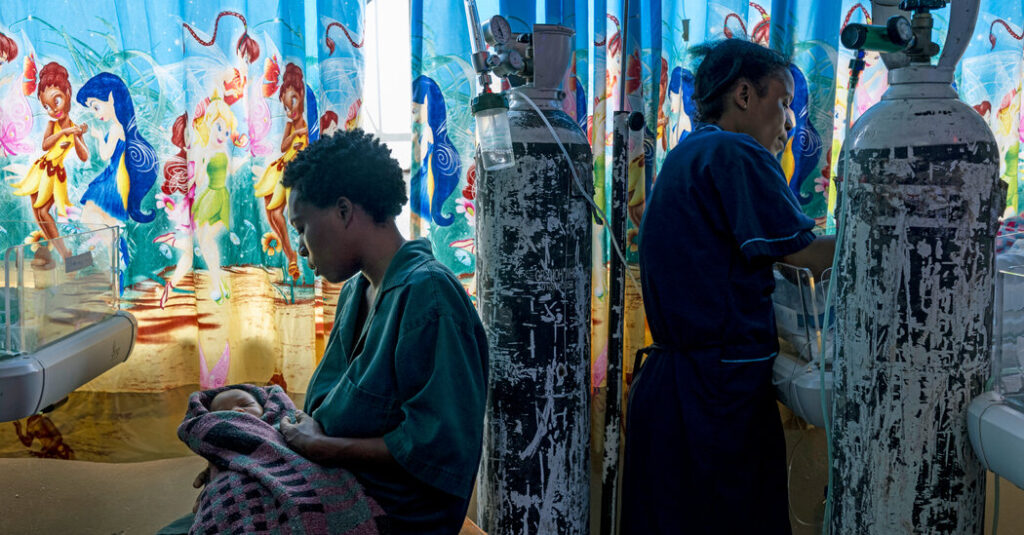
There, the baby was placed on oxygen, and began to regain color. But no one tested him for H.I.V., even though his mother lives with the virus. No one gave him H.I.V. prophylaxis for nearly two full days after his birth, even though every moment counts to prevent an infection.
Before the cuts, a community health worker would have accompanied Ms. Dhaka and the baby to the hospital, and made sure the baby was swiftly given prophylaxis. Today, only one community health worker works at the Chipulukusu clinic, not five, and she did not catch up with Ms. Dhaka for days.
In Ipusukilo, a scrappy community outside the mining town of Kitwe, a 25-year-old patient named Precious Mulenga came to the H.I.V. clinic to pick up medication in February. When she arrived, she learned that the clinic — where a staff of 11 was reduced to just one for months after the funding cuts — had lost track of the results of a blood test she had taken last July. Those results were alarming: Her viral load was high. But there were no community health workers left to track her down to let her know, and help her take the correct medication to control it.
When Ms. Mulenga learned of those results seven months later, she was pregnant. The child she was carrying had been exposed to the virus for months. She was tested again, and in March came back to hear the new results. She sat, swinging her feet with anxiety, in the office of Ireen Lubwesha, the clinician who ran the clinic alone for much of last year. Ms. Lubwesha read Ms. Mulenga’s file, lifted her eyeglasses, and rubbed at the bridge of her nose. Here was another child facing a potential lifetime of infection, and it could have been avoided.
Despite years of discussion and millions of dollars spent on “localization” — moving responsibility for running services from PEPFAR to countries’ governments — the disruptions of the past year have made clear how little the Zambian government has taken over in the past two decades.
Thousands of critical health care workers were still employees of aid groups, and not the ministry of health, so they lost their jobs. Ministry employees had no idea how to use the drug- and test-ordering system. In Ndola they had to plead with the fired data clerks to come back and teach the remaining clinicians the passwords and how to look up patient records. The purchase of medications, operation of the supply chain, payment of staff: Zambia had continued to let the United States pay for and manage almost all of it.
At clinics throughout the north, visitors last month would see paper records stacked into teetering piles on desks, and heaped into boxes. Many clinics no longer have the funds to pay for internet access, so the tracking is intermittent and haphazard. That has led to weeks- or monthslong delays to follow test results.
At the Chipulukusu clinic, diagnosing infants now takes six weeks, not a week or 10 days as it used to. The region has a highly mobile population, people who cycle through the mines and related jobs, and in the six weeks it takes to learn if a baby is infected, mothers have often moved on — no one finds out children have contracted H.I.V. until they repeatedly fall ill. Half of Zambian children with the virus will die before age 2 if untreated.
There have been more new infections, more suffering and more deaths, Dr. Mulenga, the head of the country’s H.I.V. program, acknowledged. But Zambia is in the process of taking full responsibility for its H.I.V. program, and when it does, the country will be stronger, he said.
He hopes that a big push to distribute H.I.V. prevention medications — especially the new injectable lenacapavir, which provides protection from the virus for six months after each shot — may make up for the strategies that have been cut, and renew the effort to end the epidemic.
The United States continues, for now, to pay for a reduced but still significant amount of the H.I.V. care here, through bridge funding intended to carry the program while a new aid model is implemented.
The State Department is negotiating new health assistance funding agreements with countries that used to have U.S.A.I.D. support. These come with conditions, and Zambia’s has proved particularly thorny, because the State Department has tied support for the H.I.V. program to access to the country’s minerals.
The department has warned Zambia that if no agreement is signed by April 30, all U.S. support will end.
Zambia still has the support of the Global Fund to Fight AIDS, Tuberculosis and Malaria, but that fund is also heavily reliant on the United States and is cutting its budget.
Without a deal, Zambia will have to take over buying and moving antiretroviral drugs, laboratory chemicals, and H.I.V. tests itself; it is entirely ill prepared to do so. “If the stocks we have are the last we will get, what will we do?” Ms. Lubwesha said. “I always think about it. It will mean death.”
Under the terms of a draft agreement seen by The New York Times, Zambia would agree to hire thousands of new health workers, to replace those once paid by the United States. Dr. Mulenga hopes many will be community health workers who can restore some of the outreach that kept people in care.
In Ipusukilo, the bridge funding has allowed the clinic to rehire one data technician and a community health worker. Of the 2,000 people they had on antiretrovirals in February 2025, they lost 500 but have managed to bring 200 back. But there is no more testing or tracing the contacts of infected people.
These days, two or three people turn up in Ms. Lubwesha’s clinic every week with dangerously compromised immune systems, she said. “I know we can’t just depend on donors, we have to live within our means,” she said. “But it’s like we don’t care like we used to.”
Stephanie Nolen is a global health reporter for The Times.
The post AIDS Creeps Back in Parts of Zambia, a Year After U.S. Cuts to H.I.V. Assistance appeared first on New York Times.