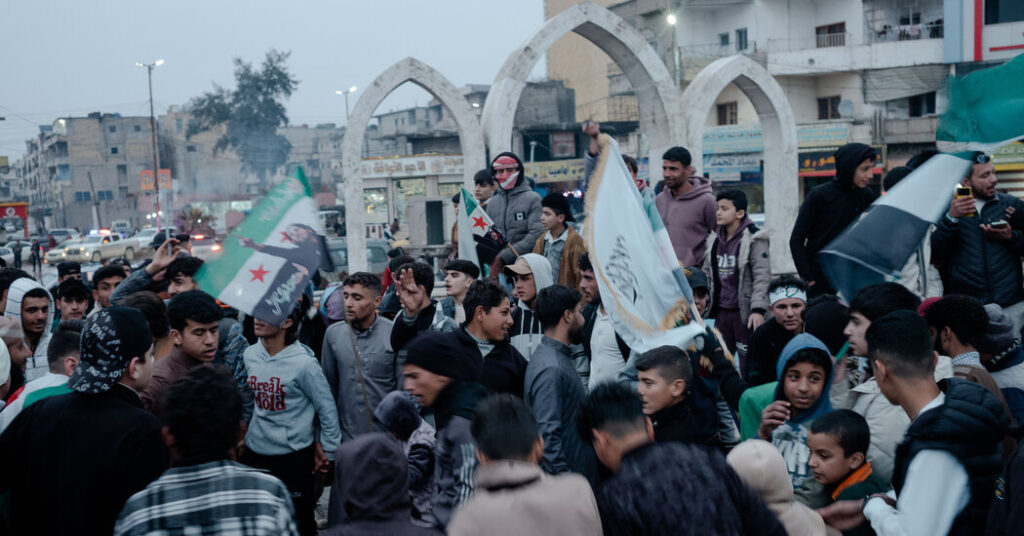
We arrived within days of the government’s takeover of the northeastern Syrian city of Raqqa, and one of the first things we saw was protesters in the main square.
A group of lawyers and activists, stalwarts of the 2011 Arab Spring uprising against the dictator Bashar al-Assad, had gathered to hoist Syria’s national flag. They had seen on social media that a group of Islamists was on its way to raise a religious flag on the square and they wanted to pre-empt them.
“We sacrificed a lot for the revolution, and we will not let others raise their flag,” Duha Fraih, 48, a lawyer who wore the green, white and black flag of the revolution — now the national flag — around her shoulders, told us.
The protest was small, but it revealed the divisions that run through Syrian society, and nowhere more so than in Raqqa.
Raqqa became infamous as a center of terrorism when the Islamic State, or ISIS, under its black banner made it the capital of its caliphate in Iraq and Syria 12 years ago.
ISIS imposed a bloodthirsty rule and instigated terrorist attacks abroad, which brought U.S. forces to Syria more than a decade ago. The American-led coalition bombed Raqqa heavily to oust ISIS, at great cost to the civilian population.
A Kurdish-led group, the Syrian Democratic Forces, or the S.D.F., allied with American forces then occupied Raqqa and much of northeastern Syria. It controlled the region for nine years until through a mixture of negotiation and military muscle the government of President Ahmed al-Sharaa took control in January.
Over the years of Syria’s civil war, I interviewed scores of people from Raqqa — activists, soldiers, victims of torture, even terrorists. So when the Syrian government seized control of the city and province, it was a chance to see the wellspring of so much turmoil firsthand for the first time.
“Raqqa has a great history, but we also have a black history,” Mustafa al-Issa, the head of a government reconciliation center, told us.
Mr. al-Issa had joined the Arab Spring protests. He had celebrated in 2013, when Raqqa became the first provincial capital to expel the Assad government. But within months, ISIS fighters took over the city and declared their caliphate.
He fled Raqqa in 2014 and earned an M.B.A. abroad as a refugee. He said he could safely return home only now.
He found the city battered, still showing destruction from American-led bombing and struggling with power outages, poverty and widespread drug addiction.
“When we liberated Raqqa for a second time, we felt happy, as we did in 2013 before ISIS took away our achievement,” he said. “But when we saw it, it was a bittersweet feeling.”
Beneath the city, government soldiers found miles of tunnels and bunkers dug by the Kurdish-led forces and even modern living apartments.
“If they had done above ground what they did underground,” Mr. al-Issa said, “they could have built the whole city.”
Nearly everywhere around Raqqa people were celebrating the takeover by the government, happy to be reuniting with relatives after years of separation and hopeful for the future.
Many did not hide their bitterness for the Kurds, and for their American backers.
“I have a space of freedom that I could not find under ISIS or the S.D.F.,” said Mustafa Sadiq, 40, a humanitarian worker, though he was skeptical of any swift democratic transition.
On Naim Square, an unruly group of teenagers and young men danced to music on a central marble dais in a spot where ISIS once held public executions and displayed the severed heads.
The square had been repaired, but driving around, we could see whole blocks still in ruins.
The once grand governor’s palace, destroyed by American-led airstrikes, had been cleared away and was an empty plot. A broken pedestal was all that was left of the statue of the dictator Hafez al-Assad, the father of Bashar, pulled down when the regime was ousted in Raqqa in 2013.
Nearby was the compound of the state security office. It had also been bombed and the rubble cleared. Only the arched gateway was still standing. Many protesters were once interrogated under torture there by the Assad government’s security services.
I stood at the entrance recalling my interviews with survivors who had testified against two former officials who were indicted recently by an Austrian court on counts of torture.
We visited the great hulking city walls and the courtyard of a grand mosque, reminders of Raqqa’s prominence when it served as a capital of the Abbasid empire in the eighth century.
Under the rain, the city seemed a bleak place of cratered roads and muddy potholes. Practically everyone recalled wistfully the prosperous agricultural city that Raqqa once was.
The Euphrates, one of the great rivers of Mesopotamia, which gave life to the world’s earliest civilization, feeds the surrounding fertile lands. Beloved to the people of Raqqa, the river offers cool respite during the blistering summers.
I messaged a colleague to say I was in his home city. “Now you have seen our river,” he wrote back.
Carlotta Gall is a senior correspondent, covering the war in Ukraine.
The post Raqqa Showcases Syria’s Tumultuous Past appeared first on New York Times.