Dawa Jangbu Sherpa is one of 11 elite doctors who monitor the perilous slopes of Mount Everest. But he isn’t there to address medical emergencies — the mountain itself is his patient.
He and a team of other Nepali mountain guides, known as “icefall doctors,” tend to Everest’s ever-shifting landscape. Mr. Sherpa operates on a two-mile stretch of treacherous terrain near the peak, called the Khumbu Icefall, mending routes with ropes and ladders to establish safe paths for the hundreds of climbers who attempt the summit each year.
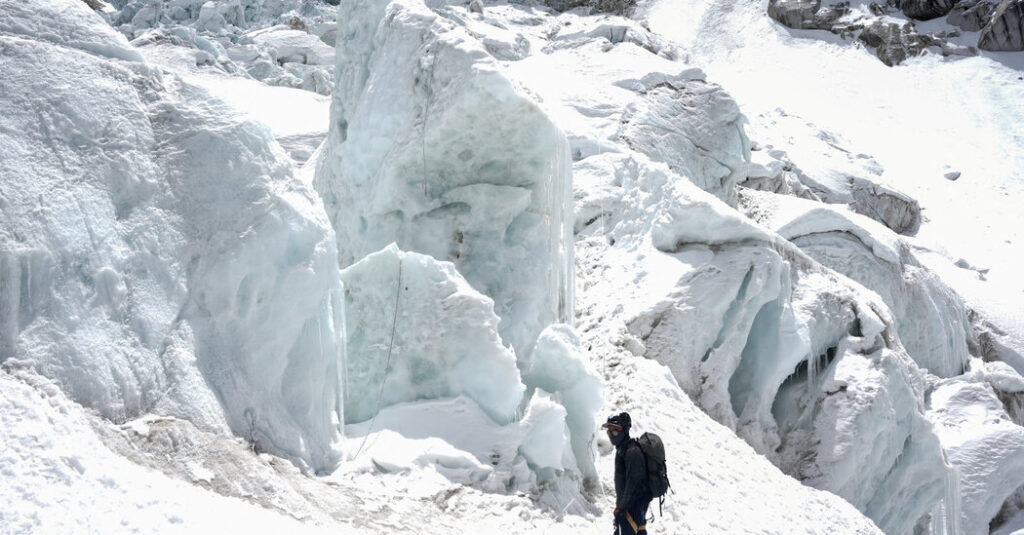
Mr. Sherpa and his colleagues have come under extra pressure this week as hundreds of climbers at Everest’s base camp stare up at an obstacle between them and the highest point on earth: a towering blue-white ice wall that has blocked the only passable path to the top.
“The paths are generally blocked by layers of snow every year, but I’ve never seen one this big before,” Mr. Sherpa, 28, said in a phone interview from the camp more than 17,000 feet above sea level.
After visiting the ice and surveying it with drones, he and other icefall doctors deemed it too risky to pass because of its uncommonly large size. But they have struggled to find an alternate path. This has forced the hundreds of climbers to wait for days until the ice wall melts and collapses.
The ice wall, called a serac, appeared about a week ago after heavy snowfall, Mr. Sherpa said on Friday. The blockage has shortened the brief window of time when climbers can reach the peak during the busy spring season.
The wall is expected to melt completely by Monday, he said. But with each passing day, the base camp grows more crowded.
More than 400 climbers from around the world are waiting there, said Dawa Steven Sherpa, secretary of Expedition Operators Association Nepal, a nonprofit that promotes mountain expeditions in the country. (He is not related to the icefall doctor, who shares the surname Sherpa with many other mountain guides.)
“Smaller blockages are common,” said Himal Gautam, director of Nepal’s Department of Tourism. “I don’t remember this level of blockage by a serac in recent times.”
Each year, between 700 and 1,000 climbers, guides and porters try to reach the summit of Mount Everest. Their expeditions provide a major source of revenue for the Nepali government. Recently, it increased the permit fee for foreign climbers during the peak spring season to $15,000 from $11,000.
Climbers aiming for the summit must first arrive at base camp, a sprawling tent city below the Khumbu Icefall. Above the icefall, there are three other camps where the trekkers stop before reaching the peak.
But none of those camps are accessible until the icefall doctors establish routes through the constantly shifting glaciers of the Khumbu Icefall at the beginning of each climbing season.
Even among the experienced Nepali mountain guides at Everest, icefall doctors are especially capable. They perform what is widely regarded as the most dangerous job on the mountain.
“We are called icefall doctors because we repair the route to the summit,” said Mr. Sherpa, who has worked as a porter and mountain guide on Mount Everest for 10 years.
He and his team work for the Sagarmatha Pollution Control Committee, a nongovernmental body that oversees operations on Everest. Before each season, they venture into the Khumbu Icefall to assess the terrain. They hammer in anchors, string ropes and lay aluminum ladders across crevasses that plunge hundreds of feet into darkness. Their work enables other guides and climbers from around the world to traverse the icefall.
But this year, the ice doctors said they had not found a safe path.
Their concern for safety has been heightened by recent memories of a disaster. An ice wall that collapsed at Khumbu Icefall in April 2014 killed 16 guides, some of whom were preparing paths for other climbers. It was the single deadliest day on Mount Everest.
Still, the icefall doctors understand the importance of the climb for those waiting to make it. “Hundreds of people from different corners fulfill their dreams to be at the top of the world,” Mr. Sherpa said.
If the ice wall does not melt in time, Nepal’s Tourism Department said it would help airlift guides from the base camp to a higher point so they can get a head start on laying the ropes in the upper area. But this would not allow the climbers to bypass the ice.
Even when the route opens, it could be clogged by a single-file march of hundreds of people, which introduces separate hazards.
“Mountains are dangerous,” said Mr. Sherpa, who has reached Everest’s summit three times. “A single mistake can take a life.”
John Yoon is a Times reporter based in Seoul who covers breaking and trending news.
The post The Elite ‘Doctors’ Who Care for Mount Everest appeared first on New York Times.