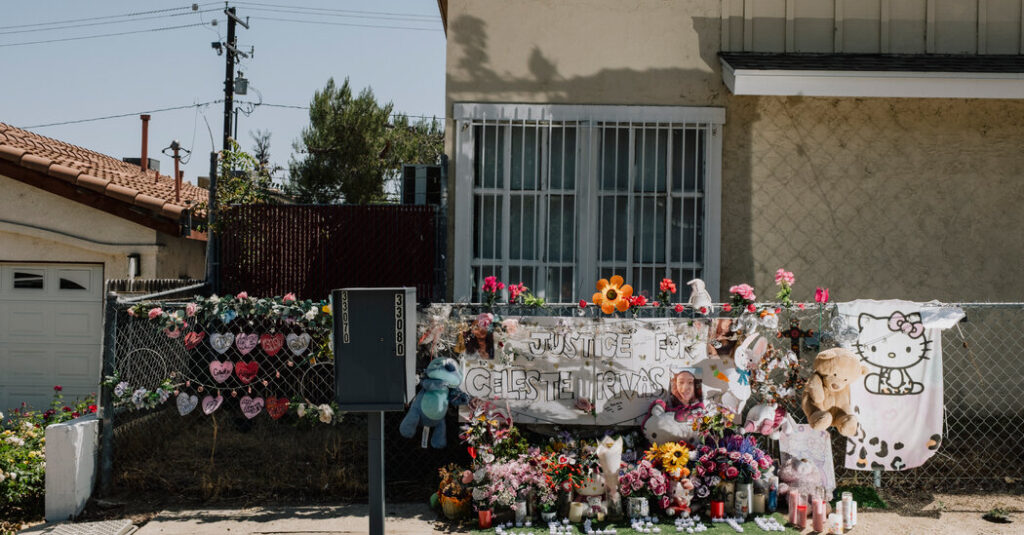
It was far from a simple death investigation.
The remains of a teenage girl were discovered in early September in the front trunk of a Tesla that had been abandoned for weeks on a Los Angeles street during peak summer heat. The body — dismembered and placed in black bags — was decomposed beyond recognition.
The pressure on law enforcement to solve the case intensified once it emerged that the car was registered to David Burke, a rising indie-pop singer with a huge Gen Z following who performs as D4vd.
But the investigation dragged on, for seven months, with few updates from the Los Angeles Police Department.
The silence ended when the authorities arrested Mr. Burke on April 16 and then charged him with the murder of 14-year-old Celeste Rivas Hernandez. He has pleaded not guilty.
There were no shortage of challenges for those trying to solve the mystery of Celeste’s death.
The authorities have said more than four months passed between her killing and the discovery of her body, a gap that complicated evidence collection. They encountered resistance from some witnesses during their investigation, driving prosectors to convene an investigative grand jury that could allow for witness testimony to be compelled. All the while, misinformation was swirling around Los Angeles and online.
In interviews after Mr. Burke was charged, officials for the Los Angeles Police Department and the Los Angeles County District Attorney’s Office said the case was built methodically and brought forward when it was ready.
“We need to make sure that whatever case we bring to the district attorney’s office for prosecution is going to be able to meet the ‘beyond a reasonable doubt’ standard,” said Capt. Scot Williams, who runs the Police Department’s robbery-homicide division, the unit responsible for investigating Celeste’s murder.
“And if it takes a little bit more time,” he continued, “as this one did for a variety of reasons, we will not change the way we do business.”
Nathan J. Hochman, the Los Angeles County district attorney, said that the hurdles facing law enforcement officials included uncooperative witnesses and, he said, the fact that investigators did not identify anyone else who saw the crime.
“Where you have, in this case, no witnesses — direct witnesses — to the murder, other than probably the murderer,” Mr. Hochman said, “then you’re trying to piece that case together through every other means possible.”
Prosecutors decided to convene an investigative grand jury, a powerful and secretive tool that is used to procure hard-to-reach documents and to compel resistant witnesses to testify under oath. Several family members fought the subpoenas in court, and a friend of Mr. Burke’s was arrested in Montana after failing to appear for his testimony.
On Monday, prosecutors pressed forward, charging Mr. Burke, 21, with first-degree murder with the special circumstances of lying in wait, committing the crime for financial gain and murdering a witness to an investigation. He is also accused of sexually abusing Celeste when she was 13 years old and of mutilating her body after killing her.
The murder charge carries a maximum sentence of life without the possibility of parole, or the death penalty, which prosecutors have not yet decided whether to pursue.
Mr. Burke’s lawyers have said in a statement: “The actual evidence in this case will show that David Burke did not murder Celeste Rivas Hernandez and he was not the cause of her death.”
The decision to file charges is only the beginning for prosecutors.
The criminal complaint started the clock for a flurry of legal deadlines, including for turning over to the defense a vast tranche of related information — about 40 terabytes, prosecutors have said.
“Enough discovery that, if you were to read every page of it, it would keep you busy for years,” Mr. Hochman said.
Prosecutors will now have to get the charges through a judge in a preliminary hearing, which resembles a mini-trial, or take the case back to a grand jury to seek an indictment. If successful in either scenario, they will then present the case to a jury.
Mr. Burke, a singer known best for creating the anthem for Fortnite, commands a huge online following, turning the grisly death into an immediate tabloid fixation.
After Mr. Burke’s abandoned Tesla Model X was towed, the manager at the impound lot noticed an odor of decay and flies surrounding the vehicle. The manager called the police, who discovered the corpse in the front storage compartment of the car.
The body was so decomposed that the head was partially skeletonized, and it took about eight days for the medical examiner’s office to identify Celeste using dental records, according to the office’s report.
Her limbs had been severed, two of her fingers were missing and there were two “penetrating wounds” caused by sharp objects — one to the chest and one to the abdomen, the report said.
The district attorney’s office unearthed more information through the investigative grand jury, a process that in California empowers prosecutors to secure subpoenas without asking the jurors to vote on whether to indict a suspect.
“The case probably had some pieces that were locked up behind reluctance or secrecy, and the grand jury is how you pry those pieces loose,” said Sam Ahmadpour, a criminal defense attorney and former prosecutor for Los Angeles County.
Grand jury proceedings are secret, but bits of information trickled out through TMZ, which staked out the courthouse to observe who came in and out.
Some details also emerged through a court battle in Texas, where Mr. Burke’s parents and brother objected to subpoenas to appear before the grand jury in February. The Tesla where Celeste’s body was discovered had been registered to the singer’s family home in the small city of Hempstead outside Houston.
Lawyers for Mr. Burke’s family members argued that their clients had not been provided sufficient justification from prosecutors about why their testimony was required.
“I would say if a car with a dismembered decomposing body is registered to your home address, that is something you should expect to be questioned by the authorities about,” said Bennett Dodson, a prosecutor in Texas who assisted his counterparts in California, according to a transcript of the hearing in February.
The judge for the lower court agreed, but Mr. Burke’s father appealed the case up to a Texas appellate court. Kent Schaffer, a lawyer representing the parents, said they were not ultimately required to travel to California to testify. Whether the brother was compelled to testify is not clear.
Mr. Burke’s lawyers have begun to push for a preliminary hearing as early as next week.
At a hearing on Thursday, while Mr. Burke was seated in the courthouse in an orange jumpsuit and wrist shackles, the prosecution and the defense sparred over the time it was taking for the district attorney’s office to hand over the enormous pile of discovery.
“We don’t see a reason for them not to release it,” Marilyn Bednarski, one of Mr. Burke’s lawyers, told the judge.
Prosecutors said in court that it was an enormous collection of data that would take time to fully transmit. Beth Silverman, a deputy district attorney, said the records include grand jury materials and a wire tap that are currently sealed, as well as data from Mr. Burke’s iPhone, which she said includes child sexual abuse material that can only be viewed in the prosecutors’ office.
Both sides are projecting a sense of urgency.
“Today it’s been exactly one year since the death of Celeste,” Ms. Silverman said at the hearing on Thursday, “and the family wants this to proceed quickly.”
Rachel Parsons contributed reporting. Alain Delaquérière contributed research.
Julia Jacobs is an arts and culture reporter who often covers legal issues for The Times.
The post The Long, Challenging Road to D4vd’s Arrest appeared first on New York Times.