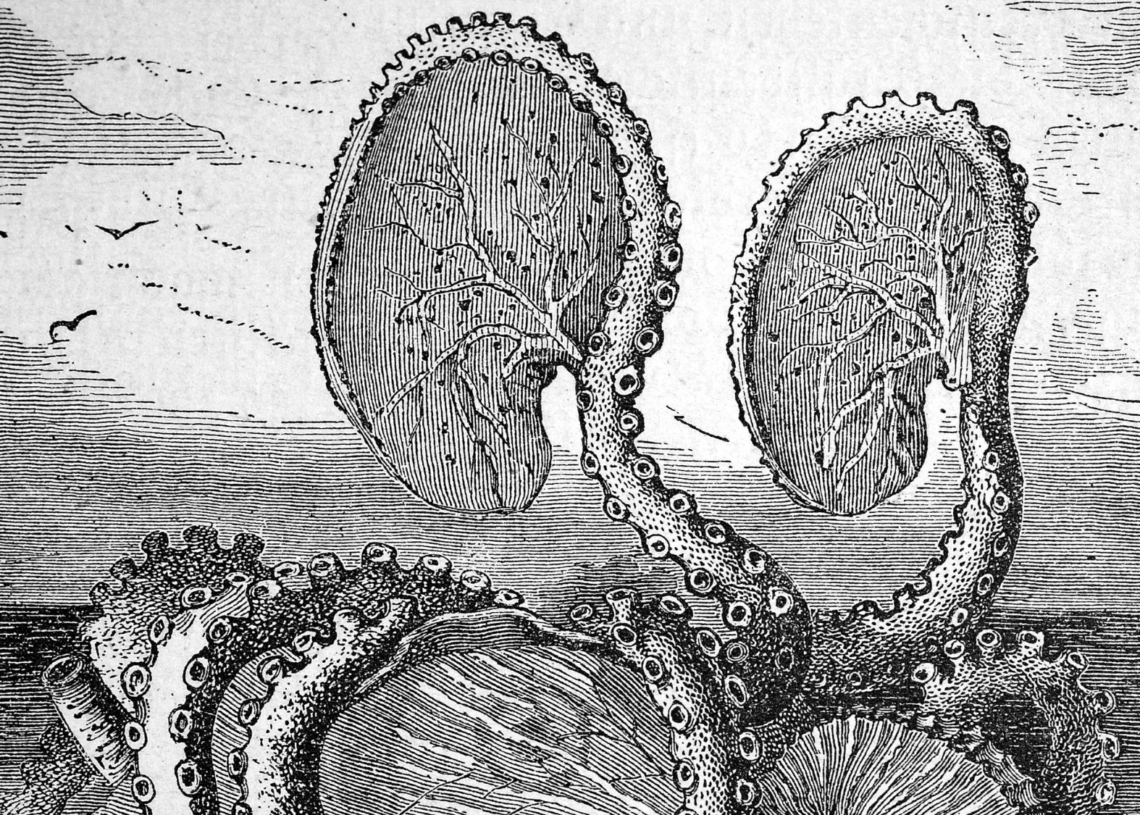
The Kraken was not real. It’s a piece of fiction dreamed up thousands of years ago to terrify sailors and entertain Norse mythology fans. Like an ancient version of Bigfoot. But just because it wasn’t real doesn’t mean something like it couldn’t have been.
According to research published in Science, a team of scientists has uncovered fossil evidence of a massive, kraken-like octopus that lived around 100 million years ago. You know, way before humans, our myths, or Scandinavia even existed.
CNN reports that the creature, named Nanaimoteuthis, is estimated to have reached lengths of up to 60 feet. This puts it in the same size range as some of the largest marine reptiles of the time. That alone would be enough to earn it a reputation, but what really stands out is that it likely sat near the top of its food chain.
Octopuses don’t have a skeletal structure. When they die, it’s only a matter of time before evidence of their existence rots away entirely. One of the few parts that stick around for millions of years is their jaws. Scientists found evidence of the Nanaimoteuthis’ jaw, which showed heavy wear and tear, including chips and scratches consistent with crushing hard prey like shells, or even pulverizing bones.
That suggests these massive creatures were actively hunting and chomping their way through large, tough prey.
Scientists Found Fossils of a Massive Kraken-Like Octopus
The fossils were identified using a combination of traditional analysis and newer techniques like “digital fossil mining,” which scans rock layers at high resolution to peek inside.
This discovery in the theories of where it sat in the food chain throws a wrench into what we know about late Cretaceous oceans. We know those seas were packed to the brim with predators of all kinds, like the plesiosaurs (which look like a brontosaurus with fins and razor-sharp teeth) and the mosasaurs (which looked like a gigantic cross between a gator, a T. rex, and a whale).
There were also gigantic sharks swimming around the oceans at the time. It was generally assumed that vertebrates ruled those seas, but this discovery hints that at least some invertebrates, like freaking huge octopuses, were hovering around somewhere at the same level.
There will be debate for years to come about exactly how dominant these creatures were. It’s not like we have direct evidence of stomach contents to provide some clues as to the exact creatures they ate. It could’ve taken on gigantic sea beasts its own size or bigger, or it could have taken the chiller route and snacked on smaller, easier creatures. But their size and jaw strength suggest that these things are capable of inflicting some serious damage, and surely they must’ve used it for some reason. Usually, that reason is eating big, mean things.
The literal Kraken of Norse myth was never real, but those imaginative Norse myth makers were on to something. But, then again, it’s probably not too hard to imagine a gargantuan octopus after seeing a regular, massive octopus.
The post Scientists Uncovered Fossils of a 100-Million-Year-Old ‘Kraken’ appeared first on VICE.