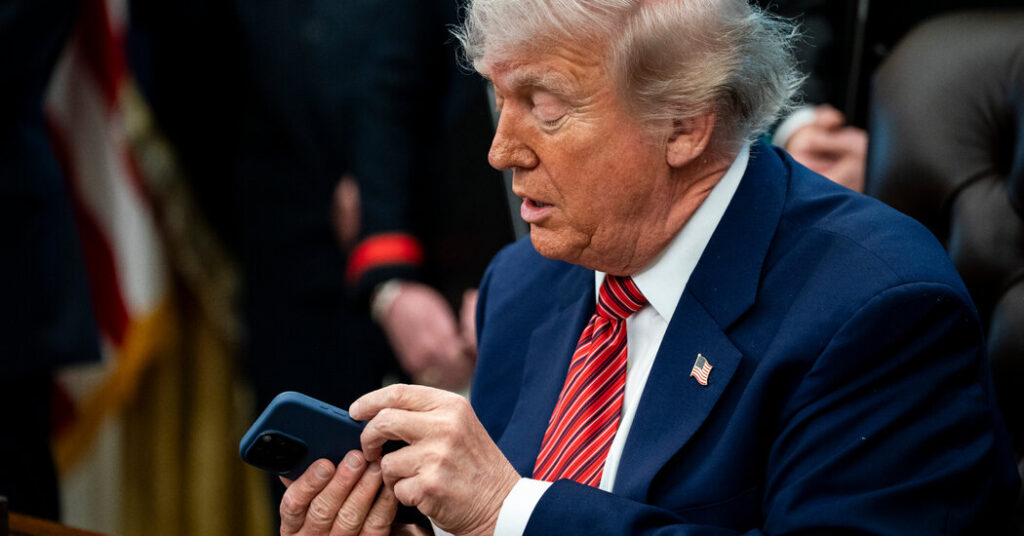
Two government watchdogs sued President Trump and the White House on Friday over internal guidance that instructed that some text messages exchanged between officials could be deleted, despite a law generally mandating the preservation of presidential records.
The watchdogs, Citizens for Responsibility and Ethics in Washington and the Freedom of the Press Foundation, also asked a federal judge to overrule a separate but related Justice Department memo, which declared unconstitutional a longstanding federal law requiring safeguarding of presidents’ records, including text messages. The White House guidance cited the memo.
Their lawsuit comes amid a torrent of accusations that the Trump administration has disregarded record-keeping and document disclosure required by law, even as the president and his officials have sought to transform the government and push the legal bounds of their power. They have displayed a particular willingness to skirt record-keeping requirements on text messages exchanged among top officials.
In their complaint, the two watchdogs said the “deficient instructions” from the White House would “result in the irreparable loss or destruction” of presidential records.
“These text messages capture the day-to-day business of the most powerful office in the country — and arguably the world,” said Lauren Harper, who advocates government transparency for the Freedom of the Press Foundation.
She added that the memo “sanctifies” the idea that the president and his White House officials “get to decide what becomes part of the American story,” which she views as “fundamentally wrong.”
The White House did not immediately respond to a request for comment. But the complaint cited a White House statement from this month: Mr. Trump “is committed to preserving records from his historic administration, and he will maintain a rigorous records retention program.”
On April 1, lawyers at the Justice Department asserted that the Presidential Records Act, which became law in 1978 after the Watergate scandal engulfed Richard M. Nixon’s presidency, was unconstitutional. The act “aggrandizes” Congress “at the expense of” the executive branch and presidential powers, lawyers claimed.
The law stipulates public ownership of presidential records and mandates that documents that reflect “the performance” of the president’s duties and record White House “deliberations, decisions and policies” be “preserved and maintained.”
A day after the Justice Department issued the memo, however, the White House issued internal guidance telling employees that text messages need not be preserved unless “they are the sole record of official decision-making.”
The guidance argued that texting had become “akin to speaking every day” and that preserving all of it would “create an enormous technological burden while chilling the ability of presidential advisers to provide candid advice.” It also said that “complying with” the requirements of the Presidential Records Act “would be immensely time consuming and costly.”
The lawsuit follows another legal challenge to the Justice Department memo by the American Historical Association and American Oversight, another nonprofit watchdog, which led to the disclosure of the April 2 guidance.
Jason R. Baron, a former director of litigation at the National Archives and Records Administration, which manages presidential and agency records, called the White House guidance “deeply flawed.” He said it gave employees “wide latitude in deciding whether or not to preserve records.”
He also questioned the White House claim that text message retention was burdensome, citing detailed National Archives guidance from 2023 on how federal agencies could automate the capture of officials’ text messages.
The lawsuit also lists the National Archives, which is led by a Trump appointee, as a defendant, saying that the organization gave “no indication” that it would resist Mr. Trump’s potential attempts to “assert personal ownership over presidential records.”
Mr. Trump has long shown little regard for records laws. He was known to tear up White House documents and leave them on the floor during his first term. Politico reported in 2018 that some administration officials even had to tape back together shredded documents to ensure compliance with federal laws. At the end of his first term, Mr. Trump took presidential records including classified documents to his private Florida residence, leading to his criminal indictment. (A judge later dismissed the case, and the special counsel dropped it as Mr. Trump re-entered the White House.)
In August, the Department of Homeland Security told a government watchdog that the agency “no longer has the capability” to produce copies of text messages on its immigration crackdown that were sent among its top officials. It was later revealed that the department ditched software that enabled automatic capture of officials’ text messages, citing national security concerns, and instead resorted to manual screenshots.
Ms. Harper and Mr. Baron warned that White House records, even from Mr. Trump’s first term, could never be released if the Justice Department’s assertion — that the Presidential Records Act was unconstitutional — stands.
That means accounts of internal White House deliberation on a lethal strike on an Iranian general, Mr. Trump’s reaction to impeachment proceedings and the president’s attempts to overturn the 2020 presidential election could be lost, Ms. Harper said.
Minho Kim reports on breaking news for The Times from Washington.
The post White House Allowed Officials’ Text Messages to Be Deleted, Lawsuit Says appeared first on New York Times.