President Donald Trump has threatened to impose a “big tariff” on the United Kingdomif it doesn’t drop its digital services tax on U.S. tech companies.
“They think they’re going to make an easy buck. That’s where they’ve taken advantage of our country,” said Trump late Thursday. “We’ve been looking at it, and we can meet that very easily by just putting a big tariff on the U.K.”
The digital services tax was introduced in 2020 and imposes a 2% levy on the revenues of several major U.S. firms.
Citing his “obligation to protect” American companies, the President doubled down on the threat, warning the British government to be “careful” as “if they don’t drop the tax… we’ll reciprocate by putting something on that’s equal or greater than what they’re doing.”
Downing Street issued a defiant response Friday morning, confirming its outlook on the levy remains the same.
“Our position on that is unchanged. It is a hugely important tax to make sure that those businesses continue to pay their share. So it is a fair and proportionate approach to taxing business activities in the U.K.,” a Downing Street spokesperson told TIME.
Trump’s threat to apply economic pressure to yield desired results is the latest display of how the so-called “special” relationship between the U.K and U.S. has significantly splintered since the start of the Iran war.
Just last week, Trump warned that the U.K.-U.S. trade deal reached in 2025—which was heralded at the time for its “reciprocity and fairness”—could be changed.
“Well, it’s been better, but it’s sad,” he said of the deteriorating relationship. “And we gave them [the U.K.] a good trade deal, better than I had to, which can always be changed.”
Trump has lashed out repeatedly at British Prime Minister Keir Starmer for refusing to get actively involved in the Iran war. He criticized Starmer’s initial refusal to grant U.S. access to British military bases at the start of the war, claiming it cost American forces crucial time.
He also continues to criticize the U.K.’s handling of the Chagos Islandsdeal and referred to NATO allies as “useless” after they refused to send warships to secure the Strait of Hormuz.
In turn, Starmer recently said he was “fed up”with people in the U.K. encountering economic instability due to the actions of Trump during the war, the fallout of which has sparked a worldwide energy crisis.
With relations between Europe and the U.S. under great strain, the Pentagon is now reportedly considering a number of options to punish U.S. allies for showing restraint to directly intervene in the war. According to Reuters, a U.S. official described a Pentagon email in which high-up officials were reviewing the U.S. position on the U.K.’s claim over the Falkland Islands.
TIME has been unable to independently said email and has reached out to the Pentagon for comment.
In response to the reports, a Downing Street spokesperson told TIME: “The Falkland Islands have hugely voted overwhelmingly in favor of remaining a U.K. overseas territory, and we’ve always stood behind the islanders’ right to self-determination and the fact that sovereignty rests with the U.K.”
They added: “We’ve expressed this position previously clearly and consistently to successive U.S. Administrations and nothing is going to change that.”
Stephen Doughty, the U.K.’s Minister of State for Europe, North America and Overseas Territories, also issued a defiant response, insisting: “The Falkland Islands are British.”
These latest threats against the U.K. come just days before King Charles III and Queen Camilla are set to make a highly-anticipated state visit to the U.S., where they will be hosted by Trump for a banquet dinner at the White House.
It’s the first U.S. state visit from a British Monarch since Queen Elizabeth II was greeted by President George Bush in 2007, and the stakes are undoubtedly high as it could serve as an opportunity to calm the escalating tensions between the U.K. and U.S.
Here’s what to know about the tax that Trump is taking issue with and where the U.K.-U.S. relationship now stands.
What is the digital services tax?
Introduced by the previous U.K. government in April 2020, the digital services tax imposes a 2% levy on the revenues of “search engines, social media services and online marketplaces which derive value from U.K. users.”
The first £25 million ($33.7 million) in revenue gained from U.K. users by these companies is not taxed by the government.
Between April 2021 and April 2025, the tax generated over £2.4 billion ($3.2 billion) in revenue for the British government.
A 2022 audit of the tax from the British National Audit Office found that in the first year of its implementation, around 90% of the total revenue came from five businesses, with 18 companies paying the tax as a whole that year.
Trump previously voicedhis disapproval of a similar tax put forth by Canada amid a trade war between the two countries. In June 2025, the President said he would be “terminating all trade negotiations” with Ottawa because of the levy.
The Canadian government then announced its decision to rescind the tax “in anticipation of a mutually beneficial comprehensive trade arrangement with the United States.”
The tax, which was officially rescinded last month, applied a levy of 3% on revenues similar to those taxed by the U.K.
Can King Charles’ state visit to D.C. save the ‘special’ U.K.-U.S. relationship?
With the visit of British royals now just days away, Trump is eyeing up the meeting with King Charles and Queen Camilla as an opportunity to reestablish a stronger connection between London and Washington.
When asked if the royal visit could help repair the historically strong relationship, Trump said: “Absolutely, the answer is yes.”
Praising the royal family, who he has long admired, Trump referred to Charles as a “great man, a brave man.”
Trump visited the King and Queen last September during his unprecedented second state visit to the U.K, staying at Windsor Castle and attending a number of events alongside Charles.
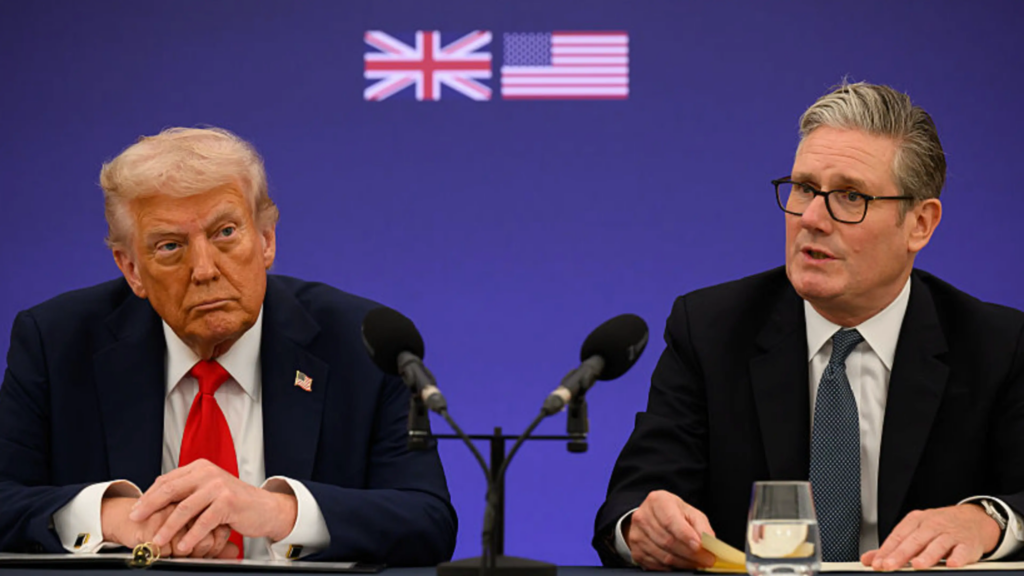
During the visit, the President also met with Starmer at his country residence, Chequers, where the pair signed a “groundbreaking” billion-dollar technology prosperity deal.
The post Why Trump Is Threatening to Impose a ‘Big Tariff’ on the U.K. appeared first on TIME.