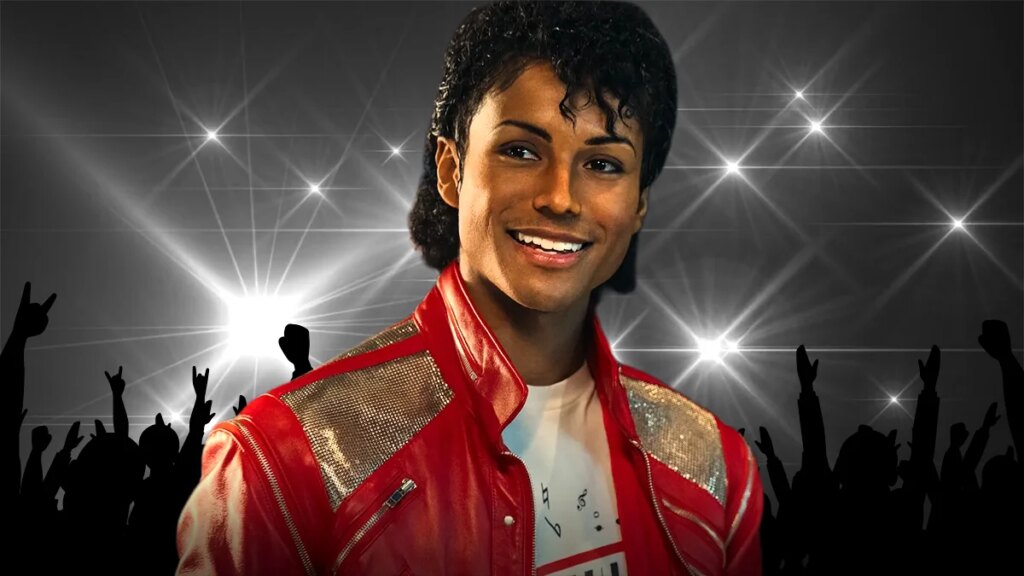
“Michael,” the star-studded, $200 million biopic of the troubled King of Pop, arrives in theaters this weekend amidst a flurry of pre-release buzz and withering reviews (the Rotten Tomatoes score is currently sitting at 39%). But more dramatic than anything on screen is the movie’s journey through production, sidestepping controversy, enduring costly reshoots and finally arriving with a version of the Michael Jackson story free of thorny legal brambles and primed for potential sequels.
As “Michael” — which charts the singer’s career from the Jackson 5 up through his 1988 “Bad” tour — makes perfectly clear, Jackson’s legacy as a man has been eclipsed by his continued sustainability as a brand. Since his death in 2009, his estate has earned over $3.5 billion, and Sony Music paid $750 million for just half of his publishing and recorded masters catalogue in 2024, valuing the entirety at $1.5 billion.
The bottom line: There’s more at stake than box office with a Michael Jackson biopic. With the estate’s active involvement in “Michael,” the narrative told in John Logan’s screenplay was controlled by the late singer’s family. With this film, the aim was to retroactively refine it with a story that covered his rise and perseverance through many trials and tribulations — including the sex abuse allegations that went to trial in 2005.
“Sorry media, u don’t get to control the narrative anymore of who Michael Jackson truly was,” Jackson’s nephew Taj Jackson said on X this week. “The public gets to watch this movie…they will decide for themselves.”
That decision was to include the dramatization of Jackson’s trial in 2005 over the allegations and subsequent acquittal, but after filming wrapped the estate discovered a clause in a settlement with one of the accusers that threw their film into chaos: the accuser couldn’t legally be depicted onscreen. Director Antoine Fuqua, Logan and Lionsgate had to reconfigure the film and undertake $15 million of reshoots after scrapping their entire third act.
This was but one of many hurdles the filmmakers had to cross to get “Michael” to the screen, and as the film defies poor reviews and questions about what’s not in the final cut, it’s on track for a massive opening weekend box office.
“”You’ve got to give them credit to a degree, they were going to attempt to tell the fuller story,” said one producer.
A top agent waved off the discussion around what the film gets right or wrong about Michael Jackson: “Last I checked, it’s tracking to be the biggest musical biopic of all time.”
***
Producer Graham King secured the rights to a Jackson biopic in 2019. It made perfect sense. King had just produced “Bohemian Rhapsody,” based on the story of British rock band Queen, which was nominated for five Academy Awards and won four, including Best Actor for Rami Malek’s portrayal of Freddie Mercury, and made more than $900 million worldwide. The movie was an antiseptic crowd pleaser, a PG-13-rated all-ages hit that avoided the complicated, messy life of Mercury because the songs were so fun. It also weathered a production that saw original director Bryan Singer, who has his own laundry list of allegations, fired midway through and replaced by Dexter Fletcher.
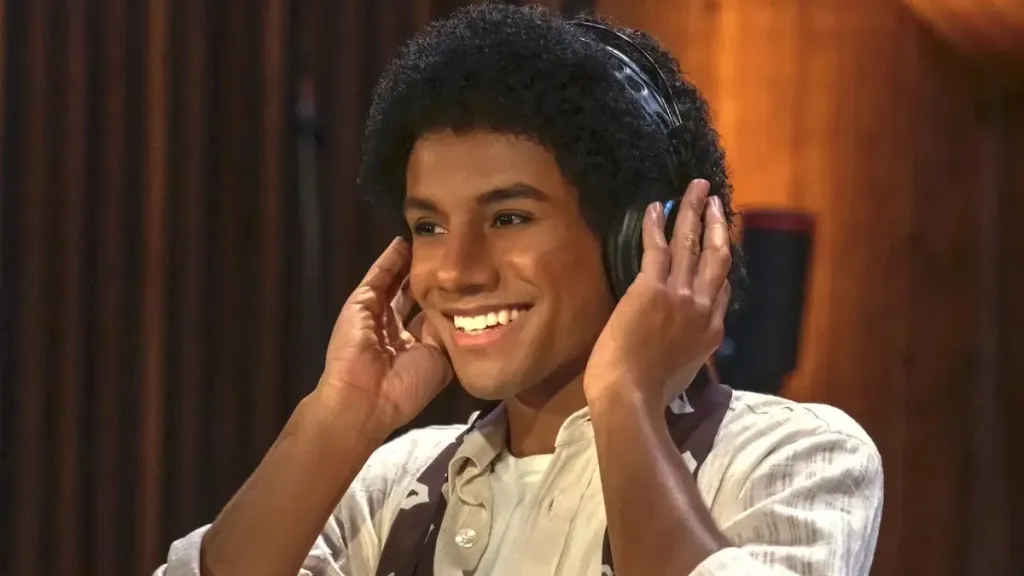
King could tell Michael Jackson’s story in cooperation with Jackson’s estate and without ruffling any feathers, recruiting “Gladiator” screenwriter John Logan to pen the script and Antoine Fuqua, who had a background in the music video boom of the 1990s, to direct. Lionsgate bought the global distribution rights, partnering with Universal Pictures International for the overseas release, after Sony backed away (Sony Music is still releasing the soundtrack). Jaafar Jackson, Michael’s real-life nephew (he’s Jermaine’s son) was cast in the title role, despite no acting experience whatsoever and after a supposed two-year casting search.
Early remarks by the filmmakers suggested that they wouldn’t shy away from the uglier aspects of Jackson’s life and legacy; they promised that this would be the full story. In other words – the man, the myth, the moonwalking legend. “Michael’s too important a character for our culture to just walk away from,” Fuqua recently told the New Yorker.
But telling that story was easier said than done.
***
There had been other Michael Jackson movies before, of course.
Most famous, because of its incessant basic cable repeats, was probably “The Jacksons: An American Dream,” a five-hour miniseries that aired on ABC in 1992 and starred Angela Bassett, Terence Howard, Vanessa Williams, Lawrence Hilton Jacobs and Billy Dee Williams. A VH1 biopic, “Man in the Mirror: The Michael Jackson Story,” with Flex Alexander as Jackson, aired on Aug. 6, 2004, a month before Jackson’s criminal trial was set to begin. And in 2017 Lifetime aired “Michael Jackson: Searching for Neverland,” starring Trinidadian Jackson impersonator Navi, based on “Remember the Time: Protecting Michael Jackson in His Final Days,” a book written by Jackson’s bodyguards Bill Whitfield and Javon Beard.
What set “Michael” apart was that it was the story, vetted and approved by his family, where the earlier films were unauthorized dramatizations. It also, crucially, could use all of his music.
“Michael” finally began production in January 2024 and wrapped in April. It was initially scheduled for release on April 18, 2025, and even after word started to leak that there were problems with the movie that would require extensive reshoots, Lionsgate maintained that it would be released in 2025 (its new date was Oct. 3). It even showed off footage way back at CinemaCon in 2024. According to one report, it “electrified” the audience.
But it couldn’t make that date after all. In fact, the movie had to be completely reconfigured.
An opening that saw the police swarming Jackson’s Disneyland-like estate Neverland Ranch was jettisoned, as was much of the third act, which involved the allegations and subsequent trial. This happened only after lawyers for Jackson’s estate realized there was a clause in the settlement with one of Jackson’s accusers, Jordan Chandler, that forbade the depiction (or mention) of him in any movie. Whoops.
Last June, the production reassembled for 22 days of additional photography in Los Angeles. On the docket was a new third act and additional sequences for earlier in the movie, to the tune of $15 million. Jackson’s estate paid for the extra photography since it screwed up, but that gave it a greater position of power, with an equity stake in the production.
At least the filmmakers were working to salvage it. “Michael” could’ve fallen victim to the fate that befell “The Book of Prince,” a six-part documentary that was scrapped because the estate felt it wasn’t positive enough.
The ”Michael” team plugged along.
It’s unclear how thoroughly the original version of “Michael” was going to investigate the seedier aspects of Jackson’s life. The New Yorker said that Fuqua “envisioned a film that might have read as a provocative defense of its subject.”
“When I hear things about us — Black people in particular, especially in a certain position — there’s always pause,” Fuqua told the outlet.
“It’s not the movie they intended to tell,” the producer who spoke with TheWrap added. “They made a creative decision to end before the stuff they’re not allowed to use … It definitely causes a perception issue in the marketplace.”
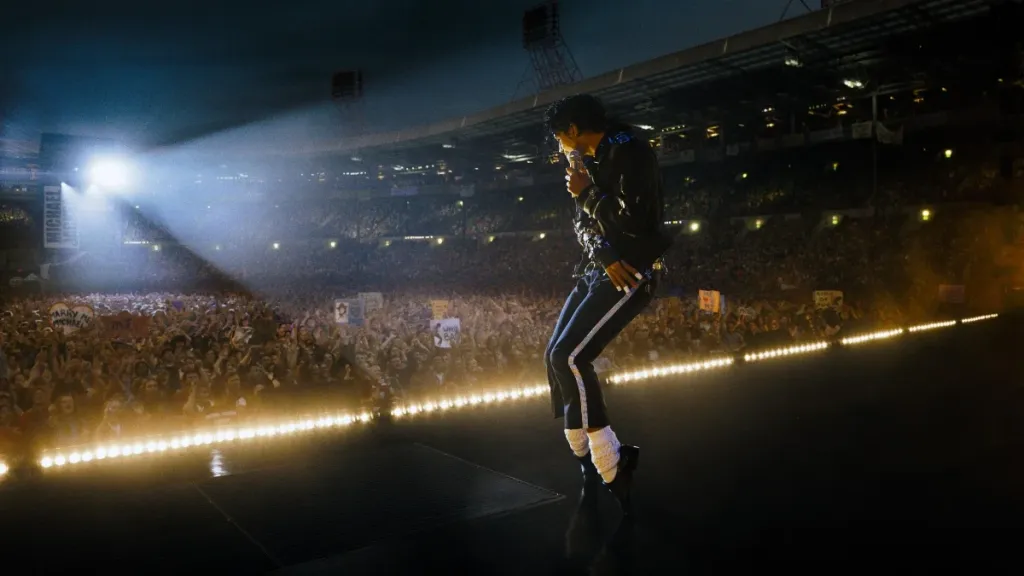
Now, instead of dealing with the devastation of his career in freefall, “Michael” ends on the triumph of the “Bad” tour. It gives the movie an odd, clipped sensation, like an unfinished school project. The movie even ends on a title card and ellipses, in the style of James Bond or the “Avengers” movies, promising the King of Pop will return.
But that half-completed conclusion might actually end up paying off, as Lionsgate, Universal and the Jackson estate plot a potential film franchise built around Jackson.
“There’s a possibility of it being a Part 2 that may deal with some other things that happened afterward,” Colman Domingo, who plays Michael’s father Joe in the film, said on the “Today” show this week while sidestepping questions about the film’s decision to not tackle the allegations. “This is about the making of Michael, how he was raised and then how he was trying to find his voice as an artist and be a solo artist.”
When Jackson died in 2009, at the age of 50, he had already lived a life defined, in large part, by pain. He was abused by his domineering father Joe, suffered a horrific accident on the set of a Pepsi commercial that led to his eventual dependance on painkillers (something that would ultimately lead to his death) and was addicted to cosmetic surgery that left him bizarrely disfigured (read the medical reports following his death if you want to be horrified).
He was also plagued by accusations, beginning in the early 1990s, of child sexual abuse. It’s hard to fathom just how much of an impact this had on Jackson’s career, particularly as we’re staring down the barrel of a glitzy biopic being released by two of Hollywood’s most powerful studios (Lionsgate and Universal), but it was catastrophic. Jackson’s 3D movie for the Disney Parks, “Captain EO” (at the time the most expensive film, per minute, in history) was pulled from circulation. Pepsi ended its nine-year, multimillion-dollar partnership with the star following the allegations, and there was the cancellation of a world tour and Jackson’s admission that he was hooked on painkillers.
Jackson continued to wrestle with the allegations for the rest of his life; he would frequently sing about being prosecuted and tormented by the press. His 1995 album “HIStory,” which generated its own media circus, was largely concerned with the claims. His 1996 short film “Ghosts,” from a story co-conceived by Stephen King and directed by make-up effects maestro Stan Winston, casts Jackson as a magical figure, known for his relationship with children, who is tormented by the bigoted local townsfolk.
Following his death, the controversy seemed to subside, at least for a little bit. Sony released “This Is It,” a fascinating 2009 documentary that charted Jackson’s preparation for an upcoming series of concerts that he would never live to see, to widespread acclaim.
“Captain EO” even returned to the Disney Parks for five full years, from 2010 to 2015, as a tribute to the fallen star. And “MJ the Musical,” a jukebox musical, premiered on Broadway in 2021, with a U.S. touring production and versions in London’s West End, Hamburg and Australia following. It’s one of only a handful of Broadway musicals to debut since the pandemic that is still running, with a box office gross of more than $300 million.
Not even “Leaving Neverland,” a damning, deeply emotional documentary that aired on HBO, recounting the stories of two men (Wade Robson and James Safechuck), who claim that they were abused by Jackson as children, was enough to slow down the momentum of his posthumous comeback.
And now there’s “Michael.” Not that everyone in the inner circle is happy with the film.
Jackson’s daughter Paris took to social media to suggest the movie “panders to a very specific section of my dad’s fandom that still lives in the fantasy” after reading an early draft of the script, opting to wipe her hands of the project altogether. But Prince, another of Jackson’s children, is an executive producer on the movie.
According to a New York Post report, Janet Jackson, who asked to not be depicted in the film, eviscerated the movie after a screening earlier this spring, criticizing everything “from the performances to the makeup.” Her outburst led to a confrontation with Jermaine. Janet is one of the only family members backing Paris’ ongoing lawsuit against the estate. “You are going to miss this wave,” Jermaine told his sister, according to the New York Post report. “You are so jealous — just get on the wave.”
But just how big will that wave be?
During the prolonged post-production process, Lionsgate flirted the idea of releasing the movie in two separate chunks. Before much of it had to be removed, the running time was said to be more than three-and-a-half-hours. Now that idea is being resurrected, with as much as 30% of the unused footage usable for a sequel. If “Michael” makes more than $700 million worldwide, a sequel is all but guaranteed, with King recently making mention of exploring different parts of Jackson’s life, including his “love of animals.” In the New Yorker article, King calls the movie “a nostalgia journey.”
The sky is the limit when it comes to “Michael,” which is particularly fitting for a man whose signature move was the moonwalk.
At the time of his death, Jackson’s estate was deeply in debt to the tune of around $500 million. It is now, 17 years later, worth a whopping $2 billion. “Michael” isn’t as much a biopic as much as it is a brand extension. No matter how much it makes at the box office, it will have done its job. “Michael” has resurrected a man who forever changed the cultural landscape in a quintessentially Michael Jackson way – full of controversy, contradictions, cost overruns and competing narratives.
When the legend becomes fact, print the legend.
The post Reshoots, Legal Threats and a Scrapped 3rd Act: How ‘Michael’ Made It to Theaters appeared first on TheWrap.