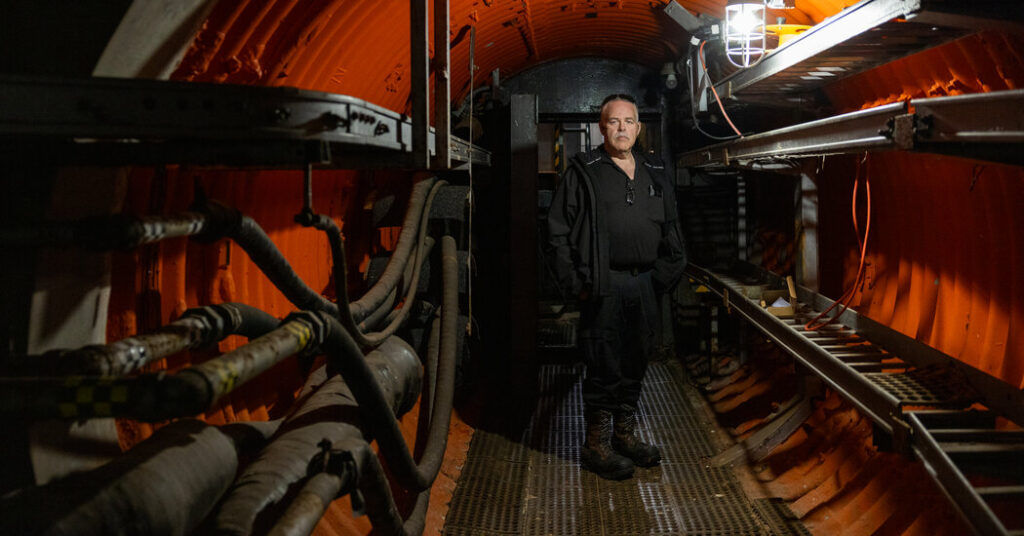
In a pristine and private corner of the Adirondacks in northern New York, an imposing guardhouse with surveillance cameras discourages the outside world from entering Michael Hopmeier’s property, as does a sign that says: AUTHORIZED PERSONNEL ONLY.
Secrecy and privacy are paramount in his line of work, he explained, standing deep inside a decommissioned nuclear missile silo that the military carved into this land at the height of the Cold War.
Business requires him to travel the world, but when he is home, he sleeps in the silo’s old control room, attracted to its silence and solitude. An air mattress sits alongside piles of tactical gear. A wall of monitors flicker with footage from a network of security cameras minding the property. A framed blueprint of the silo with an Atlas missile in its chamber leans against a nearby concrete wall.
Many of his neighbors here in Lewis, N.Y., know little about Mr. Hopmeier’s work or the facility’s history. What they do know is mostly from what they have heard: gunfire and loud explosions, and the roar of helicopters participating in military exercises just above their homes.
But Mr. Hopmeier, 61, who manages a weapons and security consulting company, has been forced to go public with his latest business endeavor: He wants to test-fire a howitzer, a roughly four-ton piece of artillery that has been used by the American military in conflicts across the globe.
Doing that requires the approval of the Adirondack Park Agency, a state agency that administers the six million acres of the park, which includes both public and private land. Getting that approval has proved difficult. Over the last five years, the agency has deemed his application incomplete six times and, last fall, pushed the matter to an administrative law judge. Mr. Hopmeier sued in response and in frustration.
“The reason we are a United States and fought the Revolutionary War was based primarily around taxation without representation,” he said. “The A.P.A. is exactly that situation.”
“It’s like an H.O.A. out of control,” he added.
Mr. Hopmeier’s quest has enmeshed the region’s residents in an acrimonious debate over conservation, the propriety of using the park for military testing and exercises, and what it means to be a good neighbor.
Annie Preston, who lives about two miles from Mr. Hopmeier in a home she built with her partner, said it would be easy to label her a NIMBY, but her opposition is more fundamental.
“I would be protesting if I lived in the suburbs,” Ms. Preston, 34, said. “I would protest it if I lived in a place that was not as environmentally or nature-oriented because I don’t want to live in an increasingly militarized world,” she said.
Mr. Hopmeier said banning the military from the park would be “horrifyingly bad.” On a personal level, he said, he’s been stung by the outrage and broader skepticism about his work. A career of constant travel and discretion has meant Mr. Hopmeier, who described himself as a “misanthropist,” rarely developed close personal ties.
“I’ve never felt part of a community and in all fairness, I didn’t want to. I don’t like people. I have no interest in them,” he said.
But he feels different about his current situation. “Now I know my neighbors,” he said later. “And I actually like them.”
Mr. Hopmeier planted roots in the Adirondacks about a decade ago. He laid out $575,000 for an Atlas F Missile Silo that was decommissioned in 1965 and is now the centerpiece of his 360-acre property, near the Jay Mountain Wilderness Area. About 72 of these sites were constructed, including 12 in New York and Vermont surrounding the now-shuttered Plattsburgh Air Force Base, where a key contingent of the nation’s nuclear-capable aircraft operated from during the Cold War.
Mr. Hopmeier said he spent hundreds of thousands of dollars removing tons of trash that the community had dumped into the silo. Gallons of fetid water also had to be pumped out and treated for contamination.
The care he takes to keep the surrounding woods unblemished reflects not just a conservation bent but a business imperative, he said. Armed service branches and private companies often train on the property with the latest laser, drone or communications technology. A stray beer can or cigarette butt could falsely register as a target and hinder that work, he said.
Mr. Hopmeier’s clients appreciate his efforts. A Ukrainian defense manufacturer recently spent two weeks in Lewis with the United States Air Force tinkering with radios.
The test — known as “Operation Fuzzy Bunny” — worked well, according to Mr. Hopmeier, in part because of the property’s resemblance to Eastern Europe.
“A great facility for applications that need low ambient signals (noise),” reads a brochure for Mr. Hopmeier’s company, Unconventional Concepts.
Michael Kuiper, a Marine veteran who is an adjunct professor at the U.S. Naval Academy, said he recently brought about a dozen midshipmen to the facility. They slept in the woods and spent several days flying drones on the property.
Mr. Kuiper said the facility’s narrow concrete corridors and the silo’s 20 story-deep chamber, taller than the Statue of Liberty, was a perfect place for the future naval officers to train without heading to sea.
“The missile silo was really helpful,” he said. “We were simulating how you would go about clearing the inside of a ship.”
Mr. Hopmeier is mostly loath to talk about his work or himself. At first, he resisted having his picture taken or even showing The New York Times the silo, which is surrounded by several large huts and more than two dozen tanks and other military vehicles.
But he spoke with some pride about a visit that former members of the 556th Strategic Missile Squadron — who served in this facility and ones like it — made to the property. Before descending the stairs into the silo last week, Mr. Hopmeier pointed north toward Plattsburgh.
“Those guys, when they walked up and looked toward Plattsburgh, they knew that, if they ever had to launch, everybody they knew was dead. They would be able to literally see the mushroom cloud rising above Plattsburgh,” he said earlier in the day.
“So few people around here even knew that these missile silos were here. It’s hard to understand how they could not know”
If Mr. Hopmeier is permitted to fire the howitzer, people will certainly know it. The gun would be set up on a hill and fired toward the side of a mountain down a range that is roughly the length of two football fields. The nonexplosive projectiles would be shot into a large metal shipping container full of sand or soil.
The howitzer’s barrel wears out with each firing. The goal is to use the testing to explore ways to extend its life.
The opposition to Mr. Hopmeier’s application is not necessarily driven by liberal politics. Many support the military (Fort Drum is 150 miles away); some have served or have veterans in their families. Their beef is simpler: They say that Mr. Hopmeier is a bad neighbor.
Gun shots and explosions emanate from his property without warning, they say. Large convoys of military-style vehicles roll through the town at all hours of the day. And mystery — along with some fear — abounds about what is going on at the silo.
Last September, the local community’s anger with Mr. Hopmeier reached new heights when he hosted a special forces training exercise known as “Jaded Thunder.”
Most residents had not seen the notice posted on the town’s website warning of the impending shock and awe.
Jacob Gittler, a part-time hiking guide who works at a local school and is Ms. Preston’s partner, described how the noise from the helicopters and gunfire sent their dogs, Kazoo and Atlee, into a frenzy. Kazoo frantically ran up and down the length of their house, barking and whining. Atlee mostly hid beneath the kitchen table. Mr. Gittler and Ms. Preston, ensconced on their couch, felt no less confused and unsafe.
“All of this just feels incredibly unneighborly,” Mr. Gittler, 33, said. “It feels disturbingly obnoxious.”
These residents — and several local environmental groups — have pushed back against Mr. Hopmeier’s plan to fire the howitzer roughly 30 to 40 times a year between 10 a.m. and 4 p.m. on weekdays.
“Jaded Thunder” and the proposed artillery testing prompted Mr. Gittler to attend one of several community meetings. More than 1,000 messages were sent to the park agency opposing the artillery testing, including one from Mr. Gittler.
Neighbors registered their fear that the loud blasts could disrupt their slice of tranquillity. They worried about the impact on the local wildlife. And they expressed concern about the tests’ ecological ramifications, with some worrying that the artillery barrages would imperil the drinking water.
“He’s not taking the neighbors’ peace and quiet into consideration,” said Kim Wimett, 57, who has lived on a property bordering Mr. Hopmeier’s for 25 years.
Mr. Hopmeier has also attended community meetings, arguing that a nearby mine made more noise and imposed more damage to the environment than anything he has done. He also resented that he was blamed for the “Jaded Thunder” disruptions, rather than the military officials who supervised the event.
He has won over some people in Lewis, who said they appreciated Mr. Hopmeier’s efforts to hire local residents, donate to the community and buy from their stores. Standing in a clearing of the Magic Pines Family Campground, Glen Delk, its owner, pointed to where about 20 visitors to Mr. Hopmeier’s compound would be bunking later this summer.
“That’s revenue for us,” Mr. Delk said.
Sandy Denton, the owner of Denton Bear Necessities, has catered events hosted by Mr. Hopmeier. She said that he recently paid for another employee’s daughter to travel to a riflery competition.
Ms. Denton, 57, suggested that Mr. Hopmeier might find less opposition if he lifted the veil a bit on his work. She has implored him to be more transparent about the facility’s value and his contributions to the community. Neither Ms. Denton nor Bridget French, 42, who made sandwiches nearby, had seen the postings on the town website about “Jaded Thunder.”
“I know he’s a very private person, but I think he needs to open up more,” Ms. French said.
Mr. Hopmeier’s fight with the park agency shows no signs of ending soon. Keith McKeever, a spokesman for the Adirondack Park Agency, declined to address the specifics of Mr. Hopmeier’s lawsuit, saying that the agency’s mission was to “ensure the long-term sustainability and preservation” of the park.
He said that the hearing before an administrative law judge would “create a record that can then be reviewed by the agency board,” which would retain authority to make a final determination. Mr. Hopmeier contends that the whole process is tainted, accusing the judge and the board of having conflicts of interest.
In the meantime, Mr. Hopmeier is still getting plenty of use out of the missile silo and plans to host a drone competition sponsored by a research arm of the Air Force in June, mixing racing with simulated battlefield scenarios. A contingent from the Australian Defense force won last year’s event.
“This will be where commercial drone racing will meet defense technology,” the event description states.
But as his battle with the park agency dragged on, Mr. Hopmeier lost his contract for the howitzer testing. Army officials said the firing range was no longer needed, adding that it would be too expensive to do the proper safety assessments, according to the Adirondack Explorer, which has closely covered this dispute.
Mr. Hopmeier intends to plow ahead with getting the permit for the firing range. Building it, he reasons, is the best way to attract new business.
Benjamin Oreskes is a reporter covering New York State politics and government for The Times.
The post A Man, a Howitzer and His Battle to Fire It Into the Adirondack Woods appeared first on New York Times.