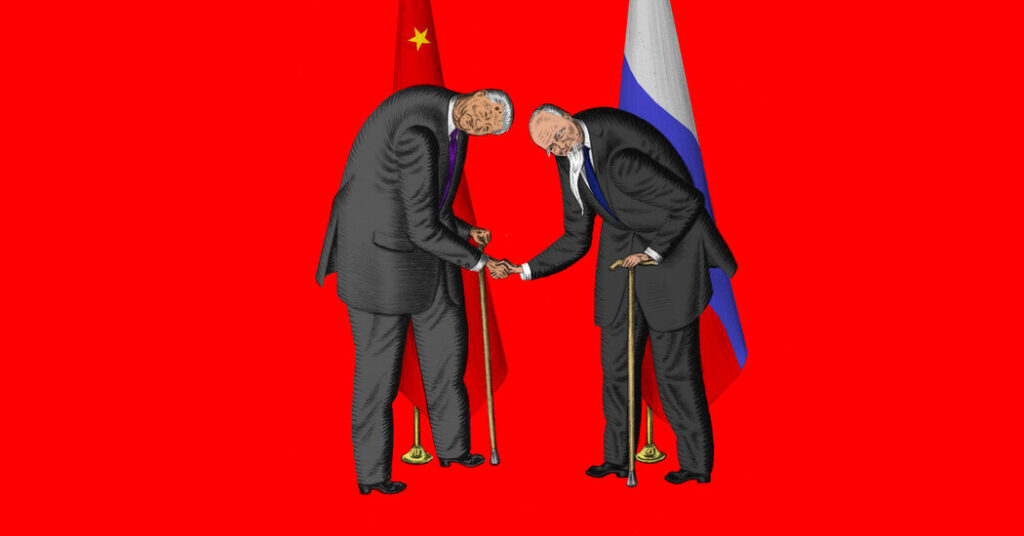
One day, two emperors — the emperor of China and the emperor of Russia — were walking side by side through the Forbidden City. As they walked, their steps cushioned by an embroidered carpet of red and gold, their retinues followed along behind in cheerful deference. Both emperors were 72 years old, about the age at which the people they ruled over typically died. Though neither spoke the other’s language, they talked contentedly through their interpreters, of the possibility of cheating death.
At one point, the Chinese emperor remarked that while in the past it was rare for a person to live beyond 70, these days it was said that at 70, one was still a child. At this, the Russian emperor became more animated. It was possible now, he suggested, to take out an aging man’s heart or liver and to replace it with a new organ, so that in spite of his advancing years, the man would become younger and younger, and perhaps even evade death entirely.
Then the exchange stops abruptly, like one of the fractured clay tablets on which the ancient Mesopotamian epic of Gilgamesh is etched, ending the narrative. This fragmentary form only adds to the strange intensity of the moment, the sense of being party to a scene we were not supposed to glimpse, in which some secret about the nature of power is hinted at.
Perhaps you saw this video last September, when it went viral: The two most powerful autocrats in the world — Xi Jinping and Vladimir Putin, both of whom have been heads of state for well over a decade, and neither of whom shows any signs of intending to relinquish that power — caught by an interpreter’s hot mic discussing their own apparent shared desire for immortality.
The moment, though brief, felt lavishly overdetermined, rich in a kind of mythic political symbolism. Xi and Putin were walking toward Tiananmen Square, the ceremonial center of the world’s emerging superpower and a place synonymous with the government’s brutal suppression of dissent. For a brief euphoric moment in 1989, it seemed as if Chinese communism might pass into history, creating space for the birth of some new democratic possibility. And then the tanks rolled in, announcing the state’s power as eternal and indivisible, the lives of its subjects as entirely disposable.
Over the past decade or so, democracy has been retreating against a rising tide of illiberalism and plutocracy. Power, in much of the world, is becoming more and more concentrated in the hands of a few authoritarian leaders and a small number of expansively ambitious tech billionaires. As average life expectancy has increased, inequality — in income and in access to health care — has widened. And amid all of this, the world’s wealthiest and most powerful have developed a persistent hope, and perhaps even generated some small possibility, that death might be eradicated entirely, or pushed back so far that its existential force is diminished.
The fact of death is, famously, a source of terror and melancholy, but also one of consolation. Say what you like about historical dynasties, but even the worst of hereditary sovereigns couldn’t rule from the grave. Henry VIII died in his mid-50s; Cesare Borgia barely made it into his 30s. Blunt instruments though they may have been, morbid obesity and syphilis played their roles as agents of change. If even the greatest tyrants must eventually die, there is always some hope for a better world, or at least a different one.
But what if the tyrant succeeds in making himself immortal, or in expanding his allotted life span so radically that he might as well be? What if autocrats like Xi or Putin were to extend their rule by decades, or even to rule indefinitely, never relinquishing their grip on their respective states, on the lives of their citizens? Such a prospect is, to say the least, still scientifically remote. But that these two leaders seem to want it in the first place, and seem to believe that science might facilitate it, suggests something important about our political era — and hints at the shape of the era to come.
We live under the sign of the vampire. Among the most potent archetypes of our time is the elite who seeks eternal youth, whose power is drawn from the blood of lower mortals. And the most prominent of our current elites is the small upper echelon of capitalists whose technologies — social media, online retail, artificial intelligence, data surveillance — determine our present and mold our future, and who wield an increasingly disproportionate political power. And these men are, we know, obsessed with pushing out the horizons of human mortality.
The man perhaps most associated with this desire is Peter Thiel, who once outlined his interest in blood plasma transfusions from the young as a means of extending life. But more practically, and less vampirically, he has also invested many millions of venture capital dollars in various biotech concerns, seed-funding a flourishing Silicon Valley longevity ecosystem. “There are all these people,” as he put it to Business Insider in 2012, “who say that death is natural, it’s just part of life, and I think that nothing can be further from the truth.”
The OpenAI chief executive Sam Altman has invested $180 million of his own fortune in Retro Biosciences, a Bay Area biotech concern aimed at stalling and potentially reversing human aging. Jeff Bezos is reportedly among the major funders of Altos Labs, a company that hopes to find stem cell therapies to extend human life spans. The treatments pursued by such initiatives exist somewhere on the spectrum of plausibility; you could even imagine a scenario in which some of them eventually become accessible to ordinary people. Yet it also seems obvious that the tech moguls’ obsession with longevity most specifically applies to their own. Thiel has signed himself up to be cryogenically preserved. Altman has said he takes the diabetes medication metformin as part of an anti-aging regimen, despite somewhat shaky evidence of its efficacy.
And then there is Bryan Johnson, who has devoted his online-payments fortune to the monomaniacal pursuit of eternal life through a bewildering array of approaches: prodigious consumption of supplements, gene therapy, immunosuppressants, transfusions of plasma from his son and the taking of detailed measurements as to the quality and durability of nocturnal erections. A lot of Johnson’s endeavors are, at best, long shots — or less charitably, symptomatic of some deep pathology — but his naked yearning to escape the human condition itself exposes the half-sublimated desire at the heart of the more scientifically reputable life-extension projects.
The goal of this enterprise, of Johnson’s sacramental observances in a monotheism of the self, is to slow and eventually reverse the processes of aging, and to thereby become (and remain) biologically indistinguishable from an 18-year-old. Johnson’s motto, and the tagline of his proprietary longevity regimen, Project Blueprint, is “Don’t die.” In its reduction of multiple disparate imperatives — of the pharmaceutical industry, of the Christian faith, of American individualism — to a single command, it must be admitted that this formulation has about it the simple-minded genius of a classic advertising slogan. Don’t die is the precise message audible in your heart’s every finite beat, encoded in your troubled dreams and futile anxieties.
What do these men, these autocratic heads of state and staggeringly wealthy technologists, have in common, other than the desire to don’t die? They have, for one thing, arrived — through ruthlessness and ingenuity, through the obsessive pursuit of power and personal enrichment — at an Olympian distance from the mortals from whom their profit and power derive.
Consider the tech billionaire: This is a man who has amassed unimaginable wealth through the disruption of economic and social relations. He has completely reshaped how we buy things, how we pay for them. He has changed how we interact with our fellow humans. He has restructured our brains and reordered the global economy, and is now creating the ultimate technology, the one that promises to do away, once and for all, with the need for human intellectual labor. Is it not right that such a man should buy his way out of death, that he should break this last tie that binds him to the fate of his fellow humans?
Indeed, just as it represents the final victory of capital over labor, A.I. is also being pointed toward a greater and more decisive victory, the victory of technology over the human condition itself. The futurist and entrepreneur Peter Diamandis is convinced that A.I. can facilitate huge increases in human life span. In 2023, he unveiled XPrize Healthspan, a seven-year competition for longevity research whose goal is to award $101 million to a team that “successfully develops a proactive, accessible therapeutic that restores muscle, cognition and immune function by a minimum of 10 years, with a goal of 20 years, in persons aged 65-80 years, in one year or less.”
The prize is backed by the Hevolution Foundation, a longevity-focused nonprofit with a $1 billion annual budget largely funded by the kingdom of Saudi Arabia, as part of its plan to make the country into a global hub of longevity research and innovation. As with the likes of Altos Labs and Retro Biosciences, Hevolution employs an egalitarian language in its public communications. Aging, the company says, is “a condition that affects every human on the planet,” and therefore “every human has the right to live a longer, healthier life.” And yet it’s hard to imagine that the Bangladeshi and Pakistani migrant workers who account for much of the Saudi work force — many of whom are essentially indentured laborers — are likely to have the same access to new life-span-extending technologies that their employers (or their employers’ employers) do.
Singapore, too, has emerged as a hub for experimental life extension, with longevity-focused venture funds like Immortal Dragons investing millions in biotech start-ups. In a recent interview with The Financial Times, the fund’s founder, Boyang Wang, revealed that one of the companies in his portfolio is working on “brainless clones.” The aim, he said, is to deliberately induce hydranencephaly, a disease in which infants are born without cerebral hemispheres but in which the basic functions of the body are in working order. “If we can trigger this artificially in the future, it might become a backup body for yourself. Imagine if we can do a brain transplant. Then this new body can become our second home.”
As an actual scientific possibility, this is distant or even outright fantastical, but it is worth thinking about on just those terms. What is revealed by this particular vision of the future, by this fantasy of literally mindless humans who would serve as repositories of spare parts to extend the lives of their wealthy owners?
Power is its own kind of immortality project: The power to leave your mark on the world — to mint coins bearing your image, to redraw maps — is the power, on a symbolic level, to deny death. Over the past four years, Putin has sent hundreds of thousands of young Russians to their deaths in Ukraine, in a war that has also killed more than 100,000 Ukrainians. He has said that his decision to invade was rooted primarily in geopolitical considerations — that it was a response, first and foremost, to the threat of an eastward expansion of NATO. But the deeper motivation seems imperial; Putin wants to remake the map of Eastern Europe, and to reconstruct a lost and betrayed Russian empire, and in so doing to shore up his power at home.
His accidentally public musings about the prospect of immortality through science seem to emerge out of the same grand narcissistic fantasy as his project of imperial restoration. As with so many futurist dreams, the project of radical life extension reveals something important about our present. It appeals to the superwealthy, and to authoritarian leaders like Putin, not merely because it allows them to deny the certain prospect of their own deaths but also because of the reactionary energies it channels.
Xi, it seems, is less concerned with personal immortality than Putin. Watching that hot-mic clip, it’s easy to imagine that he was really just indulging the eccentric preoccupations of his Russian counterpart, if for no other reason than it was something to talk about while they walked to the podium. But in 2018, Xi rescinded a two-term limit on the presidency that had been in place for decades, removing any legal barrier to his serving as leader for life.
And like Putin, he is driven by a desire to restore his country to a former imperial grandeur; “the great rejuvenation of the Chinese nation,” and the redressing of humiliations imposed on the country during the 19th and early 20th centuries by Western imperial powers, have been presiding goals of his premiership. China’s seemingly inexorable rise, under Xi’s leadership, to global hegemony secures him a kind of figurative deathlessness. It’s not quite immortality, but it’s not nothing either.
The obsession with bodily immortality has a long pedigree in Chinese history. Chinese alchemists believed that they could synthesize gold through compounds of arsenic and lead and mercury, and that drinking such compounds in a liquid form might impart the metal’s incorruptible essence to the human body. (“The 24 Histories,” a collection of the official chronicles of the Chinese dynasties, records that drinking the golden elixir caused the deaths of no fewer than six emperors of the Tang dynasty alone.)
The symbolic connection between gold and immortality transcends cultures and historical periods. For the ancient Egyptians, gold was associated with the life-giving power of the eternal sun, and for the alchemists of medieval and early modern Europe it was both a symbol and a potential source of eternal life. Because of its comparative rarity, and because it is a metal that does not tarnish or corrode with time, gold became the universal substance of wealth, something that could be passed on to descendants, as kings handed on power to their heirs. A person could live on in his money, as he lived on in the structures it built: the temples, the cathedrals, the libraries and galleries and opera houses, the technologies and the social orders.
These lines of magical thinking have now been rewoven in a more technologically sophisticated form. In his 2023 “Techno-Optimist Manifesto,” the billionaire venture-capitalist Marc Andreessen made the following assertion: “We believe artificial intelligence is our alchemy, our Philosophers’ Stone — we are literally making sand think.” This was something of a tell, this invocation of the Philosophers’ Stone: a mythical material that the alchemists of antiquity and the Middle Ages believed could transmute base metals into gold, and could be used to produce a potion that granted its drinker eternal youth. This is the promise of technology, that it will intercede between us and our deaths. This is the promise of money itself.
For now, though, no matter how greatly a person is enlarged by his wealth, his own power and prestige, there is no escaping the determinism of death. Bryan Johnson will die. Peter Thiel will die. Sam Altman will die. Xi Jinping will die. Donald Trump will die. Vladimir Putin will die. And so will you, and so will I, and so will all those now living and yet unborn. Not a one of us will be saved: not by 3-D-printed organs, not by artificial superintelligence, not by transfusions of plasma from our beloved and indulgent teenage sons. None of these things will intervene between even the richest and most powerful of us and our common animal end. The great and terrible democracy of death abides.
Mark O’Connell is a writer in Dublin and the author, most recently, of “A Thread of Violence.”
The post The Rich and Powerful Want to Live Forever. What if They Could? appeared first on New York Times.