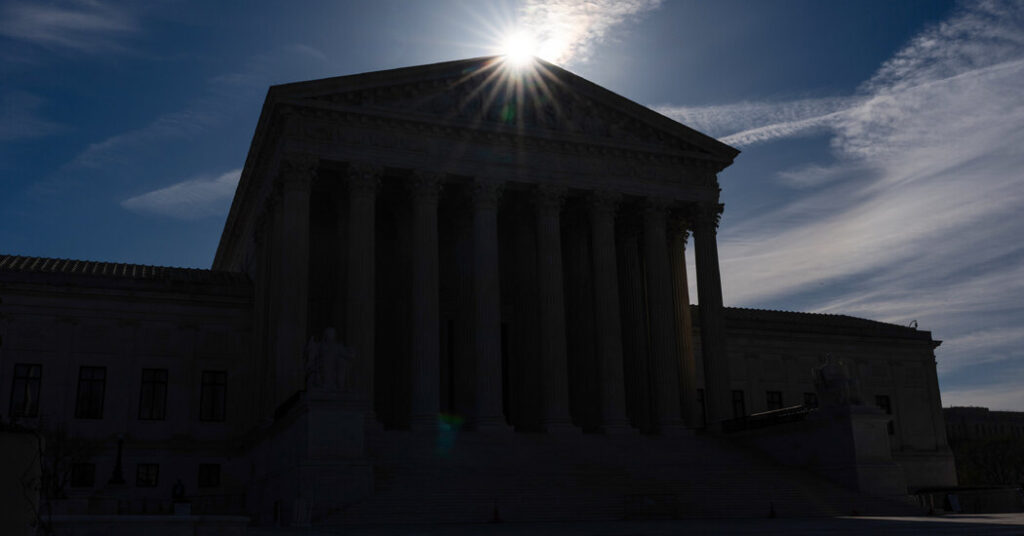
In 2016, a surprise decision from the Supreme Court “sent both climate policy and the court itself spinning in new directions,” Jodi Kantor and Adam Liptak wrote in an investigation published last week.
The one-paragraph ruling halted the Clean Power Plan, President Barack Obama’s signature environmental policy, which was aimed at reducing emissions from power plants. The decision signaled the birth of the court’s modern “shadow docket,” which the court uses to issue short opinions and bypass the time-tested procedures of hearing oral arguments and publishing detailed explanation of the justices’ thinking.
The court has since used this emergency docket to grant President Trump more than 20 victories on issues like immigration and employee firings. Decisions made with it are typically temporary but can be enormously consequential.
At the heart of the case were the Obama administration’s attempts to address climate change. And, yet, even as Chief Justice John G. Roberts fretted about the costs to industry of allowing the rule to go into effect, not a single justice mentioned climate change throughout any of the memos The Times unearthed.
Since the investigation was published, environmental lawyers and former E.P.A. officials have criticized the court’s use of the shadow docket and called its decision rushed and flawed.
Claims of unbalanced evidence
The flurry of internal Supreme Court memos published by The Times began with a 2016 message from Chief Justice Roberts arguing that the court should move quickly to block Obama’s environmental policy.
But the evidence he cited in that memo to his fellow justices was incomplete and biased, according to the former head of the E.P.A. under President Obama and environmental law experts.
Roberts argued that the Supreme Court was likely to eventually overturn the Clean Power Plan and that waiting for the case to move through the lower courts would cause irreparable harm to energy companies because they would have to make big investments in emissions reductions.
In 2015, the Supreme Court had ruled against the Obama administration in a case involving mercury emissions. But by the time of the decision, the case had been in court for three years and many power plants had already taken steps to comply with the emissions rules. By acting earlier this time around, Roberts wanted to prevent what he viewed as a potentially unlawful regulation from having its intended effect before the courts had their say.
In making this final point, Roberts referred to a recent comment the E.P.A. administrator at the time, Gina McCarthy, had made to the BBC, in which she said, “We are baking” the Clean Power Plan “into the system.”
McCarthy, in an emailed statement to The Times said, “It seems clear that in making their decision to stay the Clean Power Plan, the majority of the Supreme Court were more focused on the fossil fuel industry’s wants and needs than on people’s health and well-being.”
The court’s notes “show that the majority had personal biases against the Obama administration that factored into the legal merits of the rule,” she wrote. “Their actions were more than a failure of due diligence or communication; they were taking away the ability of people across the country to tackle climate change and breathe cleaner air.”
In a memo, Chief Justice Roberts cited an estimate that the cost of implementing the plan could be as high as $480 billion, averaging $32 billion per year over 15 years.
That number was far higher than the E.P.A.’s own cost estimate, which was less than $10 billion per year.
“The majority was taken in by the one-sided cost estimate from the appellants, which turned out to be completely false,” said David Doniger, a senior attorney with the Natural Resources Defense Council who worked on the case. (State governments and companies challenged the E.P.A.’s plan in court.)
“If they’d gone through a normal briefing and so on, these facts would have come out,” he added. The Supreme Court did not respond to a request for comment.
What’s happened since
The court halted the Clean Power Plan in February 2016. Still, energy companies met its emissions targets by 2019, well ahead of the 2030 deadline. This happened, experts say, in large part because the fracking boom and other developments shifted the economics of energy production away from coal toward other less-polluting sources.
The emergency docket has not been used extensively to halt environmental policies without explanation in recent years, Doniger said. The court’s makeup has also changed. Six of the nine current justices were appointed by Republican presidents. But in 2016, five justices had been appointed by Republicans, and Justice Anthony M. Kennedy, appointed by President Reagan, was often a swing vote.
But the memos may shed some light on how the Supreme Court could treat the Trump administration’s recent efforts to rescind the scientific finding that underpins the federal government’s legal authority to combat climate change.
Richard Lazarus, an environmental law professor at Harvard Law School, said the documents suggest the new court could be willing to entertain the administration’s argument.
Recycling
You paid to have old clothes recycled. Here’s what that really means.
It’s springtime and a lot of us are refreshing our wardrobes, retiring old clothes and picking up new ones for the warmer weather. But can we get rid of the used stuff responsibly?
While this is possible, it’s not as easy as an increasing number of companies would have you believe. Just drop the used clothes into a collection bin or a prepaid mailer, they say, and they’ll recycle your textiles, keeping them out of landfills.
It’s an admirable goal, but those companies talk more about collecting clothes than about where they end up. Often, that’s because they have little or no idea. And that raises major concerns. Chief among them: When a company doesn’t track the full journey of a garment, it has no way to know where the item really ends up. — Rachel Cernansky
China
Chinese solar exports doubled in a month during the Iran war
Chinese solar exports soared to record levels in March, according to data from the Chinese customs authority compiled by the research group Ember. China’s monthly exports doubled over the previous month, Ember found, and were roughly equivalent to the entire solar capacity of Spain. Fifty countries, many in Asia and Africa, set records for purchases of Chinese solar equipment.
The spike was driven in part by a looming price increase for Chinese exports, Reuters reported, but the market is also getting a boost from the energy shock radiating outward from the Strait of Hormuz. High oil and gas prices are pushing some governments to accelerate their plans to install renewable power sources.
This is not the only indication that the war is driving people toward energy alternatives. In Europe, some rooftop solar companies have seen demand double since late February. E.V. sales in Europe rose by a third in the first quarter of this year compared with the same period in 2025. — Claire Brown
Number of the day
More than 240 million gallons of human waste
As Scott Dance reports, even as public health officials declared the end of a sewage contamination emergency in the Potomac River last month, scientists feared the waterway was still in distress. Nearly a quarter-billion gallons of human waste had poured into the river from a broken sewer main, he writes. Researchers went out in early March to sample the water, trying to see what damage had been done. Among the worries that are unlikely to arrive until the heat of summer sets in: toxic algae blooms, fish kills and “dead zones” devoid of dissolved oxygen. And sewage may be lurking around popular recreation spots that will soon draw people.
One last thing
“My proposal was to create a kind of symphony of all the sounds that have either disappeared, or will soon disappear — frogs, pelicans, rattlesnakes, all kinds of insects and bees and flies. It was an attempt to create awareness of a void, a negative space.”
That’s from Olafur Eliasson, a Danish-Icelandic artist, describing his latest project, which is being displayed in Salt Lake City. Farah Nayeri reports that Eliasson created a soundtrack using sounds made by more than 150 local animal species, which he has paired with abstract images inspired by crystalline shapes and motifs in nature.
More climate news from around the web:
-
Oil spills from the war in Iran are now visible from space, CNN reports.
-
CATL, the Chinese automaker, has developed an E.V. battery that can recharge in just six minutes and travel roughly 930 miles on a single charge, The Financial Times reports.
-
The Guardian writes about a major new report by the United Nations, which says that the world’s food systems are being “pushed to the brink” by extreme heat. In parts of India, Southeast Asia, Africa, and Central and South America, farmers could find it too hot to work for 250 days a year, the report estimates.
Read past editions of the newsletter here.
If you’re enjoying what you’re reading, please consider recommending it to others. They can sign up here.
Follow The New York Times on Instagram, Threads, Facebook and TikTok at @nytimes.
Reach us at [email protected]. We read every message, and reply to many!
Claire Brown covers climate change for The Times and writes for the Climate Forward newsletter.
The post How the Supreme Court’s Shadow Docket Upended Climate Policy appeared first on New York Times.