This week on Uncanny Valley, the team discusses what’s next for Apple as Tim Cook steps down from his role as CEO. They also go into the reasoning behind SpaceX and Cursor’s surprising deal, and why Palantir’s self-published manifesto drew a lot of heat online. Also, we discuss why some conspiracy theorists are leaving Trump’s side, and how a scammer created an AI-generated woman to attract and grift MAGA men.
Articles mentioned in this episode:
- Tim Cook’s Legacy Is Turning Apple Into a Subscription
- MAGA Is Starting to Look Beyond Trump
- This Scammer Used an AI-Generated MAGA Girl to Grift ‘Super Dumb’ Men
You can follow Brian Barrett on Bluesky at @brbarrett, Zoë Schiffer on Bluesky at @zoeschiffer, and Leah Feiger on Bluesky at @leahfeiger. Write to us at [email protected].
How to Listen
You can always listen to this week’s podcast through the audio player on this page, but if you want to subscribe for free to get every episode, here’s how:
If you’re on an iPhone or iPad, open the app called Podcasts, or just tap this link. You can also download an app like Overcast or Pocket Casts and search for “uncanny valley.” We’re on Spotify too.
Transcript
Note: This is an automated transcript, which may contain errors.
Brian Barrett: Hey, it’s Brian. Zoë, Leah, and I have really enjoyed being your new hosts these past few weeks, and we want to hear from you. If you like the show and have a minute, please leave us a review in the podcast or app of your choice. It really helps us reach more people, and for any questions and comments, you can always reach us at [email protected]. Thank you for listening. On to the show.
Leah Feiger: Zoë, welcome back.
Zoë Schiffer: Thank you. Thank you, thank you.
Leah Feiger: I missed you so much.
Brian Barrett: And I missed you the exact same amount.
Zoë Schiffer: Wow.
Brian Barrett: It’s not a contest.
Zoë Schiffer: Oh, my gosh. I feel so loved. I’m going to go away more often. Absence makes the heart go fonder, as we all know, and I’m thrilled to be here. Welcome to WIRED’s Uncanny Valley. I’m Zoë Schiffer, director of business and industry.
Brian Barrett: I’m Brian Barrett, executive editor.
Leah Feiger: And I’m Leah Feiger, director of politics and science.
Zoë Schiffer: This week on the show, we’re saying goodbye to Apple CEO, Tim Cook, who announced that he is stepping down from the top gig at the company. And, more than just talking about his legacy at Apple, we’ll be looking into what this long-awaited shift actually means for the future of one of the world’s biggest companies.
Brian Barrett: We’ll also get into why SpaceX and Cursor’s potential $60 billion deal announced this week is pretty staggering, and we’ll get into Palantir’s controversial 22-point manifesto. I feel like manifesto’s inherently controversial, otherwise they’d be memos that they posted on X this week.
Leah Feiger: And slowly but surely, we have been seeing certain MAGA leaders and supporters move away from Trump. We’re going to break down whether these instances are actually building to something meaningful or just some wishful thinking on the behalf of our Bluesky followers.
Zoë Schiffer: So let’s kick it off this week with the news that grabbed all of our attention on Monday. It had Brian Barrett calling me, I don’t know, 15 times in the span of two minutes. Tim Cook officially stepping down.
Brian Barrett: If you’d picked up, Zoë, I wouldn’t have had to.
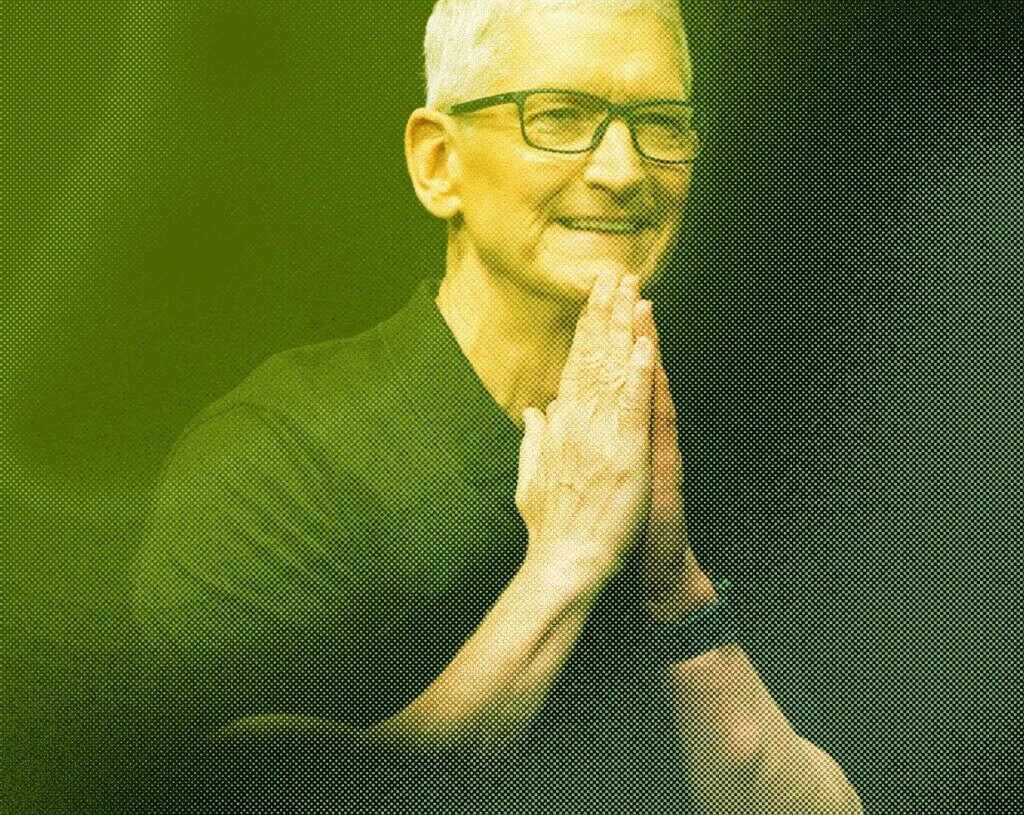
Zoë Schiffer: Brian, I was trying to fill out the goddamn art request. It was really stressful. He has officially stepped down as the CEO of Apple. I think the official transition is September 1st, but the announcement is out there. John Ternus, a longtime executive at Apple, is taking over the CEO gig. This is a pretty pivotal moment for the company. I mean, Cook’s legacy, I think, will be twofold, one in just honing in on Apple’s financials. The company was doing really well, but he took it into the trillion dollar range, and he’s also perfected its kind of operations and supply chain. He went all in on making Apple a services and subscription business with things like the App Store, iCloud, Apple Pay, all of that. So this doesn’t sound quite as sexy as launching the iPhone, but in many ways he’s the person that shaped Apple into what it is today. And rumors about Tim Cook stepping down have been swirling for a really long time. Back in 2024, WIRED’s Steven Levy asked him if retirement was on the horizon and Cook responded like this.
Tim Cook, archival audio: I’ll do it until the voice in my head says, “It’s time,” and then I’ll go and focus on what the next chapter looks like. My life has been wrapped up in this company, as you mentioned since 1998. This is a long time. It’s the overwhelming majority of my adult life, and so it’s tough to envision life without Apple.
Leah Feiger: I’m also going to do this job at wired.com until the voice in my head tells me to stop.
Zoë Schiffer: Wow. OK. Well, we’re going to table that for another time.
Brian Barrett: Yeah.
Zoë Schiffer: I think what’s really interesting about this moment is Apple obviously is doing phenomenally as a company, again, trillion dollars, et cetera, et cetera. However, it does feel like it has missed the boat in the AI era, and I think John Ternus’ job will be in part to figure out what is Apple’s place in the AI race.
Brian Barrett: Well, I think the fact that it’s Ternus in general already sort of speaks to that a little bit. Ternus is a longtime hardware engineer that’s continuing Apple’s history of product people versus AI people, software people, and I don’t think that’s a bad thing. I think on the one hand, yes, Apple is behind in this AI race. On the other hand, Apple hasn’t set fire to hundreds of billions of dollars in pursuit of a race that maybe it doesn’t even need to win, right?
Zoë Schiffer: Yeah, it doesn’t think it needs to. Its answer to this, I mean, Steven Levy interviewed Ternus somewhat recently and asked again, “What are you going to do in the AI era?” And his response was very much, “We have the iPhone. We think AI apps will exist in the App Store on iPhones, and that’s going to be, in many ways, our answer.” Not to say they’re not going to try and embed AI in different ways, but I still think they think the primary computing platform is going to be Max and iPhones, the devices that they create.
Leah Feiger: I kind of love this because in an era where we’re seeing sneaker companies—shoutout Allbirds’ pivot to AI—I like that there is this massive, very successful tech company that’s saying, “Yes, we’re going to live with this. We’re going to make sure that our subscriptions, our products are adaptable to this clearly very important and instrumental technology, but we don’t need to blow up,” like Brian said, “our entire business plan to make this a core structure here.”
Zoë Schiffer: I like that for Allbirds because those shoes are absolutely hideous.
Brian Barrett: A parallel might be … So Apple never made a search engine, right? Search is one of the biggest businesses in the world. Apple never made a search engine, but Google pays Apple’s billions of dollars to be the primary search engine on the iPhone. I think Apple’s bet is that by building relationships with OpenAI, with Google again, with Anthropic at some point, who knows, it can have that similar, “We’re just the vessel. We’re just the thing.” And I like their odds because all of the AI hardware that we’ve seen so far … I know that Sam Altman and Jony Ive are cooking something up. I know that everybody’s got some sort of pendant or speaker or whatever that they’re trying to make happen. At the end of the day, I don’t think that AI computing is going to replace your phone. I think fundamentally you’re always going to need something with a display and apps, and the broader internet versus just something you could talk to and get answers back from.
Zoë Schiffer: I sincerely hope you’re wrong. I’m really wanting an AI hardware device that could be like headphones that you could just speak to and you wouldn’t have to look at a screen. But I think you’re right that there will always be certain things we need screens for, and that humans are better at just doing ourselves. And then I would like to think there will be a whole slew of tasks that we can eventually offload to AI agents, and that would make more sense for a voice computing paradigm. I do think to the partnership point that you made, Apple has already partnered with Google and it’s going to embed Google Gemini into its devices. I think some people saw that as a stopgap, like, “OK, it doesn’t have frontier models up and running. It’s going to use Google in the interim.” I saw that as Apple admitting, “We’re not even going to try and get into this race in a full-throated way. Google’s right there, we can use Gemini and that’s what we’re going to do.”
Brian Barrett: Yeah. Now, there’s another part of Tim Cook’s legacy that I want to ask Leah about. Because Tim Cook, of all the Silicon Valley titans who have been friendly and made nice with Donald Trump, Tim Cook kind of stands out in a couple of ways. One in that I think he’s the only one who presented Trump with a custom trophy designed by his company’s engineers.
Zoë Schiffer: Embarrassing.
Leah Feiger: I was waiting for you to bring this up, but Brian, just so you know, in my world, we don’t call him Tim Cook. We call him Tim Apple. This is—
Brian Barrett: That’s true. Rightly so.
Leah Feiger: Just like my president, he is Tim Apple to me now and forevermore. No, this is such an interesting point. Actually, I’m going to throw this back to you guys. What’s Ternus’ relationship with Trump admin people? We have been seeing their colleagues in the tech industry fawn over the administration in the last year and a half. Apple has simultaneously, while placating has also managed to stay out of the fray in some ways too. I’m very curious to see how that changes.
Zoë Schiffer: I think that Cook is a diplomat first and foremost, and he used that diplomacy to position Apple to get deals that were favorable to the company. I think there was a surprise factor with Trump because he reads as more liberal. There was a feeling that behind closed doors he wasn’t as complimentary of Trump as he was in public, but nonetheless, he was at the inauguration, he was appearing in photo ops. I did actually hear something funny. I mean, this caveat is a rumor, but from people who are in these types of circles, and said that he wasn’t aware that he was going to be placed directly behind Trump in the inauguration. And when that placement was put forward, there was a moment of slight panic because they all realized what the photo was going to look like, but nonetheless, that’s the photo.
Brian Barrett: I think two things about the Ternus question specifically. One, I think we just don’t know other than I will say he is going to be the CEO of a major company that has lots of shareholders, and he has a fiduciary responsibility to make this number go up, and the way that you do that is you’re friendly with Donald Trump. That’s just kind of the way it is. I’m not saying that’s the way it should be, but I think the idea that he would take a stand against this administration feels far-fetched regardless of what his personal feelings are. The other thing I would say is Tim Cook’s not disappearing. He’s going to be the executive chairman. As part of the announcement, Apple said he is going to be, I don’t have the exact phrasing, but something like he’s going to be working with leaders across the world. He’s going to continue that diplomacy role basically. I think he’s stepping out of his CEO role, and into more of a shaking more hands, making nice with world leaders, trying to keep up that sort of diplomatic cadence that he’d already established over the last several years.
Zoë Schiffer: Yeah. I think the last point that I wanted to make, just going back to the iPhone of it all, is if AI hardware continues to disappoint, I think that Apple is in a really strong position, and the bet that it’s making is correct. But I do think that if this mysterious Jony Ive, Sam Altman device comes on the scene and is good, or if something else comes up that is able to execute voice commands in a reliable way then … I don’t know. I think that could be a problem for Apple down the road.
Brian Barrett: Well, Zoë, they’ve got the Vision Pro.
Zoë Schiffer: Oh, right, right, right, right.
Leah Feiger: Like, “Is this the dumbest take you guys? Everyone has an iPhone.” Yes, of course, all of these companies have so much to lose, but there is this actual engagement with product that I find so hard to separate even intellectually. Yeah, you can come after a company, they’re still going to be taking their iPhones out on the campaign trail.
Zoë Schiffer: I mean, everyone had a Blackberry at some point. Everyone had a MySpace account. Things come and go.
Leah Feiger: Things come and go. That’s true.
Zoë Schiffer: I don’t know if a better thing comes on.
Leah Feiger: All right.
Zoë Schiffer: And everyone hates being on their phone.
Leah Feiger: Yeah. I’m waning here for the iPhone replacement, please.
Brian Barrett: Going to another corner of the tech industry, this week SpaceX announced a deal with the popular AI startup, Cursor, to either acquire the company for $60 billion later this year, or if an acquisition doesn’t happen they’ll pay them $10 billion for whatever work that they’ve done together. They said they’re going to work closely together to build “next generation coding and knowledge work of AI,” which is AI coding tools basically. That’s what Cursor is known for. It’s a little weird. It was unexpected and the arrangement is strange. Zoë, help me understand why it’s a potential deal for a rocket ship company buying an AI coding company that relies on other large language models who are competitive. Zoë, help me. Help me.
Zoë Schiffer: OK. Well, first I just want to say it wasn’t unexpected to me because five minutes before this news came out, I got a call that the news was coming, and I thought I had the biggest scoop of my month, if not year. And then, sadly, the press release came, so tragic turn of events for me.
Brian Barrett: Biggest almost scoop.
Zoë Schiffer: I know. However, I think this actually makes some level of sense. Might you recall that SpaceX now owns xAI, and that xAI is not incredible at coding models, and so it does need Cursor’s help.
Brian Barrett: They put so much into making anime women and non-consensual porn that they couldn’t—
Zoë Schiffer: Right. Yeah. The anime girlfriends took precedence, and companies won’t pay as much for those anime girlfriends as they will for enterprise code. I mean, I really think that this is an under understood thing that is happening in the AI industry right now. You talk to a lot of people, a lot of investors, a lot of the Andreessen Horowitz circle, and they’re like, “Dario Amodei gets up every day and he thinks enterprise code, that man just prints money. He is so focused. He is laser-focused on this actual business model and it is working. Sam Altman has a goddamn robotics division. What is he doing?” There is the sense that enterprise code is the thing that is working, and that if you’re going to be a serious AI company you need to go all in. So I don’t know, crazier things have happened. However, I think that Cursor is in a difficult moment because it has to compete with the major labs. A company agreeing to go into a deal like this with Elon Musk, who famously tried to buy Twitter and then back out despite the very expensive kill fee on that deal as well, I would be hesitant. I don’t know what they’re kind of thinking right now.
Brian Barrett: Two things. One, the weirdness to me is deeper. Just the fact that SpaceX owns xAI, which owns X is all just like we’re just putting it all under this weird umbrella.
Zoë Schiffer: Yes.
Brian Barrett: It’s a weird Elon circus.
Leah Feiger: I have to say seeing SpaceX AI actually written out whenever this was this week was, it was jarring. It was a little bit jarring.
Zoë Schiffer: This is the thing about getting too rich, is you don’t have people around you that will tell you your ideas don’t make sense and that they’re bad, and I think that that becomes a problem.
Brian Barrett: This is why I never want to have money. But Cursor’s announcement I thought was interesting because Cursor didn’t announce the acquisition part of this at all.
Zoë Schiffer: No.
Brian Barrett: They put out a pretty terse, I thought, statement, short either because it was rushed or short because they were … I don’t know. But all it said—
Zoë Schiffer: We don’t know. We don’t know. Allegedly.
Brian Barrett: Allegedly rushed. All we know is that they just said, “You know what? We’re excited about getting access to xAI’s compute.” That was basically it. Nothing about a deal, nothing about the money.
Zoë Schiffer: Yeah. You know what it made me think of? Is when Elon Musk told the world that Walter Isaacson was going to be writing his biography, and Walter Isaacson said, “What?” And then agreed to write said biography. That man can make things happen by just telling his many millions of followers that things are happening.
Brian Barrett: In terms of making things happen, so this deal’s not going to happen until later this year. It was reported recently that the reason was, then this part makes it, this is what makes most sense to me is SpaceX is gearing up for an IPO. They’re getting close to it, and they didn’t want to close this deal because it would delay the IPO. So there’s sort of an order of operation things, like, “We need to go public before we try to close a $60 billion deal,” which again feels, like everything about these feels, I’m not going to say cursed, it just feels likely to derail at some point.
Zoë Schiffer: Yeah. The reporter in me is really excited for IPO year because I feel like this is when companies really need to get their act together.They need to have their operations, internal processes really, really, really, really dialed. You’re going public, there’s going to be a lot of scrutiny. There’s going to be a lot of shareholders. SpaceX is trying to do it. Anthropic is trying to do it. OpenAI is trying to do it. I think it’s going to be a wild, wild time, and stuff’s going to get weird along the way.
Brian Barrett: Have either of you read Palantir’s CEO Alex Karp’s book The Technological Republic or rather how many times have you read it?
Zoë Schiffer: Right. That’s the operative question.
Leah Feiger: I have to admit I haven’t read it, but I have read way too many things about it. Unfortunately, I feel like I’ve read it at this point.
Brian Barrett: Well, and everybody sort of should by now if you follow Palantir on X, and if you don’t, that’s OK. Just to be clear, it’s not an endorsement. But this week, Palantir on X, unprompted, nobody asked them to, but they shared a 22-point summary of Alex Karp’s book. They prefaced it with, “Because we get asked a lot, here’s the technological republic in brief.” And it goes on to list Karp’s ideal vision of tech and the state working as one. There’s some points in there, some highlights, quote, “The engineering elite of Silicon Valley has an affirmative obligation to participate in the defense of the nation.” And also quote, “No other country in the history of the world has advanced progressive values more than this one.” There’s one more in there that I do want to call out.
Leah Feiger: The draft? You got to talk about the draft.
Brian Barrett: The draft is a good one. I was going to go with, “Some cultures have produced vital advances, others remain dysfunctional and regressive.”
Leah Feiger: Yes. It’s hard to not read every single point of this manifesto out loud. By saying strong reactions ensued though we’re kind of missing the big one, which is critics online called this fascist. They were like, “You are just giving us the point by point of Palantir’s dissent into fascism basically.” We spend a lot of time talking about this company. We don’t really talk a lot about its origins and how it views itself in the entire American dream or whatever that means. It was founded after 9/11. It was supposed to be after this big national consensus where fighting terrorism abroad was the be all end all. The company was cofounded by tech billionaire, Peter Thiel. Data aggregation analysis tool powers everything from businesses to the US military’s targeting systems, and more recently, that’s meant like targeting systems specifically on immigrants. So the way that CEO Alex Karp talks about this company as this extended arm of the US government isn’t necessarily new. I think that it’s just hitting this very specific point for critics, and critics internally as well that are going, “Wait a second, that’s not the country that I actually signed up on.” Specially this year, ICE and DHS surveillance, its support of military actions in Iran, the company has doubled down on all of these positions. We actually have a story coming tomorrow from politics reporter Makena Kelly about how internally that’s not being received super well either. And then you have Alex Karp who kind of doesn’t really appear to care, and he’s like, “No, no, no, we’re on track. We’re going to keep going here.”
Brian Barrett: Yeah, and Alex Karp says a lot of stuff all the time, and this feels like an extension of that. So it’s maybe … I think it hit a nerve because it was the first time people had seen so much of it collected in one place, then it was not something off the cuff on CNBC or at a conference. It was like, “No, this is a very intentional statement of values.”
Zoë Schiffer: I think that Alex Karp benefits from being someone who speaks like a philosophy major. When you hear him talk you’re like, “This man sounds very smart, but literally what is he saying?” So when comms translates that and is like, “OK, we’ll break it down for you. You don’t have to open the book. Here’s what it all means.” That’s what I think catches people by surprise.
Leah Feiger: Yeah, and it’s philosophical ramblings that are packaged in what appeared to be an authoritarian ultra nationalist game plan here, which is no surprise why people call it fascist.
Brian Barrett: So here’s one thing I … I know we could quote from this all day, there’s a line in there, “The pervasive intolerance of religious belief in certain circles must be resisted. The elite’s intolerance of religious belief is perhaps one of the most telling signs that its political project constitutes a less open intellectual movement than many within it would claim.” Now, what I would say, that feels like a very one-sided view of what religious intolerance is. I think there is the idea that, like are people intolerant of religion or are they tolerant of all religions and reject the idea of one religion becoming the predominant religion within a government structure? Which it should, you know what I mean? I think there’s a certain … The perspective is very clear here, and it’s sort of one, the sort of defensive crouch I think doesn’t really … It’s not very self-aware, I guess I would say.
Leah Feiger: Yeah, it doesn’t hit, and maybe that’s part of it, Brian. And this is a bad take, so this is my episode of Bad Takes, I suppose. Give me an authoritarian who really, really believes this stuff and isn’t doing it to line their pockets. I’m looking at this, and Palantir is making money hand over fist right now, so of course they’re just going to repeat anything that keeps them in the good graces with the administration. You’re watching the administration be at war with companies that even remotely speak out, whether that’s Anthropic or whomever, and just the idea of that being in the air. No, Palantir is like this institution of choice right now, and we’ve watched that happen since week one of the Trump administration. We watched so much of DOGE come from that, so it’s very hard for me to look at all this and not go, “OK, you’re also thinking about how this reads to these people that are giving you these contracts.”
Zoë Schiffer: I mean, I think that’s true, but I think Karp is a true believer. I do not get the sense from hearing that man talk or looking at his history that he is opportunistically spouting these beliefs now when he didn’t believe them before. He seems like someone who has really drunk the, not even drunk the Kool-Aid, as someone who really believes this stuff.
Brian Barrett: He’s sort of making the Kool-Aid, he’s stirring in the powder to the water. He’s painting his own picture.
Zoë Schiffer: Yeah. Yeah, thank you. I really tried to land that. Yeah, he’s the one giving the Kool-Aid to everyone else.
Leah Feiger: But you can’t separate that though from how successful that’s going for him business-wise.
Zoë Schiffer: No, of course.
Leah Feiger: And I think that’s where I keep getting back to when we’re talking about Palantir’s activities here, I suppose.
Zoë Schiffer: Well, I would just … When you listen to someone like Joe Lonsdale, I’m like … that seems a little more apparent to me. That is someone who seems like he also really believes this type of thing, and yet he kind of grew up in an environment where he was being heavily rewarded for espousing these beliefs, and so it’s no surprise that they have gotten more hardened over time, I guess.
Leah Feiger: Well, something that’s really interesting that comes up in Makena’s article that you can all read on wired.com, is in Slack people are having these kind of intense conversations about what Karp is saying in public, about their actions in public, all of these different things. There’s this one quote following the post of the manifesto that I can’t stop thinking about, which reads, “I’m curious why this had to be posted, especially on the company account. On the practical level, every time stuff like that gets posted it gets harder for us to sell the software outside of the US, and I doubt we need this in the US,” which is, I guess brings back to the business point of who is this benefiting? How is this benefiting them? How long will this benefit them? And at the very least, employees are starting to kind of freak out about it.
Brian Barrett: And I’m curious if that actually leads to any kind of material change, if people actually leave the company, if it’s harder to recruit there, or if they get a lot of like—I think too, you can’t look at this in a vacuum. The fact that this is being released at the same time that Anthropic is having that very public fight with the Pentagon saying, “Actually, we don’t think the government should use these tools for certain things. We do have a line where we are not just doing this in service of US supremacy.” It is a really interesting dynamic, and this feels almost like you’re putting it out there if you’re Palantir as a sort of, “No, actually you should get in line, Anthropic, and anyone else who thinks that they should have boundaries with the government.”
Leah Feiger: Yeah, absolutely. You got to do what you got to do to keep those government contracts rolling in. Talking about the government, I want to keep us there because there are actually, possibly, maybe, perhaps some changes afoot coming midterm season. Guys, we have to talk about the most recent trend. We’ve all been noticing it over the last couple of days, couple weeks involving the current Trump administration, and more specifically how very important factions of the MAGA movement have been shifting away from Trump. We’re talking like major figures here. We’re talking Tucker Carlson this week quite literally apologized for misleading people on Trump, said everyone’s implicated in getting him elected. We’re looking at Candace Owens, another major pundit who’s been going all against Trump. We’re looking at Marjorie Taylor Green, who in recent weeks and months has been moving against Trump, but everyone’s been going really hard on this in the last couple of days and weeks. Everyone’s a critic now, and it’s not just these high profile conservative figures who have gone through their big abandoning phase. Conspiracy theories are also abandoning Trump, which has been traditionally his bread and butter for so long. David Gilbert had an excellent piece late last week about how a number of big folks in the MAGA movement are actually all starting to say that the assassination attempt on Trump’s life in Butler, Pennsylvania during the 2024 presidential election was actually staged. Tim Dillon, a podcaster that has historically supported Trump, went in on this.
Tim Dillon, archival. audio: Maybe the assassination was not something that we … We don’t know the full story, so maybe it was staged, maybe it was faked.
Zoë Schiffer: Why does he talk like that?
Brian Barrett: Should we be talking … Wait, he’s very popular. Should we be talking like that?
Zoë Schiffer: Could you try?
Leah Feiger: Zoë, this is your pivot. I mean, but he wasn’t alone. That’s what’s so crazy. Influencer Candace Owens, who I mentioned earlier, she also spoke about this too.
Candace Owens, archival audio: I find it very strange that Donald Trump is not interested or has appeared to be completely disinterested in determining who fired that shot.
Leah Feiger: To be clear, all of this is being shared without evidence. There haven’t been any significant reports that show that any of this was in fact staged, but that really hasn’t stopped this wave of MAGA folks, in some ways, repeating the exact same claims that a lot of blue pilled people did in 2024, which was like, “This is staged. This was all against Harris. This was against Biden. This was against all of this.” So it’s been fascinating watching truly the handshaking emoji come together in that moment. But also, to me, I think it’s pretty indicative of the party is in a weird place going into the midterms. Polls are lower than they’ve ever been for Trump. The Republican Party is already distancing from him on certain elections. I don’t know. How serious are you guys taking this? What are you seeing in your circles?
Zoë Schiffer: Well, I mean, I guess before we even get there, I want to back up and ask you, why is this happening? Is it a bunch of small things that are just culminating? Is it the Iran war? Why are people so pissed right now?
Leah Feiger: Epstein was big. Full stop. Epstein was really big. He promised to release everything Epstein-wise. The rollout’s been super disappointing. No one’s really believed what he’s had to say. The little specific drops from the Department of Justice, especially everything with Trump’s names getting redacted from stuff. So that’s been messy, so people have not loved that. And he got a lot of people on his side with a big promise to campaign against pedophilia in the United States, and this was a whole Democratic plot, and to have the Epstein stuff be so bungled has screwed him for sure. That then combined with Iran, combined with rising prices, combined with all of this stuff, all of a sudden people are just looking at this going, “What are we doing here?”
Brian Barrett: I’d say too, he even lost some of his manosphere support, Rogan and Theo Von over immigration. Andrew Schulz. There’s been pushback there too. I think he keeps doing things that he promised he wouldn’t do, and that is finally catching up.
Zoë Schiffer: Right.
Leah Feiger: Anyone’s base is solid, right? When you’re talking about the Democratic base, the people that are coming out to support Dem’s year in year out, they might be mad about certain actions, but they’re going to keep voting for the Democrats. What’s really interesting here, and what we saw in 2016 is that Trump created a new base, and that’s why it was so wild for Republicans to watch this former celebrity take the stage in a really, really big way, and uniting conspiracy theorists and independents from across different camps. Yes, Republicans voted for him en masse, but he brought a lot of new people under the tent, but over the last 10 years at this point, the base hasn’t wavered. They didn’t waiver during January 6th. They didn’t waiver during a variety of different investigations in his first term. So to watch the waiver now, this really is the first time that I can think of following all of this that I’m going, “Oh, gosh, people are shaking.” And this is very different than I’ve seen before, and it’s hard to say if it’s a ramp up to the midterms, if it’s a ramp up to 2028, are we picking JD Vance? Are we picking Marco Rubio? Are we finally moving on from Trump as the head of the party? I don’t know, and I don’t think that the party has decided that yet, but to hear these rumblings is really interesting.
Brian Barrett: I guess my question is, how far is this contagion spreading? Trump has been very vocally attacking back, very long Truth Social rants against Tucker, and against Candace Owens, and all that. Do you have a sense, and it’s too early to say, I guess, I assume, but do you have a sense if this is, if he’s going to be able to contain this or if this is going to turn into a real four alarm fire for him, especially as the midterms come up?
Leah Feiger: Great question. I think that it’s going to take a little bit more time to see. I think we’re going to have to see what happens, frankly, with the US economy in the summer months. Are people going to be able to take road trips or are gas prices going to be just too high because of the Iran war? Simultaneously, and I have to say this even though this was the news last week, but I have to bring it up again, staunch Trump supporters, including many of those that we just talked about, are asking if he’s the antichrist. Trump got into fights with the Pope. He has been banking on Catholics in very specific ways, to the point that his actual supporters are going on YouTube lives and saying, “Is this person that we voted for the Antichrist?” So it’s all to say that this isn’t necessarily something that is containable, that it takes truly just another moment, just another Trump Truth Social, another missive, another war question mark for this to really, really get out of hand.
Zoë Schiffer: Do we think that the fallout hits JD Vance at this point or is he positioned to take on the MAGA mantle?
Leah Feiger: OK. I’m saying this, but I’m saying this to you guys, and pretending that we don’t have however many listeners we have right now.
Brian Barrett: Millions.
Leah Feiger: Millions. No one likes JD Vance. No one likes JD Vance. JD Vance is beloved by our Silicon Valley folks, that’s who’s thrilled that he’s in office right now. That was been very clear part. He is, in so many ways, the figure in between Trump and so many of these folks, and there’s been some great reporting on that in the past. But when you’re talking about JD Vance, man of the people, at the truck stop shaking hands, holding babies, et cetera, that’s not him, and I don’t really see how he’s able to shake the Trump stink off of him.
Brian Barrett: I live in the Deep South, and the midterm races, the advertising has already started, and they are still overwhelmingly who is the most Trump Republican? It’s still what people are running on. I’m very curious to see if that changes, and I cannot imagine a world in which that becomes who is the most JD Vance Republican?
Leah Feiger: Yeah. I don’t know if I see that either. As we know, I could talk about this forever, but we’re going to take a quick break, and when we’re back, we’re going to be getting into a fun/bizarre story about how a scammer made bank by creating an AI-generated woman perfectly tailored for a very specific kind of audience. Stay with us.
Brian Barrett: Before we wrap up for today, I want to get into a story from EJ Dickson that we published and got a lot of attention this week. It’s a story that honestly kind of perfectly encapsulates the times that we are living in. So EJ talked to a medical student based in India—we call him Sam, it’s not his real name—who was trying to make some money to cover expenses, and hopefully migrate to the US after he graduated. After trying a few things, he tried selling his med school notes, he tried making YouTube videos, he landed on a more specific and potentially more lucrative idea. He decided he was going to create an AI-generated woman using Google’s Gemini Nano Banana Pro, it’s an AI image generator service, and sell bikini photos of her online, because you can’t find those anywhere. It’s a rare commodity.
Zoë Schiffer: I really want to hear Leah Feiger have to say Google Gemini Nano Banana Pro. I just feel like that set of words—
Leah Feiger: I won’t say it. I just won’t do it. Not for me.
Brian Barrett: We’ll get there.
Leah Feiger: Thanks.
Brian Barrett: Hold on. He makes this AI-generated woman, but finds out that none of the content is picking up steam, it’s not going anywhere, so he goes back to Gemini to ask the chatbot for advice. Gemini goes back and tells him that the pictures were too generic, but maybe he might get some traction if he tailored his AI-generated model to be more MAGA-coded. So you put her in a rifle range, you have her pounding some Coors lights, posting anti-abortion, anti-immigration messages, you get the idea. Would you believe that it took off like a rocket?
Zoë Schiffer: Oh, my Lord. This really is like the story of the times, and it’s so funny that Gemini was the one to suggest it.
Brian Barrett: Well, and here’s the thing. There are so many of these accounts. This one was named Emily Hart, and within a month had more than 10,000 Instagram followers, who then also subscribed to her Softcore AI-generated content on OnlyFans competitor Fanvue, but there are so many of these everywhere.
Zoë Schiffer: Wait, but Brian, do people know that it’s an AI model or do they think it’s a real woman?
Brian Barrett: A lot of them don’t seem to know, and the one they—
Leah Feiger: They seem very, very unsure.
Brian Barrett: Yes, and some of them are like, “I know, but I don’t care.”
Zoë Schiffer: Right. OK. OK. OK.
Brian Barrett: Because it’s not like you’re ever going to meet this person in real life, and I feel like at a certain point, this kind of customer, content consumer, it’s all an abstraction anyway at a certain point. But it is interesting how the MAGA-specific, and I want to say his MAGA-focused creation, hugely successful. He tried making a left-leaning counterpart. He tried doing the Democratic version, no one—
Zoë Schiffer: Didn’t work?
Brian Barrett: Did not work. Didn’t pan out. Everyone was like, “This looks like dumb AI.”
Leah Feiger: No, it only pays to be polarizing, which is such an interesting part of this whole grift, the idea that it’s a scam. This is entirely a scam. I’m so taken with the fact that this is from someone who so clearly has no horse in this race.
Zoë Schiffer: That’s our show for today. We’ll link to all the stories we spoke about in the show notes. Uncanny Valley is produced by Kaleidoscope Content. Adriana Tapia produced this episode. It was mixed by Amar Lal at Macrosound. It was fact checked by Matt Giles. Pran Bandi is our New York studio engineer. Marc Leyda is our San Francisco studio engineer. Kimberly Chua is our digital production senior manager. Kate Osborn is our executive producer, and Katie Drummond is WIRED’s global editorial director.
The post Apple’s Next Chapter, SpaceX and Cursor Strike a Deal, and Palantir’s Controversial Manifesto appeared first on Wired.