To the Editor:
Re “The Shadow Papers” (front page, April 19):
I was a lawyer for the Natural Resources Defense Council in the Clean Power Plan case that set the court on its current shadow docket trajectory. The most surprising revelation in this report is how readily the court’s majority was taken in by one-sided cost estimates for cleaning up power plants’ climate pollution — estimates that turned out to be completely false.
Chief Justice John Roberts appeared to accept at face value claims that it would cost $480 billion to meet the Environmental Protection Agency’s emissions target for 2030 and that companies would have to start heavy spending immediately.
But after the court blocked the standards, the power industry went ahead and met E.P.A.’s target anyway in 2019 — 11 years early. And it did so at no extra cost at all, just by following the free market’s economic signals to switch from coal to gas and renewables.
This kind of puffery about high costs would likely have been exposed if the Supreme Court had let the lower court do its job in the first place, or if the Supreme Court had insisted on normal briefing and oral argument. But this case established the pattern that the court’s conservative majority jumps in early to protect powerful industries whenever it thinks it knows best.
David Doniger Washington The writer is a senior attorney and strategist for climate and energy at the Natural Resources Defense Council.
To the Editor:
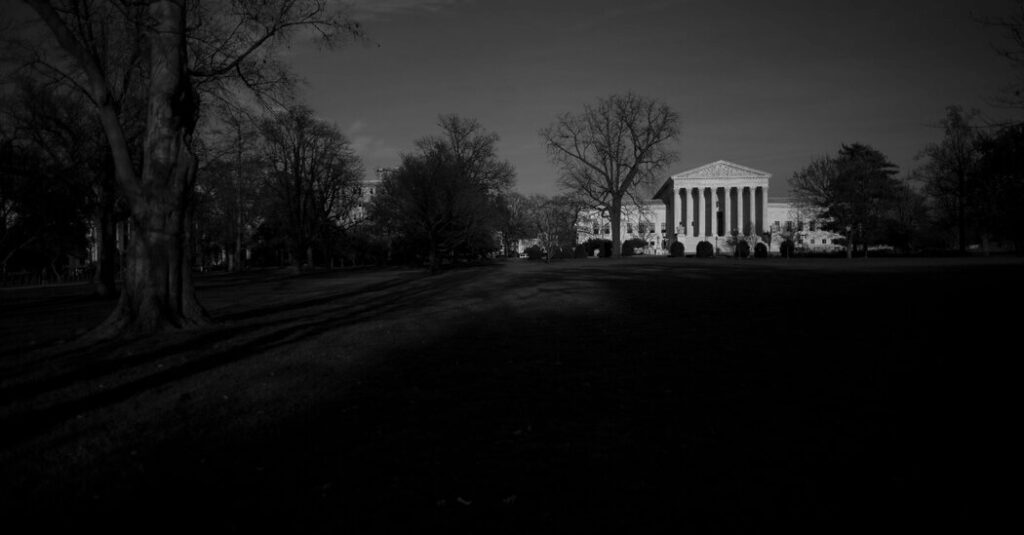
The Supreme Court’s increasing reliance on the shadow docket reflects more than procedural change; it marks a quiet shift in judicial power.
Traditionally, the court’s authority rested on deliberation — full briefing, lower court review and reasoned opinions. That process ensured transparency and accountability. By contrast, emergency orders issued without explanation compress deliberation and obscure the court’s reasoning, making its role less visible and less accountable to democratic scrutiny.
By intervening before lower courts have ruled, the court is also short-circuiting the judicial process and concentrating authority in itself. This risks diminishing the role of appellate courts and weakening the development of law through layered review.
None of this is inevitable, and none of it is without consequence. A judiciary that acts quickly but opaquely risks eroding the very legitimacy that gives its decisions force.
Just as concerning, this shift creates a feedback loop with political dysfunction. As Congress stalls and executive actions expand, litigants increasingly seek immediate relief from the Supreme Court, which has signaled its willingness to act quickly. The court thus becomes a first and only arbiter of major disputes.
The issue is not any single ruling, but a structural transformation that deserves public attention.
Nageswara Madamanchi Ann Arbor, Mich.
To the Editor:
As a former Environmental Protection Agency regional official based in Georgia, I read your analysis of the Supreme Court’s shadow docket with concern.
The issue is not simply procedural efficiency, but substantive imbalance. Decisions with major implications for public health and climate are made with limited transparency and explanation, while economic costs to industry appear to receive greater weight than risks to communities and a warming planet. Most striking, people themselves seem largely absent from the court’s consideration.
In states like Georgia, where energy policy directly affects affordability, air quality and resilience, these trade-offs have real consequences.
A legal system grounded in the common good requires transparency, reasoned judgment and accountability. It must serve the American people, not the other way around.
Jay Bassett Atlanta
To the Editor:
Chief Justice Roberts famously compared the role of judges in applying the law to the work of an umpire in calling balls and strikes. But The Times’s reporting on the origins of the Supreme Court’s shadow docket shows a Justice Roberts who tosses out the rulebook.
Presented with an application to stay a federal regulation, the chief justice mustered a Supreme Court majority for granting the stay without hearing argument on the merits. He presumed to predict the ultimate outcome of the case even at that early stage of the litigation, thinking the regulation was “highly unlikely to survive.”
The umpire made the call while the pitcher was still in his windup.
Bernard Joshua Kabak New York The writer is a lawyer.
Earth to Lee Zeldin
To the Editor:
Re “When Climate Denial Comes to Washington” (Climate Forward, Inside The Times, April 16):
Reading this report from the International Conference on Climate Change in Washington, organized by the Heartland Institute and attended by Lee Zeldin, the administrator of the Environmental Protection Agency, I felt profound anger and sadness. Heartland and the other groups that organized the conference reject the overwhelming scientific consensus on climate change.
The free swag at the conference, the reporter wrote, included blue and green stress balls that resembled Earth, with the message “Don’t stress. There is no climate crisis.”
I prefer a stress ball that echoes the words spoken by the Artemis II astronaut Christina Koch at the NASA news conference after their recent mission: “Planet Earth,” she said, “you are a crew.”
On the mission, Ms. Koch said, she saw Earth as a “lifeboat” hanging in the universe. She said she learned on the mission what it means to be a crew, working together with the same goals and purpose. The four astronauts became emotional.
We Earthlings can strive to be a lifesaving crew on this precious planet. It is the only lifeboat we have.
Lorraine Obuchowski Hartmann Seattle
To the Editor:
Re “In Upending E.P.A., Zeldin Reinvented Its Vocabulary” (news article, April 16):
Lee Zeldin didn’t just “shift” the message of the Environmental Protection Agency. He destroyed it.
It’s hard to fathom a cabinet secretary who has done more damage. And that’s saying a lot.
Barry Auskern Greenfield, Mass.
Talking to Iran
To the Editor:
Negotiations take time, mutual respect between parties, ability to compromise and communication. If negotiations are to take place, there must be designated people and official channels for setting them up; both sides must agree.
Instead, we have President Trump posting on Truth Social, often late at night, with false claims about what Iran has agreed to and with lies and threats if it doesn’t do what he demands. Government cannot be conducted on social media!
Mr. Trump seems to believe that if he declares that the war is over or that Iran has agreed to discontinue its nuclear program or whatever the lie of the day is, then saying it on social media will make it so.
In the midst of what feels like acceptance and complacency, we can only hope that there will be a breaking point and that our country will return to the care and governance of sane, professional people dedicated to seeking the restoration of our democracy and working toward peace.
Melinda Hansen San Diego
The post Judging the Supreme Court’s Shadow Docket appeared first on New York Times.