Manufactured homes became known as mobile homes because there was a time when they were truly mobile, with owners moving them around the country in search of work or better places to live.
To ensure their mobility, Congress passed legislation in 1974 requiring every manufactured home to be built on a permanent chassis — a heavy-duty metal frame that could be attached to wheels.
There is now a measure to eliminate the steel chassis requirement for manufactured homes, part of a sweeping federal housing bill moving through Congress aimed at increasing homeownership and easing the shortage of low-income housing nationwide.
Housing experts say doing away with the chassis requirement is long overdue because mobile homes are rarely moved once they are set into a foundation in a trailer park or other residential neighborhood.
The chassis requirement, they say, has also created an unnecessary burden for manufacturers because it doesn’t allow the frames to be removed and reused after a home is delivered — a cost of several thousand dollars that is passed onto consumers.
More significantly, industry executives and housing advocates say, the chassis requirement prevents manufacturers from designing homes that can be adapted for smaller lots in urban areas, where there is often a great need for affordable housing.
“The law was written for the industry that existed at that time, but the industry has evolved a lot,” said David Dworkin, president of the National Housing Conference, a coalition of affordable housing providers. “You can build a lot of mobile homes if you don’t have a chassis.”
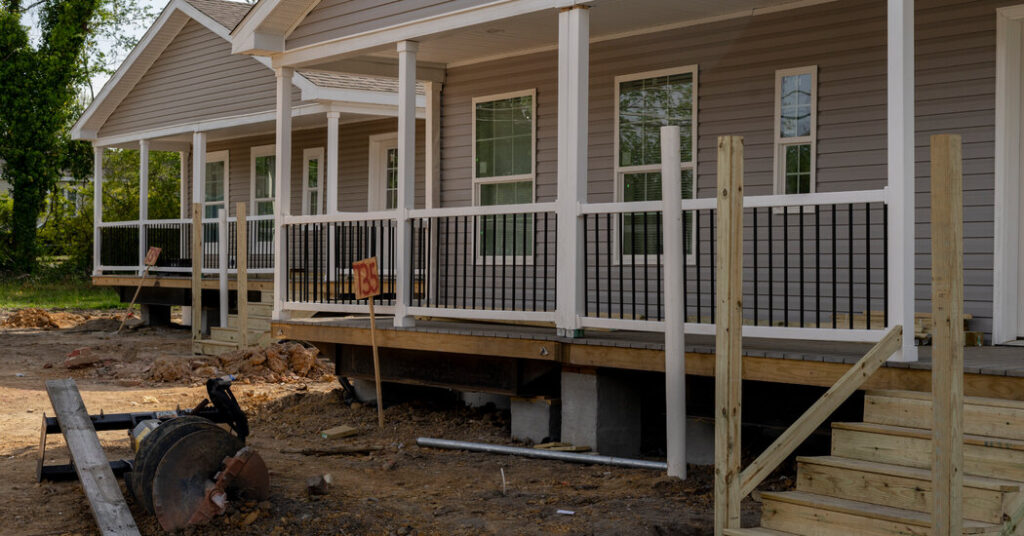
A stereotype of a mobile home is that of an aging, narrow trailer with small windows and a tiny stove and refrigerator. But today’s manufactured homes can look a lot like any other modest single-family home. Some upscale manufactured homes include front porches, large front windows and modern kitchens.
Technology also exists to combine two manufactured homes, which come largely preassembled, to create a large ranch-style home. Factory-built mobile homes also can be stacked to create a two-story duplex. These modifications can be difficult if each mobile home must be attached to a steel chassis. .
The mobile home industry historically has had a reputation for selling or renting out subpar housing units to low-income people. And trailer park communities where many mobile homes tend to be located are often not well maintained. Critics question whether eliminating the chassis requirement will ultimately lead to savings for mobile homeowners and better quality dwellings, or whether the move will simply pad the profits of the manufactured home companies.
But a new breed of housing developers are trying to change the industry’s image. The hope is that by removing the chassis requirement it will become easier to get local officials behind efforts to locate manufactured homes in more urban settings.
Thomas Heinemann, a developer with MH Advisors, said removing the chassis opens up a lot of opportunities for locating factory-built homes in urban communities and not just in traditional trailer parks.
“All of sudden you have a lot more flexibility. It makes a two-story home a lot easier to build,” Mr. Heinemann said.
He said the ability to make two-story residences was ideal for an urban setting with narrow property lots.
Right now, Mr. Heinmann’s company is locating factory-built homes on 50 scattered lots in Petersburg, Va., a working-class city of 33,000 about a half-hour drive from Richmond. To date, the company has completed the installation of 10 manufactured homes in the city and is developing another eight lots.
All of the homes are being placed on permanent foundations and targeted to families with modest incomes.
Since the requirement is written into federal law and federal housing codes, a manufacturer cannot unilaterally decide to remove the chassis after delivering a structure.
Arica Young, director for housing access and affordability with the nonpartisan Lincoln Institute of Land Policy, said some of the stigma attached to mobile homes might dissipate if Congress removed the permanent-chassis requirement. She said it would make manufactured homes seem more like any other single-family home.
Ms. Young said removing the requirement might also reduce the cost of financing a manufactured home. Historically, she said, owners of mobile homes could not get a traditional mortgage. Manufactured homes were considered personal property, as they were not seen as being permanently fixed to the land, even if they were placed on a foundation.
So mobile home buyers often had to had to resort to so-called chattel loans, which typically carry higher interest rates than a traditional mortgage and have fewer legal protections. She said the removal of the chassis requirement might make it easier for some borrowers to get a traditional mortgage.
Lesli Gooch, chief executive of the Manufactured Housing Institute, said her industry group had for years lobbied Congress to remove the chassis requirement.
Previous legislative attempts, in the 1990s and most recently in 2023, fizzled.
Efforts to remove the chassis requirement have sparked something of a turf battle between makers of manufactured homes and modular homes.
Modular homes, which rely on factory-built components, are assembled on-site like a traditional single-family home, and tend to cost significantly more than manufactured homes. Modular homes also are not bound by the permanent chassis requirement and come in a wide array of modern designs.
The Modular Home Builders Association has argued that its product is better built and has stricter local regulatory oversight than manufactured homes. And removing the chassis requirement, the trade group argues, would blur the lines between the two types of housing and create consumer confusion about the quality of the homes.
“That may not be a big deal until when they try to sell it,” said Tom Hardiman, executive director of the Modular Home Builders Association.
The Senate and House each approved their own versions of a housing bill that include the provision to remove the chassis requirement. But each version contains other differing provisions that need to be reconciled before the legislation can come to a final vote and go to President Trump to sign into law.
But Mr. Dworkin said he was reasonably confident Congress would act this time around to remove the chassis requirement given the bipartisan push to spur the creation of more affordable housing options.
Matthew Goldstein is a Times reporter who covers Wall Street and white-collar crime and housing issues.
The post Congress May Finally Recognize That Mobile Homes Aren’t Really That Mobile appeared first on New York Times.