A few days ago came the astonishing news that the world record in the half-marathon was obliterated by a 5-foot-5 humanoid robot named Lightning in Beijing.
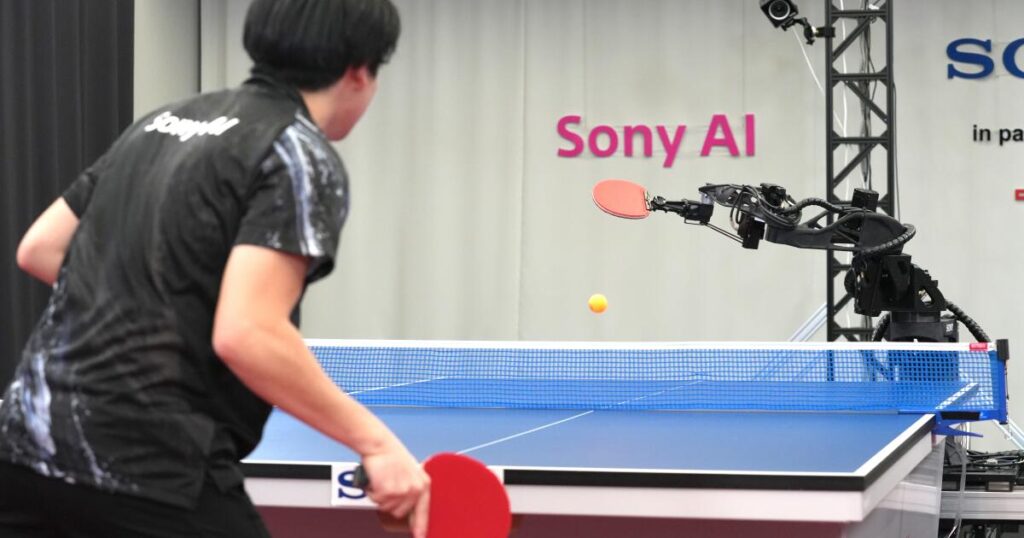
Now a robot named Ace has achieved another milestone for AI and robotics by defeating expert-level humans at table tennis in Tokyo, according to a study published Wednesday in the scientific journal Nature.
What’s next, a robotic baseball player named Babe that swats 500-foot home runs and throws 120 mph pitches, eclipsing Shohei Ohtani’s real-life achievements and commanding a billion dollar contract?
It’s all fun and games until it isn’t.
Extraordinary athletic achievements by AI robots might seem innocuous, especially compared to far more grave threats described by various experts, including the landmark publication “An Overview of Catastrophic AI Risks” by the Center for AI Safety in 2023.
To name a few: Misinformation and social media manipulation; job displacement and economic inequality; cybersecurity threats; lethal autonomous weapons; environmental impact; psychological dependence; and ultimately, the existential risk to humanity of losing control of rogue AI systems.
For now, let’s get back to ping-pong.
Ace was developed by good, old Sony, the 80-year-old makers of gaming consoles, televisions, smartphones, cameras and audio equipment that we enjoy every day.
Of course Sony has an AI research division, and while most consumers were still going ga-ga over PlayStation 5 Pro 2TB, it developed the first robot to attain expert-level performance in a competitive physical sport that requires rapid decisions and precision execution.
Ace integrates nine synchronized cameras and three vision systems to track the spinning plastic ping-pong ball. Its lightning-fast processing time would be the envy of even Lightning, the humanoid robot that broke the world record in the half-marathon by nearly seven minutes.
“Here we present Ace, to our knowledge the first real-world autonomous system competitive with elite human table tennis players,” the study said. “Ace addresses the challenges of physical real-time interaction through a new, high-speed perception system using event-based vision sensors and a new control system based on model-free reinforcement learning, as well as state-of-the-art high-speed robot hardware.”
Ace showed out in matches that followed International Table Tennis Federation rules and were officiated by licensed umpires. Most of the matches took place in 2025 — before table tennis tale “Marty Supreme” even hit theaters — although Ace defeated professional players as recently as March.
One such human is Mayuka Taira, who said in comments provided by Sony AI to Reuters that the robot’s strengths are what one might expect: unpredictability and an absence of emotion.
“Because you can’t read its reactions, it’s impossible to sense what kind of shots it dislikes or struggles with, and that makes it even more difficult to play against,” Taira said.
Initial real-world applications of Ace-like robots likely would be in manufacturing and service industries, although untapped potential lies across sports, entertainment and safety-critical environments, according to the study.
“These results highlight the potential of physical AI agents to perform complex, real-time interactive tasks, suggesting broader applications in domains requiring fast, precise human–robot interaction,” the study said.
Those domains certainly could include baseball diamonds, basketball courts and gridirons. Hockey rinks could be lumped in provided robots can skate.
AI already is used in MLB. The vaunted Automated Ball-Strike system (ABS) uses AI-powered Hawk-Eye camera technology and computer vision to determine if pitches are strikes or balls. Twelve high-speed cameras track ball flight and AI delivers the definitive call to the scoreboard within seconds of a challenge.
A robotic batter facing a robotic pitcher with calls made by ABS might eliminate any disagreements over balls and strikes.
Terrifying.
Reuters contributed to this story.
The post Robot Supreme? Table tennis clanker Ace beats elite human players in AI milestone appeared first on Los Angeles Times.