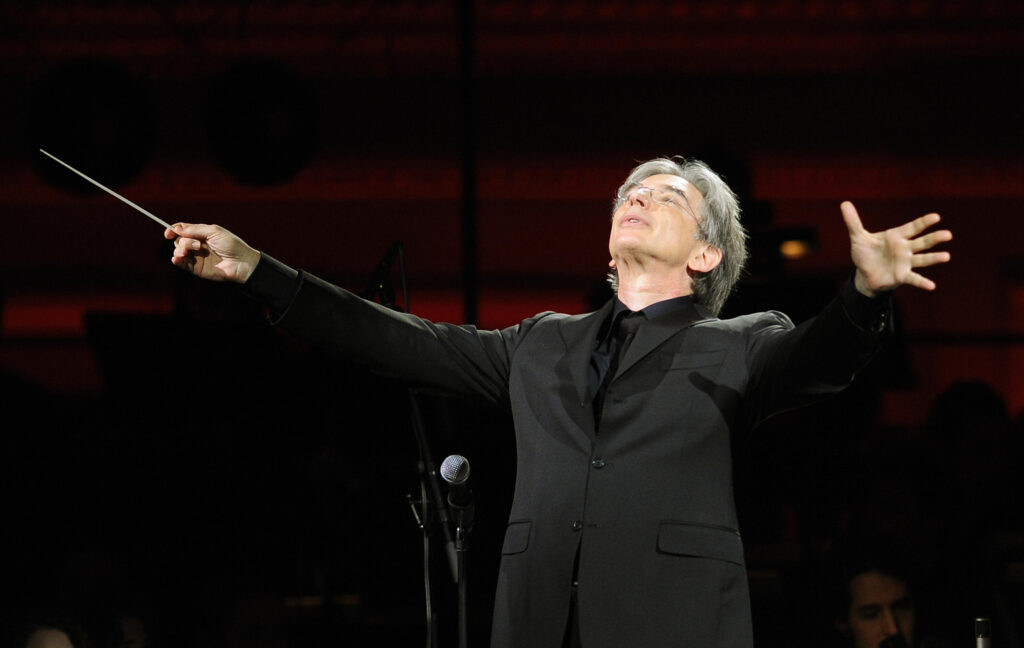
Michael Tilson Thomas, an American conductor who grew up in public from an imperious wunderkind into one of the grand old men of classical music, died April 22 at his home in San Francisco. He was 81.
The cause was glioblastoma, an aggressive form of brain cancer, said his publicist Constance Shuman. In February 2025, Mr. Tilson Thomas announced that he was scaling back engagements because of a recurrence of the disease, which he had been battling for four years.
Mr. Tilson Thomas was best known for his long tenure as the music director of the San Francisco Symphony, where he served from 1995 to 2020. He was also the founder and music director of the New World Symphony, a youth orchestra in Miami Beach created in 1987, whose best performances were on a level with the finest professional ensembles.
He was widely considered one of the most distinguished American conductors of his generation. In addition to making more than 100 recordings of both rare and familiar classical repertory, he created valuable instructional seriesfor televisionand radio.
“It’s very clear to me that I am not giving the performance,” he told the New York Times in 2002. “I am like a director who has the luxury of being able to see the big scene and be very helpful at focusing the ensemble and encouraging a section or an individual soloist to deliver a line expressively. The vision for the future of orchestral-music playing is that it can become much more soloistic and much more personal than was heretofore imagined.”
Mr. Tilson Thomas had been known and admired in musical circles since his late teens, when he served as a piano accompanist for violinist Jascha Heifetzand played in concert performances under composer Igor Stravinsky, among other early appearances.
Appointed an assistant conductor for the Boston Symphony Orchestra at 24, he took over in mid-concert for the ensemble’s music director William Steinberg in October 1969 after Steinberg took ill. After that, Mr. Tilson Thomas led the Bostonians in a majority of their concerts through 1970 and made his first recordings with the orchestra.
Fascinated by musical minimalism early on, in 1971 in Boston he programmed Steve Reich’s “Four Organs” — one dense magnificent chord drawn out again and again for about 25 minutes — when it must have seemed like music from space.
“I would say that well over three-quarters of the people were not just booing but really enraged — shaking umbrellas, you know, so loudly during the piece that onstage, we began to lose count,” Reich said in 1978. “When the piece was over, a small crowd was bravoing and a much larger crowd booing just as strongly as possible.”
Mr. Tilson Thomas knew what he was doing, though. “We came offstage and Steve was ashen-faced,” he told the Guardian in 2012. “I said: ‘By tomorrow morning everyone will have heard of you.’ And that is precisely what happened.”
Suddenly famous, Mr. Tilson Thomas became the music director of the Buffalo Philharmonic, a venturesome part-time orchestra, while taking over the telecast New York Philharmonic’s Young People’s Concerts from Leonard Bernstein.
As so often throughout his career, Mr. Tilson Thomas was ahead of the pack. He presented the terse, flinty masterpieces of Carl Ruggleswhen the American composer was all but unheard of, and made pathbreaking, idiomatic recordings of Charles Ives, Aaron Copland and the symphonic music of George Gershwin. As a pianist, he accompanied Sarah Vaughanon a jazz recording that won a Grammy Award in 1982. (He would win 11 more.)
But the young Mr. Tilson Thomas was also huffy, condescending and all but impossible to work with, as he admitted in later life. It was partly the animosity of the musicians that kept him from becoming director in Boston, and after his tenure expired, he was not invited back for many years. He acknowledged a youthful arrogance: “Back then, I thought the way to improve an orchestra was to fire a lot of the older players,” he told the New York Times in 1995.
In 1978, Mr. Tilson Thomas was arrestedfor cocaine, marijuana and amphetamine possession while going through customs at John F. Kennedy International Airport in New York. And, in 1985, before an audience of 9,000, he stormed off the podium in the middle of a Mahler symphony at the Hollywood Bowl after a police helicopter flew over the outdoor concert.
His career in America flailing, Mr. Tilson Thomas decamped to England, where his work as principal conductor of the London Symphony Orchestra was much admired.
Andrew Porter, the longtime music critic for the New Yorker, reviewed a 1993 series of the complete symphonies of Gustav Mahlerin London for the Observer: “Thomas has lived long with these scores; has lost none of a youthful, fresh response to their sheer picturesqueness; knows (and enjoys) their dangers as well as their delights; plumbs the depths and the darkness; exults on the peaks. Emotion and structure were in balance.”
There were many reasons Mr. Tilson Thomas agreed to take over the leadership of the San Francisco Symphony, his first full-time orchestral appointment after 25 years in music. The city itself was physically beautiful, politically progressive and long a center for creative innovation.
From the 1970s on, San Francisco was also considered the gay capital of the United States; there, Mr. Tilson Thomas lived openly with his partner and manager, Joshua Robison, in a mansion in the city’s Pacific Heights neighborhood. The two married in 2014.
Robison had been recovering from a fall when he died in February at 79. Mr. Tilson Thomas leaves no immediate survivors.
The San Francisco Symphony paid Mr. Tilson Thomas very well (he started at more than $1 million and his salary would go up to $2.6 million by the time he stepped down) and, as New York Times classical music critic Anthony Tommasini observed, he “clearly realized that by settling in and focusing on a single ensemble poised for adventure, he could foster curiosity among both players and audiences.”
It was also a triumphant return to his native California, where both of the major orchestras grew ever more enterprising. “In both San Francisco and Los Angeles, there’s the opportunity to do something extraordinary,” Mr. Tilson Thomas said to the Los Angeles Times in 2000, “something more adventurous, more engaging than what seems to be existing in many places on the East Coast.”
As part of his first major festival with the orchestra, he invited former members of the Grateful Dead to participate in an examination of “American Mavericks” and filled Davies Symphony Hall with eager “Deadheads.”
The symphony launched its own recording label, SFS Media, in 2001, to release all nine of Mahler’s symphonies, as well as the opening movement from his unfinished tenth. The first album, Mahler’s Symphony No. 6, won the Grammy for best orchestral performance in 2003. Over the years, music by Berlioz, Bernstein and several American composers was also recorded.
In honor of Mr. Tilson Thomas’s 80th birthday, Sony Classical released an 80-CD set of all the recordings he had made for Columbia, RCA and Sony between 1970 and 2005. Meanwhile, the Australian reissue label Eloquence released a smaller (14-disc) boxed set of his complete early recordings for Deutsche Grammophon and Argo.
An artistic family
Michael Tilson Thomas was born on Dec. 21, 1944, in Hollywood. His father, Ted Thomas, worked in theater, television and film, and his mother, Roberta Thomas, was head of research at Columbia Pictures. His grandparents, Boris and Bessie Thomashefsky, had been renowned figures in the Yiddish theater in New York during the early part of the 20th century.
“He was raised on tales of old Russia,” the British critic Edward Seckerson recounted in “Viva Voce,” a 1995 book of conversations with Mr. Tilson Thomas that remains the closest thing to a biography yet published. “His grandmother would tell of market day in Kiev when it was impossible to talk for the sound of church bells. And she would sing to him — lively, catchy tunes he later recognized as the folk tunes of Stravinsky’s ‘Petrouchka’ and ‘The Firebird’ ballets.
“This was a household where people readily sang: Broadway songs, Yiddish theater songs, Italian opera from the family gramophone,” Seckerson wrote. “His father wrote and sang songs: Gershwin had taught him the piano. It was an intoxicating environment in which to grow.”
Mr. Tilson Thomas studied composition with Ingolf Dahl at the University of Southern California, from which he graduated in 1967. The following year, he was accepted as a fellowship student at the Tanglewood Music Center in Massachusetts by Bernstein, who would become his principal mentor.
“It was important to have an older colleague who I could trust,” Mr. Tilson Thomas later told the Guardian. “He was generous with his time and I could call him and ask him things.”
Mr. Tilson Thomas was an occasional composer, whose best-known work was likely “From the Diary of Anne Frank,” commissioned by UNICEF for orchestra and narration. It was first performed by the New World Symphony in 1990 with Audrey Hepburn, who had given him the idea for the piece, as the narrator.
Although he sometimes conducted opera — notably the American premiere of Alban Berg’s completed “Lulu” in Santa Fe, New Mexico, in the summer of 1979 — Mr. Tilson Thomas was mostly indifferent to the genre. “I took to the music of opera,” he told Gramophone Magazine in 1988, “but the experience of seeing an opera is most of the time one that I find unsympathetic.”
Mr. Tilson Thomas seemed preternaturally youthful and energetic through most of his career, and those who came to know him in later life spoke of him as generous and charming. In 2019, he was a recipient of the Kennedy Center Honorsin Washington.
Early that year, he had heart surgery but returned for what had already been planned as a grand final season with the San Francisco Symphony in 2019-2020. Because of the pandemic, it was curtailed in March 2020. Davies Symphony Hall was closed for 14 months, reopening cautiously in 2021 under new director Esa-Pekka Salonen.
After a successful brain surgery operation in 2021 for his cancer, Mr. Tilson Thomas returned to the podium in November leading his first performance in 10 years with the New York Philharmonic. He managed to conduct more than 25 concerts in the next two years. One of his last appearances with the San Francisco Symphony was devoted entirely to Beethoven’s Symphony No. 9.
Writing for the San Francisco Chronicle, music critic Joshua Kosman acknowledged Mr. Tilson Thomas’s weakened state. “But as soon as the playing began, the old mastery reasserted itself,” Kosman observed. “Making music is like breathing for [him]; with the baton in his hand, he seemed to expand, both visibly and audibly, into his fullest and most fluent self.”
As Mr. Tilson Thomas had grown older, his approach had grown steadily more mystical.
“I’m happiest when I feel the music gets to a place where no one is really quite sure who is making the music,” he said to the Chronicle in 2020. “It just seems to be happening wonderfully, miraculously, rather than as a result of someone who’s saying, ‘Follow me.’”
The post Michael Tilson Thomas, eminent orchestra leader, dies at 81 appeared first on Washington Post.