Modern German politicians have long prided themselves on being among Israel’s fiercest supporters.
But over the past several weeks, some politicians’ frustration with Berlin’s longtime ally has become palpable — a sign that support from Germany may be beginning to soften.
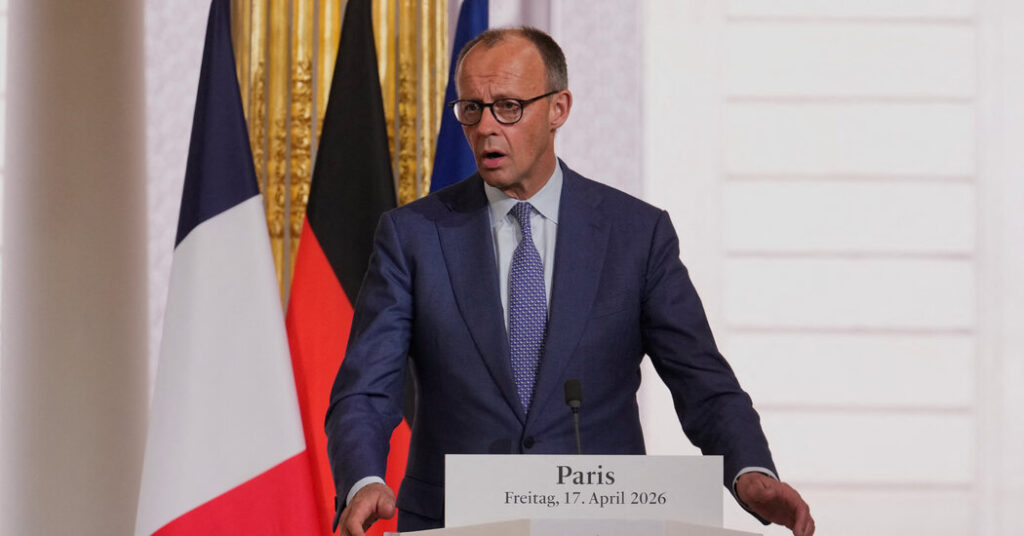
Chancellor Friedrich Merz of Germany, cabinet ministers and government press officials have used unusually pointed language in criticizing the Israeli government for its bombing of Lebanon, its new legislation on capital punishment aimed at Palestinians, its conduct in Gaza and its expansion of settlements in the West Bank.
Support for Israel — underpinned by the painful history of the Nazis’ massacre of more than six million Jews — has traditionally, in the postwar era, extended across mainstream political parties, especially among conservatives, no matter how isolating that position has been among other Europeans.
“Israel is a constant foreign policy pillar for postwar Germany,” said Sudha David Wilp, the vice president and a senior fellow at the German Marshall Fund in Berlin. Now, she added, referring to Prime Minister Benjamin Netanyahu of Israel, “Germans are not comfortable with Netanyahu’s government’s sort of no-holds-barred approach when it comes to securing Israel.”
The shift in tone has come as other once-friendly European allies have turned away from Israel over attacks in Lebanon. Last week, Prime Minister Giorgia Meloni of Italy announced that she would not renew a longstanding defense agreement with Israel.
Germany has not gone that far and there are no indications that its extensive bilateral defense agreements with Israel are at risk. Germany did not join Britain, France and Canada last year in recognizing the state of Palestine, despite public opinion polls that suggested many voters in Germany were critical of Israel’s war in Gaza.
The German government is also not pulling back on its official support for Israel. On Tuesday, Johann Wadephul, the country’s foreign minister, announced that he would oppose proposed E.U. sanctions against Israel and the suspension of the bloc’s association agreement with the Israeli state, an agreement that deepens trade relationships, diplomacy and research ties.
But rhetorically, times have changed in Germany. Mr. Merz made headlines last year when he publicly questioned the Israeli Army’s objective in Gaza. His decision to temporarily suspend deliveries of offensive weapons to Israel for use in Gaza was widely criticized within his own party.
Here are some recent examples of issues that have spurred German criticism of Israel:
1. Israel’s Capital Punishment Law
Late last month, lawmakers in Israel’s Parliament, the Knesset, passed a measure that calls for the hanging of Palestinians convicted of a deadly militant attack; the law would not apply to Jewish Israelis, experts say. The next day, Stefan Kornelius, Mr. Merz’s spokesman, said in a statement that the German government “regrets the Knesset’s decision and cannot endorse it.” Lars Castellucci, a lawmaker from Mr. Merz’s Social Democratic Party, who is the country’s Commissioner for Human Rights Policy, called the law’s passage a “sad day.”
2. Israel’s Campaign in Lebanon
After President Trump announced a cease-fire with Iran over social media last week, Mr. Merz warned that it was not certain that the truce would evolve into a lasting peace deal. He criticized Israel for its continuing attacks in Lebanon, one of the sticking points in achieving a peace deal. Mr. Merz pointed out that he and his European partners had asked the Israeli government to end the attacks. “The ferocity with which Israel is waging war there could derail the peace process as a whole,” Mr. Merz said.
3. West Bank Expansion
Mr. Merz said in a post on X last week that he had expressed “concern” to Mr. Netanyahu about developments in the Israeli-occupied West Bank, amid accelerating Israeli efforts to exert permanent control over the territory. “There must be no de facto annexation of the West Bank,” Mr. Merz said he told Mr. Netanyahu. German reservations over Israeli policy in the West Bank aren’t new, but it was unusual for Mr. Merz to be so public about those disagreements.
The far-right Israeli finance minister, Bezalel Smotrich, who has argued for just such an annexation, responded in an X post as well. He accused the German leader of moral failing for preaching “morality to us on how to conduct ourselves against the Nazis of our generation.”
The message prompted the Israeli ambassador to Germany, Ron Prosor, whose role usually is to criticize German officials, to come to Mr. Merz’s defense. He called Mr. Merz “a great friend of Israel” and condemned Mr. Smotrich’s comments. “Germany has proven, especially with all the criticism against Israel in Europe, that it is our number one friend,” Mr. Prosor said.
Christopher F. Schuetze is a reporter for The Times based in Berlin, covering politics, society and culture in Germany, Austria and Switzerland.
The post Germany, a Steadfast Ally of Israel, Now Voices Some Frustration appeared first on New York Times.