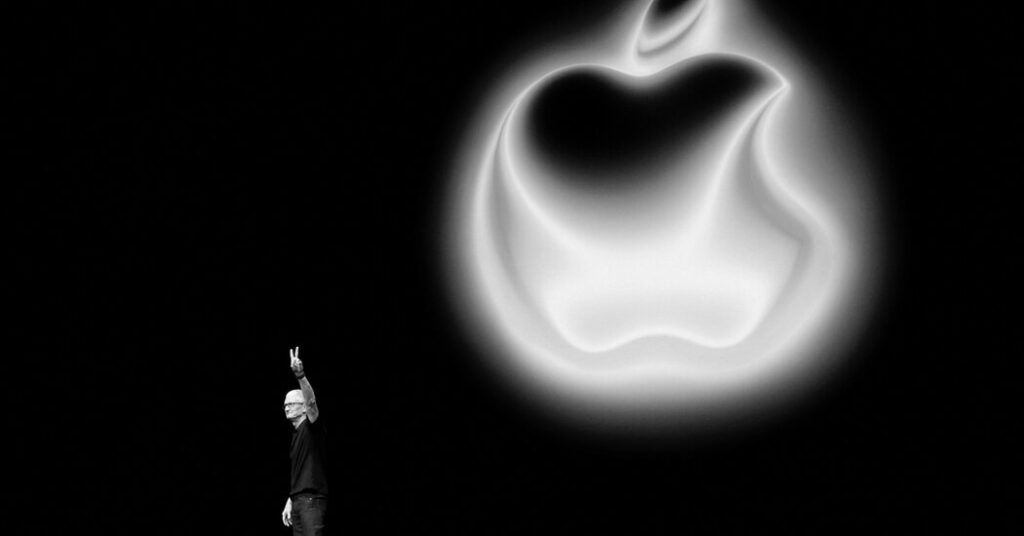
Tim Cook is ending his illustrious stint as chief executive of Apple. The soft-spoken operator accomplished the near impossible, filling the shoes of the visionary co-founder Steve Jobs, turning the iPhone from a cultural phenomenon into a financial juggernaut and transforming his company into a $4 trillion goliath — growing its market value by $682 million per day, on average, for 15 years. By the metrics investors care about, Mr. Cook is nothing short of a rock star.
But when one considers his role in the sweep of American history, his legacy grows more complicated, for much of Apple’s success is due to his move to consolidate virtually all of his company’s manufacturing in China.
The results have been profound. Apple under Mr. Cook played a significant role in the rise of China’s middle class, and produced the iPhone in enormous quantities at a low enough cost that roughly half of all Americans own one. His choices also dramatically escalated China’s economic standing and technological prowess to the point that its increasingly authoritarian leaders now see themselves as powerful rivals to the U.S.
If President Xi Jinping’s imperialist instincts fade, Mr. Cook will be remembered for helping bring capitalism and liberalism to one of the most populous countries in the world. If the tensions between China and the United States continue to escalate, especially if Beijing makes good on its threats to attack the island of Taiwan — a democracy that happens to produce the vast majority of the world’s semiconductor chips — Mr. Cook will be remembered differently. He will be the man who not only squandered his company’s future (as it is still highly dependent on China), but also handed the West’s technological prowess to its biggest threat.
History can be a brutal editor. Consider Jack Welch, the long-lionized chief executive of General Electric. In his two-decade reign, which ended in 2001, Mr. Welch earned shareholders an astonishing 21 percent annual return — just a nudge less than Mr. Cook’s — and was anointed “manager of the century” by Fortune magazine. His moves into financial engineering were the stuff of Wall Street legend — until the financial crisis exposed the company as hollowed out and recklessly overleveraged. By 2009, G.E. was begging for government-backed infusions of cash; its stock price had plummeted 85 percent. In 2022, author David Gelles recast Mr. Welch as “the man who broke capitalism.”
Mr. Cook started at Apple as a senior vice president of operations in 1998 and quickly overhauled Apple’s manufacturing strategy to rely on inexpensive labor overseas. By owning the process rather than owning the factories, Apple could retain control over production while offloading the manufacturing risks to suppliers. Mr. Cook also wrested royalties from app makers and moved into media streaming and advertising, all part of a “services” push that was twice as profitable as the hardware Apple sold.
Year after year, Mr. Cook removed microrisks from Apple’s business and made its financials smoother and more predictable. But at the same time, he proved blind to a macrorisk, moving the vast bulk of Apple’s operations to China just as the authoritarian country was turning into America’s fiercest adversary.
Based on my research, I am convinced that no company has done more to enable President Xi. Since 2008, Apple has worked with suppliers to train 30 million workers, principally in China. It has invested hundreds of billions of dollars in the mainland and facilitated an epic transfer of practical knowledge in how to make things to hundreds of Chinese factories. I wrote in my book that at two points, Apple’s Cupertino, Calif., headquarters was sending so many engineers to orchestrate production that it convinced United Airlines to fly thrice weekly from San Francisco to Chengdu and Hangzhou, arguing it would buy so many first-class seats that the route would be profitable even if the rest of the plane were empty.
The price of doing business in China was turning a blind eye to its increasingly authoritarian impulses. Apple has removed tens of thousands of apps from its Chinese App Store at Beijing’s direction. It moved mainland Chinese users’ iCloud data to servers operated by a state-owned company, likely exposing their personal data to the government. (Apple says it’s adhering to China’s laws.)
Mr. Cook has spoken out in favor of voting rights, the environment, gun control and L.G.B.T.Q. protections, but he has been conspicuously silent on China’s subjugation of Hong Kong protesters, the persecution of Uyghurs in Xinjiang or the 20-year sentence of the pro-democracy media tycoon Jimmy Lai. Most revealing of all, since taking over as Apple’s C.E.O., he has not set foot in Taiwan — a thriving democracy, but a rogue province from Beijing’s perspective. That the chief of the world’s most iconic technology company won’t visit its most important chip suppliers is telling.
Apple is hardly alone in this. Many American companies, in their scramble for lower prices, have effectively given away swaths of their practical know-how, machinery, processes and talent to China. They gave President Xi the resources he needed to attain dominance in fields as disparate as rare-earth magnets, solar wafers, steel and pharmaceuticals. The billions China is pouring into building electric cars alone could leave Detroit in the dust.
China is building far more than the country needs or that importers want. When Western economists criticize the resulting oversupply as inefficient, they’re missing the point. China’s goal isn’t to provide a return to shareholders. It is to control the world by commanding its material production. As economist Noah Smith observed, “profit is not the goal of war.”
Despite the Biden and Trump administrations’ efforts to slow the country’s momentum, China’s share of global industrial production is expected to rise to 45 percent by 2030, up from about 30 percent in 2025. And Beijing just implemented new rules to punish foreign companies taking action to divest from China.
Apple, for its part, has made tentative moves to expand iPhone assembly to India, but the bulk of its supply chain is still deeply rooted in China.
John Ternus, Mr. Cook’s successor, is relatively young, capable and ambitious. There’s reason to hope he can rethink and unlearn some of Mr. Cook’s core assumptions. But Mr. Cook isn’t retiring; he’s stepping up to executive chairman. And Mr. Ternus may not be able to chart a new course if the architect of the current strategy sits above him.
Of course, no businessman can ever truly know the historical consequences of their actions. The Cambridge historian Christopher Clark argued that the catastrophe that was the First World War resulted from the aggregation of rational, defensible decisions made by statesmen in a complex world. Mr. Cook’s decision to consolidate Apple’s operations into China fits that mold: Every decision to deepen his footprint in the country made sense at the time.
Those decisions also made Apple and its investors enormous sums of money. But stock prices don’t reflect the costs to our economy and our own gutted industries.
Patrick McGee covered Apple for six years for the Financial Times and is the author of “Apple in China.” He is now a features writer for the Financial Times and a columnist for the Free Press.
The Times is committed to publishing a diversity of letters to the editor. We’d like to hear what you think about this or any of our articles. Here are some tips. And here’s our email: [email protected].
Follow the New York Times Opinion section on Facebook, Instagram, TikTok, Bluesky, WhatsApp and Threads.
The post Tim Cook: Great for Apple Investors. Not as Great for America. appeared first on New York Times.